01
$500M+
in funding secured for our clients
UX design for AI products means shaping the experience around probabilistic systems so people can trust and act on what the AI returns. At Lazarev.agency, we design human-centered AI products that handle real complexity without making users learn the model underneath. Our focus is the trust, control, and clarity that earn adoption.
AI is now a given. Startups everywhere have it in their offering. Value has moved from the model itself to the experience wrapped around it: how quickly someone reaches a useful result, how much they trust it, and whether they come back. Delivering such experience is the job of a UX design agency for AI products.
Lazarev.agency is more than about making profits for us and our clients. We're committed to saving lives in Ukraine, taking on pro bono projects, championing diversity, equity, and inclusion.
in funding secured for our clients
awards backing our excellence
founded, 10+ years of experience
AI product design agency
from user research to production-ready design systems
Among our clients:








We’re a UX/UI web design agency with 140+ awards that helps AI‑native and AI‑ambitious B2B teams translate complex products into clear, conversion‑ready websites.

Webby Awards x10

Red Dot Design Award x6

Awwwards x16

FWA x5
Our product design and UX teams work fluently with machine learning, data science, and natural language processing, so the experiences we build address real problems.
With AI, we’re moving to a design paradigm called intent-based outcome specification: designing around the intention behind a user’s action rather than the individual interface clicks. Designing for intent produces products that respond to what a person is trying to achieve and return tailored, useful outcomes.
AI and ML systems still read as black boxes to most users, because they work over large volumes of data and uncertainty. We counter that with explainability: plain-language explanations, confidence indicators, and visualizations to show how the AI arrived at a recommendation, so people can understand the output and decide whether to trust it.
Because AI and ML learn from behavior, we design the experience to adapt to each user: prioritizing the right features in the interface and tailoring recommendations, content, and settings to their preferences. Personalization makes an AI product feel designed for the person using it.
Adoption depends on the quality of the first session, so we design the learning phase to help people “figure it out” quickly. We use predictions, prompt suggestions, and autocomplete to guide input and help users express intent, and we pair prompt-based input with hybrid GUI/AI interfaces so graphical controls take over when a prompt alone falls short. This is also how we solve the blank-canvas, cold-start problem that stalls so many AI products.
We make data handling legible: what’s collected, how it’s used, and how it’s protected, communicated in plain language. Users keep control of their personal information, with clear options to manage their privacy preferences.
Designing a natural interaction between a person and an AI system is genuinely hard. It means building experiences that respond to human behavior while staying clear, functional, and pleasant to use. We get there through deep UX research, user testing, and repeated iteration, guided by one principle: understand not only what the user did, but why they did it.
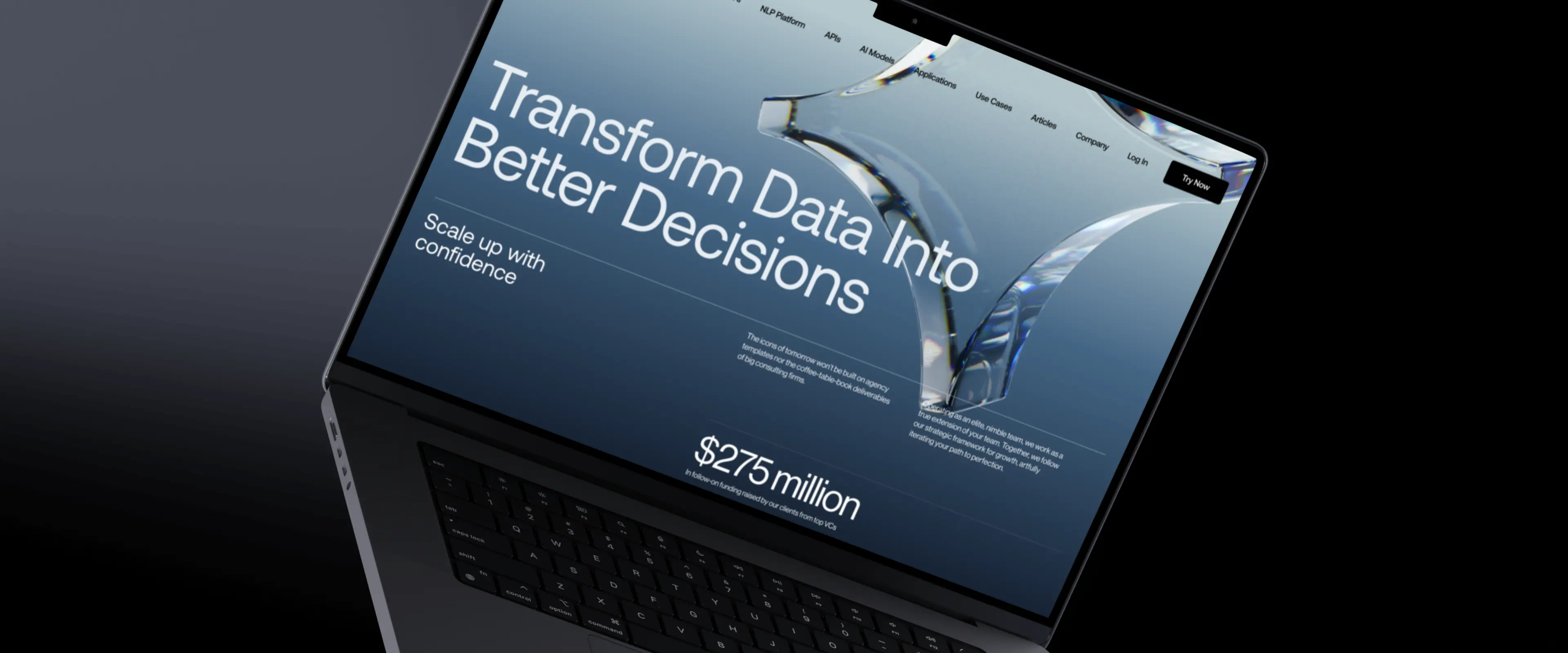
Companies putting AI into their products expect the interface to feel responsive and considered. Our visual designers craft UI that makes the most of the technology for the business and its customers, across generative and predictive AI surfaces, conversational UI, and agentic experiences.
Designing a natural interaction between a person and an AI system is genuinely hard. It means building experiences that respond to human behavior while staying clear, functional, and pleasant to use. We get there through deep UX research, user testing, and repeated iteration, guided by one principle: understand not only what the user did, but why they did it.
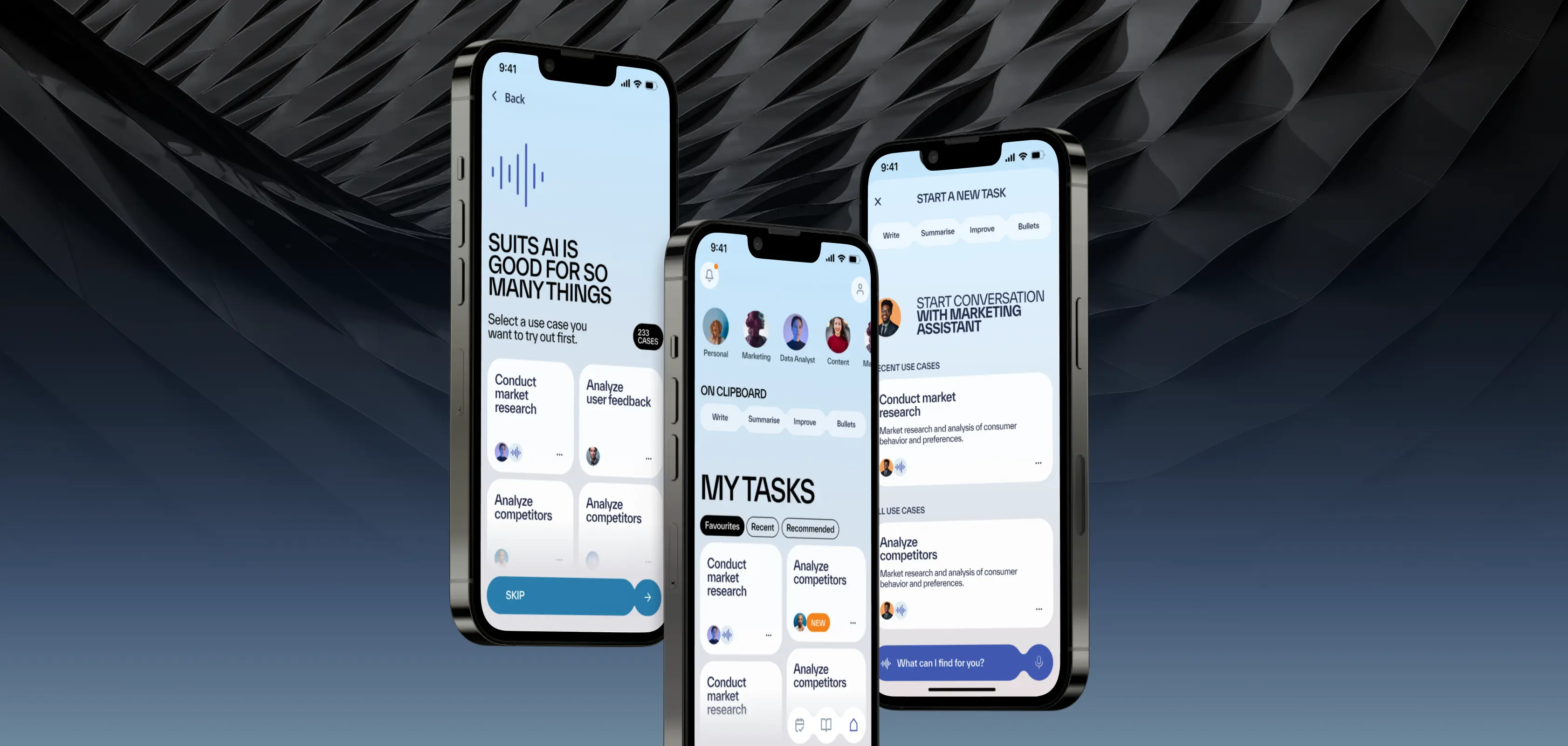
We’ve worked with a range of AI companies, so we let them describe the partnership. Hear directly from the founders about working with Lazarev.agency on AI and ML design.
Through a detailed understanding of the client’s platform, Lazarev. was able to create a clean and intuitive UI/UX design that ticked all the boxes. The team was receptive to all requirements and requests and adapted well to timeline changes. They produced accurate mockups at every iterative stage.

Founder of Teachchain
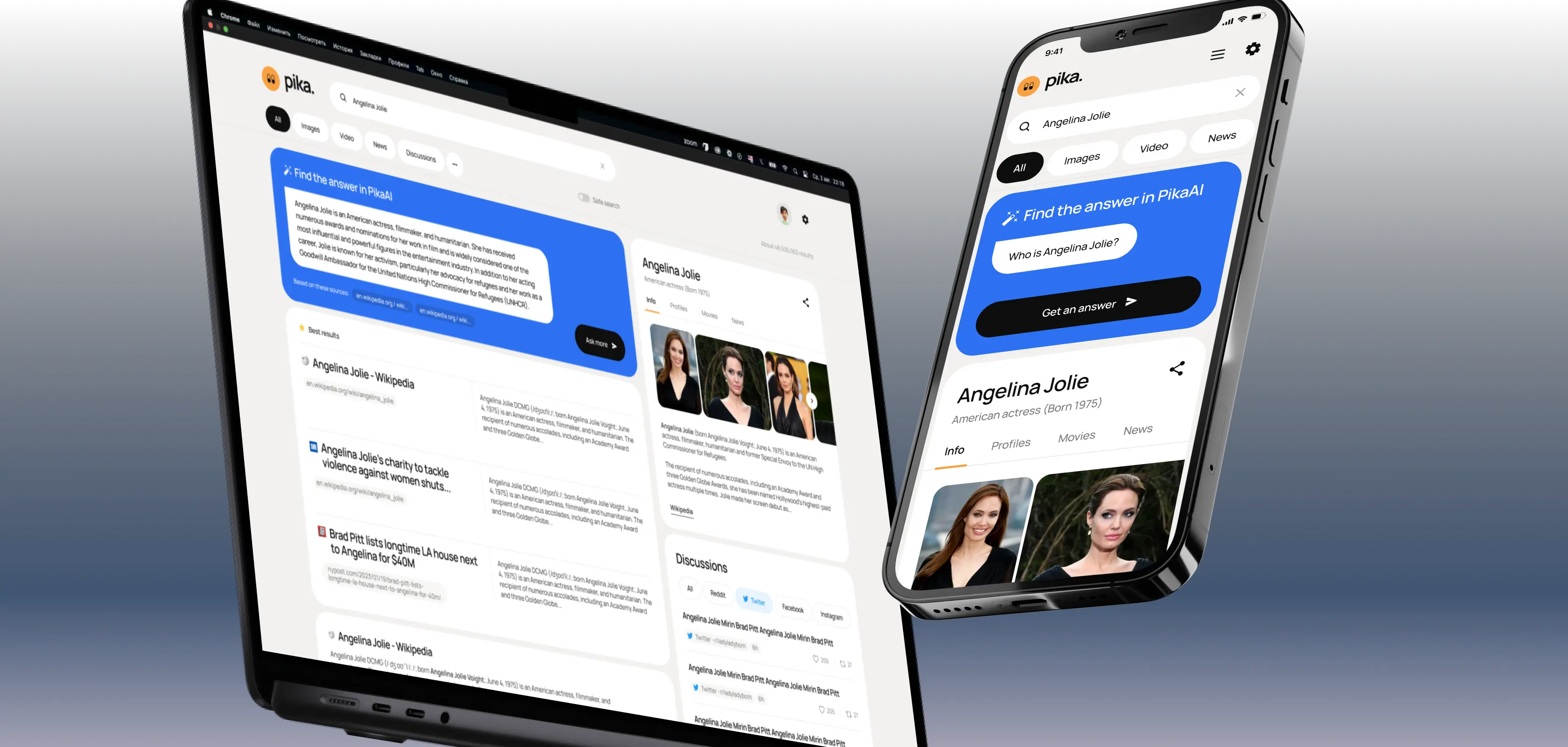
I had the pleasure of working with Maria and Lera backed by the amazing design team at Lazarev, and I cannot recommend them highly enough. From start to finish, they were excellent communicators and made the entire process incredibly smooth. Their attention to detail and commitment to delivering high-quality work on time was truly impressive. Moreover, their positive attitudes and enthusiasm made them a joy to work with. I would definitely look forward to working with them again!

Founder at Pika AI
We're big believers in AI user experience and where it's heading. For us, AI UX isn't only the intersection of AI and UX design. It's becoming a basic condition of how people will interact with products in the future. The questions below are the ones teams ask right before choosing a partner.
Cost depends on scope. The main drivers are how many surfaces and AI features the product has, how deeply you integrate AI and connect the underlying AI models, whether generative AI and content generation are involved, the size of the design pod, the timeline, and how the work ties into product strategy and ongoing support. A generative experience with agentic flows takes more than a single predictive dashboard. We scope against the outcome you're modeling toward and share a concrete estimate privately after an intake call.
Partner with a specialist agency when you need proven experience with AI-powered products quickly and can't wait to recruit it. An in-house hire fits steady, long-run iteration once product direction is set; building a full team of UX designers and product designers is slow and costly early on. A UX design agency for AI products brings people who already understand probabilistic outputs, user control, and onboarding for AI-driven user experiences, and who work alongside your existing team and design system.
Look for a portfolio of launched AI and ML products with stated outcomes. The best UX design agency for AI startup products will show hard results (funding raised, adoption, retention), fluency across generative, predictive, and agentic AI, and real user research behind its AI-powered design decisions. Ask how they turn AI features into real value for users, how they explain the way the AI works, how they've handled the cold-start problem, and how they measure user trust.
Delivering UI UX design for AI products means working with uncertainty. Build user trust, keep the system transparent about what the AI is doing, give people enough basic understanding of the AI technology to stay in control, make the input experience easy, and handle wrong answers gracefully. Whether the product is an AI assistant, an AI bot, or a set of intelligent assistants inside a workflow, the same key concepts apply: prompt scaffolding, confidence indicators, transparent system states, graceful fallbacks, and override controls that preserve user control. Those are the mechanics behind AI-driven user experiences people rely on, layered on standard user research and user flows.
Most engagements run in phases rather than to a single date. User research and flows come first, then interface design, usability testing, and quick iteration as real user feedback comes in. The timeline scales with product complexity, the number of surfaces and AI features, and how deeply AI integrates with your systems. We build feedback loops into our design workflows so you can provide feedback early and often, and we map a realistic schedule during scoping so you can plan launch and fundraising around it.
Stronger adoption, faster activation, and more trust in the AI's output. Our clients have reported outcomes like a 30% average increase in marketing ROI, 85k new users in a month, and funding milestones tied to a launch-ready product. Good AI UX also helps mitigate risks: clear ethical considerations, transparent data handling, and honest confidence signals reduce misuse and build durable trust. Results depend on your market and starting point, but the mechanism is consistent: when people understand and trust AI-powered features and see real value, they use them more and stay longer.
Yes. We design to fit the system and workflows you already have, extending your component library rather than replacing it, and collaborating directly with your product teams and engineers. We're comfortable working inside existing products, integrating AI into a live codebase, and aligning with the AI models and AI design tools your team already uses. Our design thinking adapts to your stack; where a design system doesn't exist yet, we can build one alongside the product.
It covers user research to ground the work in real user needs, user flows and information architecture, UI concepts and interaction design, onboarding, data visualization, and the patterns specific to AI: prompt scaffolding, confidence indicators, transparent system states, and graceful fallbacks when the model gets something wrong. For AI-first and AI-powered products, we also design content-creation and content-generation flows, including generative AI surfaces built with AI design tools like Adobe Firefly, and we find the right balance between automation and user control. Our designers approach every engagement with a deep understanding of how AI works, so the result is an AI product design that's clear, trustworthy, and genuinely useful.
Let's talk about your AI adoption challenge