in UI/UX design
Digital transformation services
Most legacy B2B products don’t need a rebuild. They need AI-powered search, copilots, and decision support layered onto the workflows already converting, with a redesign of the surfaces where time-to-value is bleeding. We modernize the product without tearing down the engineering investment behind it.
- Modernize what you have
A profitable but aging B2B product can’t afford a two-year rebuild. Digital transformation services from Lazarev.agency layer AI patterns onto the workflows already converting, so the product feels current to new users while long-tenured customers keep getting what they pay for. - Time-to-value compressed in the workflows your C-suite cares about
Legacy enterprise platforms carry time-to-value into every QBR. The digital transformation work targets the surfaces where new users get stuck: onboarding flows, the first three jobs to be done, and discovery paths where users keep Ctrl-F-ing through menus. First-value moments compress from days into minutes. - AI features integrated to lift adoption without retraining your customersThe long-tenured customer base resists change, and the new-user activation curve depends on it. Our digital transformation services thread AI behavior into the patterns existing users recognize: recommendations where the product used to stay silent and explainability where the model would have stayed hidden.
for our clients
our excellence
of experience
Lazarev.agency designs the best UI for AI products. Officially.
2026 Webby Winner, AI — Visual Design. Three years of Webby recognition for AI product design.
& Recognition
Our team’s work was honored with most of the world-known trophies
Where legacy B2B modernization keeps stalling
Aging B2B products land in the same trap. The product still works, customers still pay, but new-user activation slips quarter after quarter while competitors release AI-native features in the meantime. The product stays between "fine" and "current" — waiting for the kind of digital transformation to protect what's working and replace only the surfaces where users are getting stuck.
Vendors pitching rebuilds the team can’t afford
A modernization consultancy proposes a 24-month rebuild covering everything: stack, UX, data model, design system. The estimate runs into the millions. The rebuild has nothing to do with the workflows already converting. Founders end the meeting with a quote nobody on the team can defend to the board.
New users churning before they reach first value
The product still serves long-tenured customers well. New users get lost. Time-to-value sits at days or weeks when competitors hit minutes. Heads of Product explain the activation gap in QBR after QBR, while the AI-native challenger captures the next round of trials with a faster onboarding.
Search and discovery from 2015
The product has thousands of features, dozens of integrations, and a search field returning literal keyword matches. Users with a question can’t find the answer. AI-powered search and inline recommendations would solve the discovery problem, but the team doesn’t have the AI UX pattern library to design them inside their existing system.
Legacy design systems with no AI surfaces
The current design system was built before AI was part of the product. Confidence states, override flows, citation surfaces, and explainability panels don’t exist as components. Every new AI feature becomes a one-off treatment that the design lead absorbs as system debt the team has no calendar to repay.
How we modernize legacy B2B products with AI-powered digital transformation services
The product does serve long-tenured customers. New users get lost. The modernization protects what is working and replaces bottlenecks without the multi-year rebuilds. The engagement scopes precisely around the problematic UX surfaces and leaves the rest alone.
Activation-curve diagnostic before any new design
A focused diagnostic on the workflows where new users drop. Don’t think of it as a general UX audit. It’s an activation-funnel mapping to help identify which surfaces collapse time-to-value and which ones long-tenured customers depend on. The output drives the scope of required modernization and protects the engineering investment behind what is working.
AI-powered search as the first AI layer
Inside legacy products, AI-powered search shifts the activation curve faster than most other AI features. We design the result patterns, the empty and uncertain states, and the path from search to action. Users stop Ctrl-F-ing through documentation. Time-to-value moves the same quarter.
Copilots and inline suggestions inside the existing UI
Generative copilots and decision support get designed as natural extensions of the current interface, in the patterns existing users already recognize. New AI feels like the product growing up. Adoption shows up in usage reports without a six-month change-management program attached.
Customer-base-aware rollout sequencing
New AI surfaces land on the activation and discovery paths new users move through. Long-tenured customer flows stay in place. The rollout maps explicitly which surfaces upgrade and which stay, so the existing revenue base does not notice the change, while the activation curve does.
Legacy products modernized with AI without breaking what worked
Each digital transformation case below preserved the existing engineering foundation while redesigning the layers slowing users down. The results included faster decision-making, consolidated workflows across fragmented systems, measurable operational time savings, and legacy platforms rebuilt to compete with newer products on usability and conversion.
Why teams pick us for digital transformation
Teams come to us when a previous digital transformation vendor pitched a rebuild the team couldn’t afford, when new-user activation is collapsing while existing customers stay loyal, or when the C-suite asks why competitors look so much more AI-native. The takeaway clients share after rollout: the product feels modern again to new users, while the customers paying today never noticed a thing changed under them.
"We've been working with Lazarev. since the very series seed to series B stages of our product. It's amazing how they always research and find ideas that exceed our own initial envision!"
“Thanks to Lazarev.'s work, the client was highly satisfied with the UI/UX design. The team was responsive and provided updates frequently. The quality of work was impressive, and their attention to detail was highly commendable. They are professionals who are passionate about their work.”
Industries we modernize legacy products inside
The legacy products we modernize share a profile that crosses industries. The revenue is still there, but new-user activation is sliding. The engineering team built well, but built before AI was part of the product. The C-suite wants AI-native momentum without burning the loyal customer base. This profile shows up in fintech dashboards, enterprise SaaS, healthcare platforms, logistics control rooms, and a long tail of category leaders who’ve aged out of feeling current.
Who we are and why teams like yours work with us
We exist for B2B teams under pressure to turn an AI roadmap into visible product usage, expansion, and a safer story in front of the C‑suite and investors. If design isn’t moving revenue, adoption, or retention, it’s decoration. We design to avoid that. Since 2015, we’ve shipped 600+ products and earned 120+ awards for work on complex, data-heavy tools: fintech platforms, AI copilots, decision engines, and vertical SaaS. Our work has helped clients turn “we have AI features” into “our customers actually use and pay for them.”
We started designing AI products in 2017, long before “AI-native” became a buzzword. With 30+ AI products shipped, we focus on the hard part most teams struggle with: making complex intelligence feel simple, trustworthy, and obviously valuable in a demo, a POC, or a QBR. We’re a 40+ person team of UX strategists, product designers, and analysts who treat design as a business function. Every engagement is anchored to the metrics you care about: AI feature adoption, activation and retention in key accounts, time-to-decision in core workflows, and upgrade/expansion tied to AI-powered plans.
in UI/UX design
industry awards
successfully completed
We operate on a simple principle: if you're not measuring design against business outcomes, you're wasting money.
What sets us apart from a typical agency or a single in-house hire is pattern recognition at scale. We’ve seen what works – and what quietly kills adoption – across hundreds of AI and data-heavy products. That lets us spot failure modes early, bring proven interaction patterns to your team, and reduce the risk that your next AI release is another unused toggle in a settings menu.
We start with research not because it’s “best practice,” but because designing without understanding your users, your market, and your revenue model is just guessing with nicer pixels. From there, we collaborate with your product, AI, and design leaders to define where AI should show up, how it should behave, and how to make it obvious, safe, and monetizable.
If you’re a Head of AI, Product, or an AI-native founder who needs AI capabilities to be seen, understood, and used now, not someday, we’re built to be that partner.
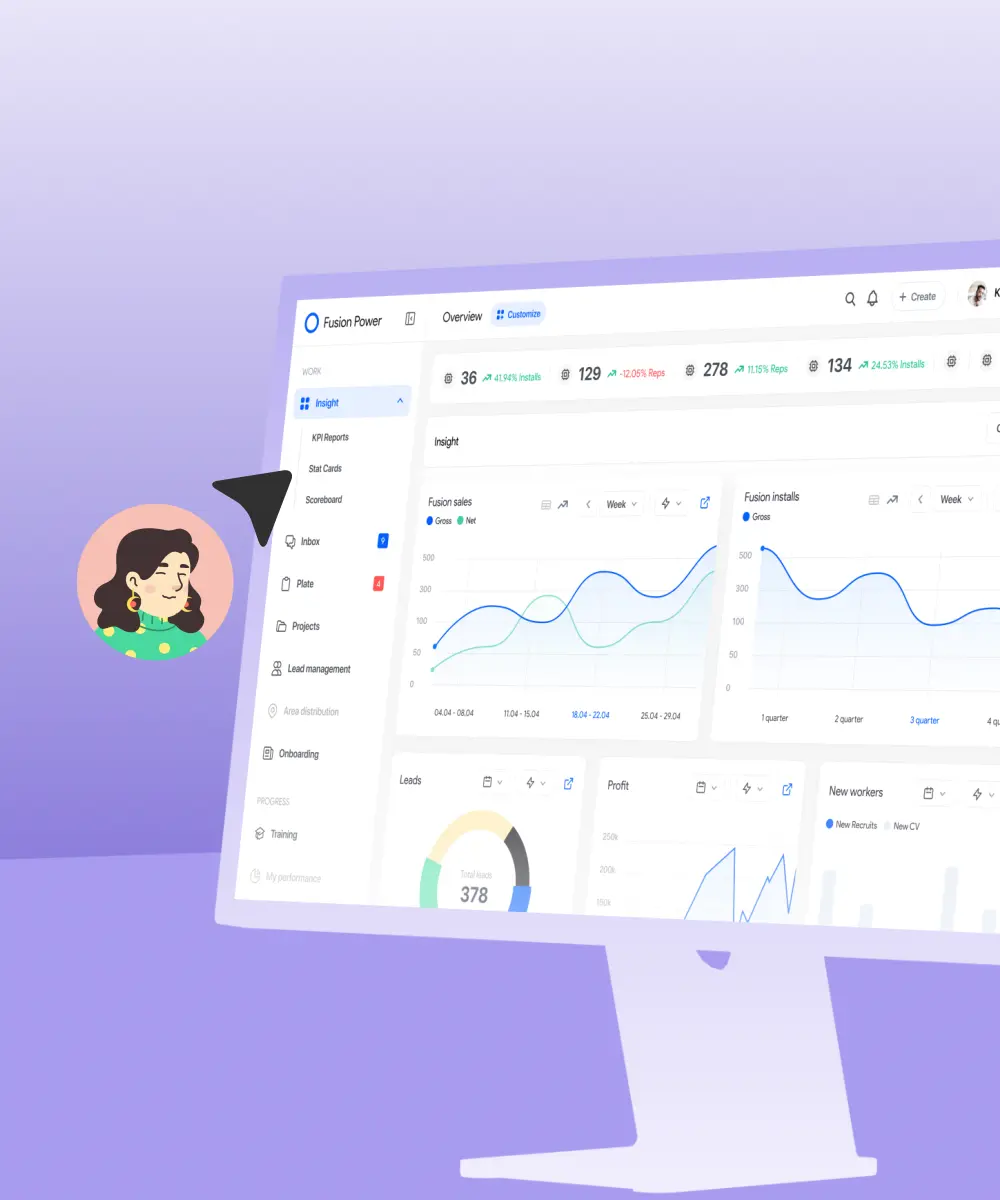
How digital transformation services run
A timeframe usually takes 4–8 months and covers audit, AI strategy, prototyping, design system extension, and rollout. The team running the audit is the team running the rollout. Existing engineering decisions stay in production unless the data argues for replacement.
Your tech is mature. Your UX isn’t.
Intake and product audit
The audit produces a modernization scope covering what stays untouched (the workflows long-tenured customers depend on), what gets replaced (the surfaces where new-user activation is sliding), and what gets layered in (the AI patterns that close the gap to current-generation products).
AI strategy tied to time-to-value
We agree on the workflows: intent-aware discovery, workflow automation, and embedded analytics will land first. Each AI surface gets a draft pattern and a metric attached. Roadmap decisions get made before the team commits engineering time.
Prototyping with realistic data
High-risk modernization flows get clickable prototypes with realistic data and real model behavior wired in. Synthetic user simulations show where new users still get stuck after the redesign. Risk drops on the most uncertain parts of the modernization before engineering builds.
Design system extension for AI patterns
AI patterns get added to your existing design system: AI-powered search, copilots, citation, confidence, override, fallback. Tokens, components, variants, enterprise-grade documentation. The system extends; nothing existing gets replaced unless the data argues for it.
Rollout and time-to-value measurement
Implementation guidance, UX QA on staging, and usage signals tied to time-to-value and adoption. New surfaces ship in a sequence designed around activation; existing customer workflows stay live. The team carries clean modernization signals into the next QBR.
Share your project idea with us!
FAQ
Will your digital transformation services disrupt our existing customer base?
No, because we design the rollout sequence around existing customer workflows. New AI surfaces land on the activation and discovery paths new users move through; long-tenured customer flows stay in place. The audit phase explicitly maps which surfaces customers depend on and protects them through the engagement.
What does AI-powered search inside a legacy product do?
AI-powered search replaces literal keyword matching with intent-aware retrieval, so a user looking for a feature, a setting, or an answer finds it without knowing the exact term. We design the result patterns, the empty and uncertain states, and the path from search to action. New-user time-to-value drops because discovery stops being the bottleneck.
How fast can we see time-to-value move?
For a focused time-to-value redesign, usage data typically shows movement within the first quarter after rollout. The early AI surfaces — search, recommendations, decision support — tend to land first and produce activation lift inside the first release window. Heads of Product see the metric move inside a quarter.
What do digital transformation services cost?
The audit produces a modernization scope and a price tag, both calibrated against the rebuild estimate the team has likely already received. Scope size depends on which surfaces enter the engagement, the existing engineering complexity underneath them, and the rollout pace the customer base will tolerate.
Do you handle the engineering side of the digital transformation?
We focus on the design and AI UX layer. We work alongside your engineering team (or your existing systems integrator) and stay close to implementation through UX QA, instrumentation, and iteration. We don’t replace the engineering function; we make sure the design lands in production the way it landed in Figma. Should your team be short on in-house engineering professionals, we have trusted partners with hands-on experience in the field.