Skip to content
Let's talk
Home
Services
Generative AI consulting

Generative AI consulting

Pilots create excitement. Inference-time UX determines whether the product survives the post-rollout phase. Most gen AI consulting covers implementation mechanics — model selection, integrations, and internal demos. At Lazarev.agency, we bring the missing layer: how generative AI behaves at inference time, how users learn to trust it, and how a gen AI product becomes a workflow customers pay for.

Become a client
  1. A gen AI strategy built to survive technical scrutiny
    Any gen AI product entering serious evaluation faces technical scrutiny covering prompt strategy, model selection rationale, hallucination handling, and cost-per-inference economics. The consulting delivers a gen AI strategy artifact addressing each: opportunity mapping, capability-readiness scoring, and a pattern roadmap. 
  2. An adoption framework for generative AI in production
    Every generative AI feature carries an adoption story into the next executive review. The consulting builds a measurement framework defining the right gen AI signals and the thresholds indicating the feature has earned its place in the roadmap.
  3. A gen AI decision framework your team will reuse
    Teams inherit more than screens from the engagement. The consulting hands over a gen AI pattern library — generation, citation, edit, regenerate, confidence, override, fallback — with a decision framework for when to apply each pattern.

Where generative AI consulting stops short

Founders shipping gen AI and Heads of Product running gen AI inside enterprise platforms tell us the same set of gaps. The use cases are clear. It’s the UX that isn’t. The last consultancy left a strategy slide, and the team is left rewriting prompts three months later.

Become a client
01

Use-case selection without a UX layer

A consultancy identifies five gen AI use cases, ranks them, and hands the team a recommendation. The recommendation never includes how users will trust the output, edit it, regenerate it, or escalate when the model is wrong. The team ships use case one and discovers adoption sits below the pilot number.

02

Gen AI demos breaking in trial

Recorded demos look great. The live trial exposes what the demo glossed over. Model responses slow down mid-prompt, and generations come back half-formed. Founders rehearse the demo for hours so it lands on the call; the trial conversion stays flat because the product behind the demo wasn't built for messy reality. 

03

Strategic decisions remade for every gen AI feature

Use-case rankings and strategy decks come out of gen AI consulting routinely. Decision frameworks don’t. The team inherits no reusable answer for what the model should generate, when it should refuse, when a human reviews, or how the surface signals confidence. Each new gen AI feature triggers a fresh round of stakeholder debate the consulting was supposed to settle, and a year later, three features sit on three different sets of strategic assumptions. 

04

Strategy disconnected from real model behavior at inference

Inference time is not deterministic. The model fabricates confidently in one prompt, refuses the next, returns mid-thought on the third, and runs slow on the fourth — and the user experience absorbs all of it. The strategy didn't account for any of it, and the team has to rebuild the UX after the consultants leave. 

How a design-led generative AI consulting runs

The success of any generative AI product depends on the layer between the model and the user — when to cite, when to refuse, how to handle a partial completion, and how to make an edit feel natural. Our work designs this layer end-to-end, on prototypes wired to real model output, before engineering commits to a single line of code.

Become a client
01

Pattern set for gen AI behavior, designed together

The library covers the moments after the model returns an answer. It cites sources where the model used them, signals confidence where the answer is shaky, lets users edit or regenerate when the output is close-but-not-right, and routes to a fallback when generation fails. Designed once and inherited by future generative features, so each release adds to the library instead of inventing a parallel one.

02

Prompting and tool use as design decisions

Prompt strategy gets designed alongside the UI. Tool selection, retrieval logic, and fallback paths become key design decisions. The product’s behavior matches the surface users see, because the surface and the behavior were authored by the same team.

03

LLM-aware prototyping with real model output

Prototypes go into staging wired to the actual model output, with data behind it. The model misbehaves in the same ways it will in production: stalled responses on one prompt, confident fabrications on the next, refusals where the team didn't expect them. Finding these moments in a prototype costs nothing compared with finding them in front of a paying user.

04

Trust surface engineering for procurement and enterprise

The consulting prepares the team for enterprise procurement review: mapping the questions reviewers will ask, building the evidence framework they expect, and advising on trust patterns that stand up under audit. Teams enter procurement prepared.

Generative AI products designed to land in real use

Each case below shows how gen AI becomes usable once the right UX layer is built around it. One platform combined natural-language prompting with structured controls inside a hybrid GUI/chat interface. Another reduced the switching cost of AI search by placing conversational interactions inside familiar search patterns. A third unified voice interaction, onboarding, editing workflows, and monetization into a single AI-native mobile experience designed around real user behavior.

See all case studies

AI

14 Jul 26

How AI product design for Pika AI helped build a next-gen search platform

Explore how Lazarev.agency applied AI product design to turn Pika AI into a clear, intuitive search experience built for scale, trust, and business growth.

View case
Minimalist cover graphic featuring the PikaAI logo centered on a bright blue background.

AI

Fintech

SaaS

29 Jul 26

How we helped Accern design an AI research product that powered $40M growth and acquisition

Discover how we helped Accern build a powerful AI research tool for analysts and VCs, setting new UX standards now used by AI leaders across industries.

View case
A glassy 3D model of an AI robot

AI

Media

10 Aug 26

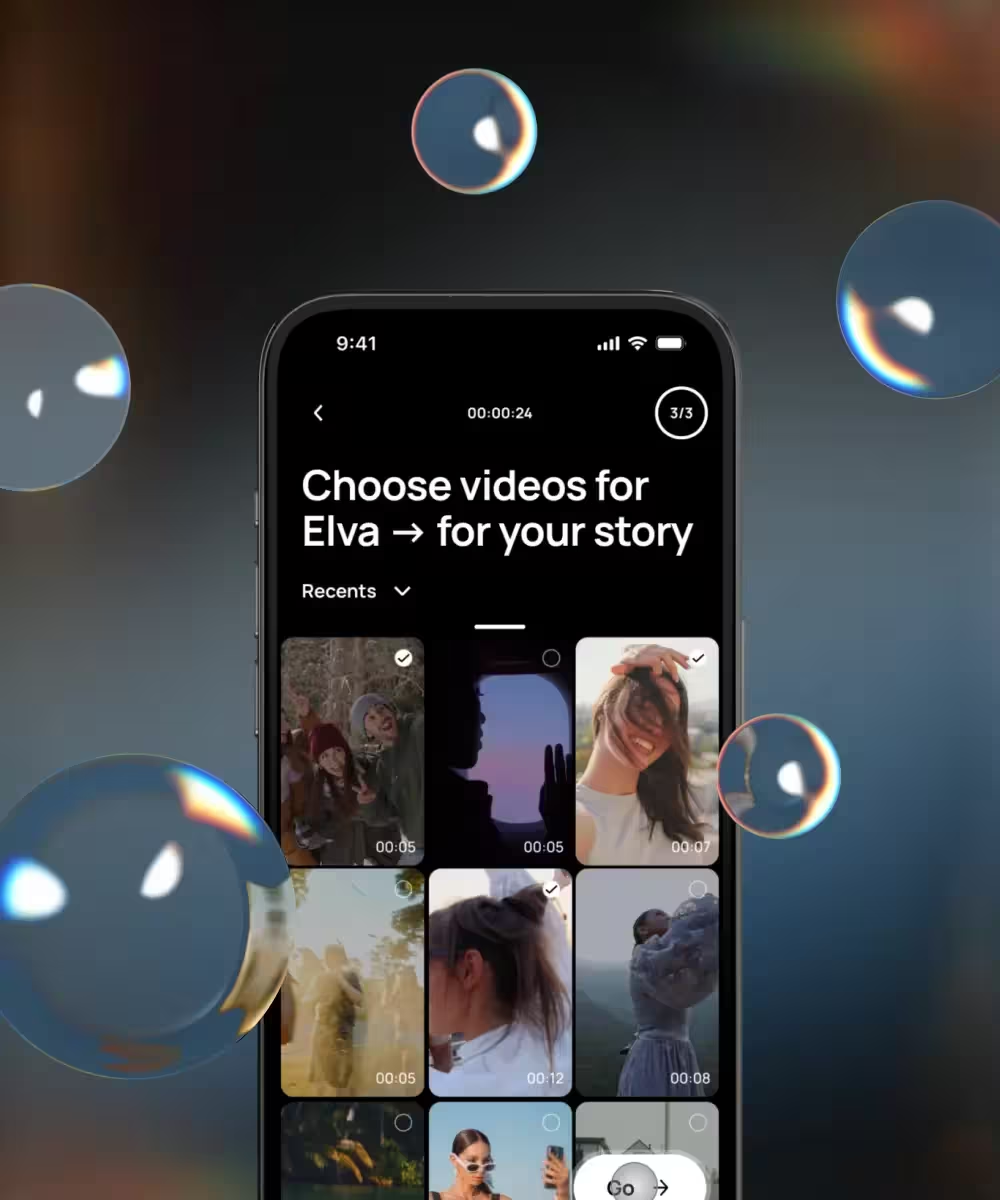
Voice AI video editor app design: how we shipped Elva's brand, onboarding, and agentic editing flow

Lazarev.agency designed Elva, a voice-first AI video editor — brand, UX, UI, onboarding, monetization — as one launch. Webby Winner, Best Visual UI in AI.

View case
Elva's video picker screen surrounded by floating glass bubbles with chromatic aberration

Lazarev.agency designs the best UI for AI products

Lazarev.agency is more than about making profits for us and our clients. We're committed to saving lives in Ukraine, taking on pro bono projects, championing diversity, equity, and inclusion.

01
$500M+

in funding secured
for our clients

02
140+

awards backing
our excellence

03
2015

founded, 10+ years of experience

04
San Francisco, CA

AI product design agency

05
Full-cycle product design

from user research to production-ready design systems

Among our clients:

Award‑winning product design agency for AI‑native B2B platforms

We’re a UX/UI web design agency with 140+ awards that helps AI‑native and AI‑ambitious B2B teams translate complex products into clear, conversion‑ready websites.

Webby Awards x10

Red Dot Design Award x6

Awwwards x16

FWA x5

Four deeper engagements our AI generative consulting routes to

After the gen AI consulting exposes real bottlenecks, we identify which of the four deeper engagements is the right way forward for your specific product. Each shape addresses a different layer of the gen AI stack: launch readiness, pattern gaps, prompt strategy, procurement-grade trust, or eval coverage. The scope locks based on what the consulting found.

Become a client
01

Generative AI product launch

4–8 months covering positioning, onboarding, gen AI UX patterns, and demo flows for a near-term launch. Founders get one team owning the AI story from product through GTM, with a demo investors and enterprise buyers can run live in real time.

02

Gen AI pattern library for existing products

A reusable pattern library for citation, confidence, edit, regenerate, fallback, and override flows. Implementation-ready specs your team plugs into the current product across multiple releases, with documentation your engineering team can extend without us in the room.

03

Prompt-as-product design

Prompt strategy, tool use, retrieval logic, and refusal patterns designed alongside the surface users see. Used when the existing prompt setup is not producing the behavior the product is sold on, or when a new model release has shifted what the prompts need to do.

04

Trust and refusal pattern design

A focused 4–6 week engagement on the gen AI trust layer for products entering enterprise sales. Citation, attribution, refusal, audit trail, escalation paths. Procurement reviewers move through the trust evidence in under a minute on first contact with the page.

Why teams pick us for generative AI consulting

Three scenarios bring teams here. Prior consulting left unbuildable slides. A funding round whose gen AI strategy has to survive technical diligence. Enterprise procurement gating deals over missing trust evidence. The line we hear back: the consulting produced frameworks the team runs on every gen AI decision since.

I've never worked with a vendor operating so well, especially on a creative job.

Generative AI consulting
Nicolas Grasset

CEO at Peel Insights, Inc

Lazarev is top-notch in what they do and they charge accordingly.

Ibrahim Hasani
Ibrahim Hasani

Co-Founder & Head of Engineering at Metastaq

Where generative AI consulting bites hardest

Gen AI faces the hardest UX scrutiny in industries where someone reviews the model's output before it reaches a customer. Legal tech checks citations against source documents. Fintech audits the data behind the generated summaries. The consulting addresses the layer between what the model produces and what the reviewer downstream needs to defend.

Web3 design agency
UX design for AI products
Real estate web design agency
Fintech design agency

Who we are and why teams like yours work with us

We exist for B2B teams under pressure to turn an AI roadmap into visible product usage, expansion, and a safer story in front of the C‑suite and investors. If design isn’t moving revenue, adoption, or retention, it’s decoration. We design to avoid that. Since 2015, we’ve shipped 600+ products and earned 140+ awards for work on complex, data-heavy tools: fintech platforms, AI copilots, decision engines, and vertical SaaS. Our work has helped clients turn “we have AI features” into “our customers actually use and pay for them.”

We started designing AI products in 2017, long before “AI-native” became a buzzword. With 30+ AI products shipped, we focus on the hard part most teams struggle with: making complex intelligence feel simple, trustworthy, and obviously valuable in a demo, a POC, or a QBR. We’re a 40+ person team of UX strategists, product designers, and analysts who treat design as a business function.

What sets us apart from a typical agency or a single in-house hire is pattern recognition at scale. We’ve seen what works – and what quietly kills adoption – across hundreds of AI and data-heavy products. That lets us spot failure modes early, bring proven interaction patterns to your team, and reduce the risk that your next AI release is another unused toggle in a settings menu.

We start with research not because it’s “best practice,” but because designing without understanding your users, your market, and your revenue model is just guessing with nicer pixels. From there, we collaborate with your product, AI, and design leaders to define where AI should show up, how it should behave, and how to make it obvious, safe, and monetizable.

If you’re a Head of AI, Product, or an AI-native founder who needs AI capabilities to be seen, understood, and used now, not someday, we’re built to be that partner.

Talk to a strategist

At this stage, clients engage us for 4–6+ month AI & data product UX redesign programs, treating us as their primary product design partner for the core platform.

10+ years

of experience in UI/UX design

Trusted by over 600 companies of all sizes

140+

international industry awards

600+

projects successfully completed

How a generative AI consulting runs

The consulting opens with a decision-readiness audit and closes with the team owning the adoption loop. Between those two endpoints sit the deliverables the engagement produces: a gen AI strategy artifact, a recommendation validation cycle, a pattern library, and decision framework. Gen AI moves faster than traditional ML, which is why no deliverable waits more than three weeks for a review.

Become a client
01

Intake and generative AI opportunity audit

Stakeholder sessions across Product, AI, Engineering, and GTM. We pick the one or two workflows where generative AI has a credible adoption path, surface the failure modes the team is most worried about, and lock the metrics the engagement will move. Scope locks before design starts.

02

Conversational and generative pattern strategy

The consulting documents the gen AI pattern set as one coherent strategy: when generation fires, how citations attach, where confidence signals appear, what users override, when the model defers to a fallback. Each pattern arrives with a decision framework the team applies to the next feature without us in the room.

03

Recommendation validation with real model output

The highest-risk recommendations get pressure-tested through clickable prototypes wired to actual model output. Stalled responses and partial completions surface in the prototype, where they are fixable. The strategy gets validated before it reaches the engineering backlog.

04

Production-ready UI and design system extension

Our gen AI consulting hands over the gen AI pattern library inside your design system. Design leads inherit reusable assets in their conventions, and engineering inherits implementation specs. 

05

Implementation advisory and adoption tracking

We advise the team through the first implementation window with structured check-ins and UX advisory on the highest-risk surfaces. The adoption measurement framework comes in, too: invocations, edit rate, accept rate, and workflow completion. Advisory phases out as your team takes ownership of the loop.

Frequently asked questions

How we work, scale, and deliver measurable outcomes.

How is design-led generative AI consulting different from a Big Four practice?

Big Four generative AI consulting tends to stop at use-case selection and capability assessment. We design the surfaces users interact with, instrument them for adoption, and stay through rollout. Founders and Heads of Product end the engagement with a working generative AI product and adoption data, instead of a slide deck describing what should happen next.

How fast does the gen AI consulting produce something we can act on?

Eight to ten weeks gets you the investor-grade outputs: audit, strategy artifact, and a validated prototype tied to model behavior. Four to eight months gets you the product behind those outputs. The first window covers the demo. The second covers the trial waiting on the other side of the round.

What does generative AI consulting cost?

The intake answers two questions before pricing locks: which gen AI surfaces are in scope, and which stakeholders need alignment around them. Add model and data layer maturity, plus the required validation window, and you have a concrete estimate. 

Do you handle the model side, or only the UX?

The consulting focuses on the layer between the model and the user. We advise on prompt strategy, tool use, retrieval logic, and eval setup so model-side decisions match the UX strategy the consulting recommends. We don't build or pretrain models ourselves; most engagements run alongside your existing AI team or your model vendor.

How does the consulting absorb new model releases mid-engagement?

Every monthly working session opens with a model-release scan — what changed at the providers your team uses, what it unlocks, what it shifts in the pattern set. The decision framework is built to absorb updates without reopening the strategy phase. Our gen AI consulting brief assumes models will update during the engagement and structures the cadence around it.

Let's talk about your AI adoption challenge

Tell us where adoption stalls. You’ll hear back from a senior product and UX lead with a practical action plan.

Response within one business day

Talk to us
Explore our services