

Lazarev.agency’s 2025 AI design recap: what the data tells us about how AI will shape digital products in 2026?
2025 was the year the design industry went AI-native.
Right after the release of GPT-5, global searches for AI design exploded, reaching all-time highs across dozens of terms that define how designers think, work, and build.
Lazarev.agency analyzed worldwide Google Trends data for over 100 search terms. The findings show a clear story: August 2025 marked the moment the entire design ecosystem shifted from experimenting with AI to fully integrating it into their workflows.
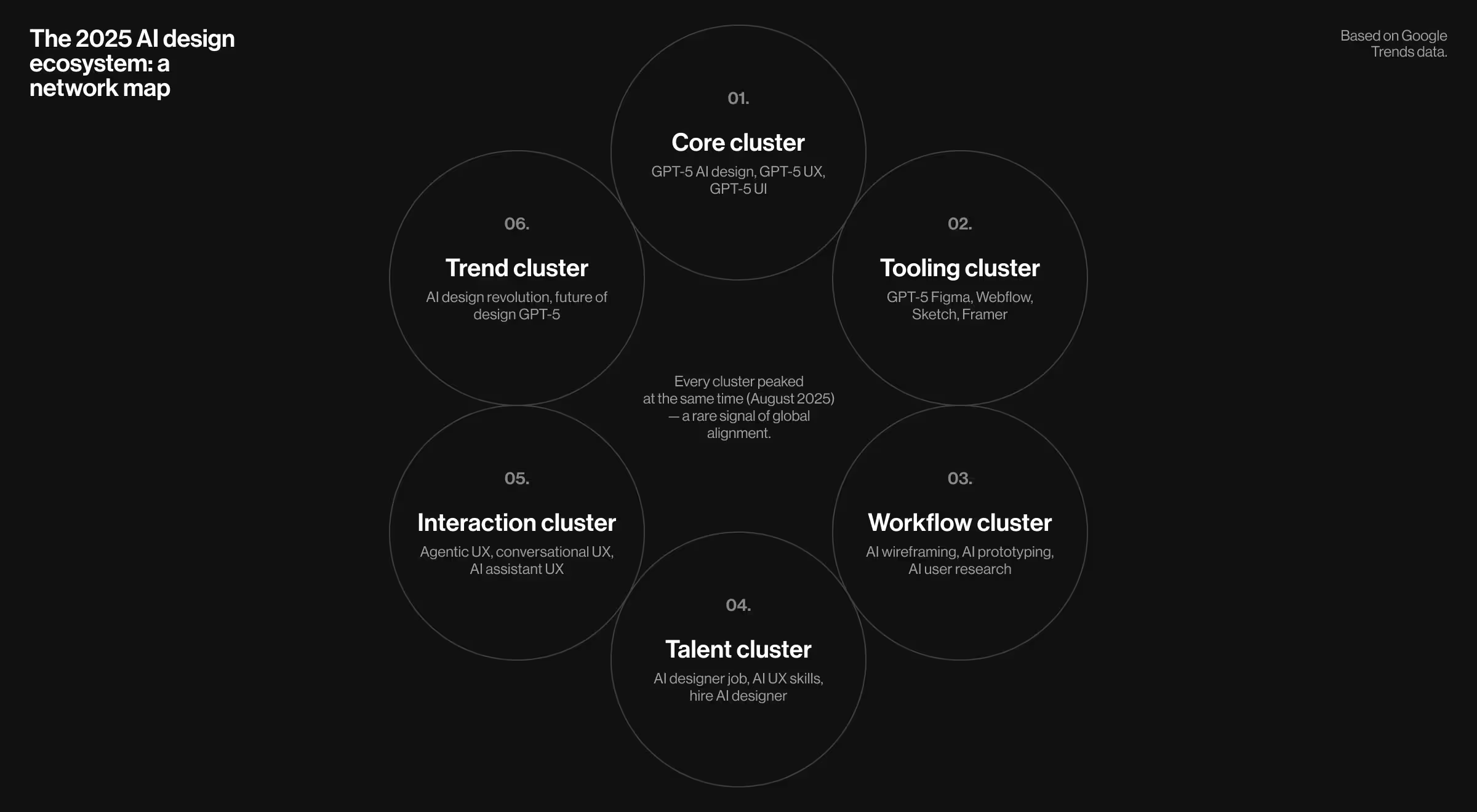
Key takeaways
- GPT-5 caused the largest spike in AI design interest ever recorded, signaling an industry-wide shift from experimenting with AI to fully operationalizing it in product workflows.
- AI-first design became the new baseline, with global peaks across AI UX, AI UI, and AI workflow searches showing that teams are rebuilding how products are designed and shipped.
- The talent market transformed overnight — demand for AI-capable designers, hybrid UX–AI thinkers, and model-literate product designers hit unprecedented levels.
- Agentic and conversational UX moved from niche to mainstream, confirming that 2026 products will rely on proactive assistants, autonomous agents, and mixed-initiative interfaces.
- AI is now embedded in every stage of design, from research and prototyping to audits and testing, dramatically accelerating validation cycles and early discovery.
- Designers expect GPT-5 inside their tools, as searches for GPT-5 + Figma, Webflow, Sketch, and Framer integrations peaked simultaneously.
- The narrative around AI matured — designers now see AI as a multiplier of their capabilities, not a competitor.
- 2025 marked the turning point, and the data shows 2026 will be the year AI-native product design becomes the standard.
Here’s the full analysis based on Google Trends data.
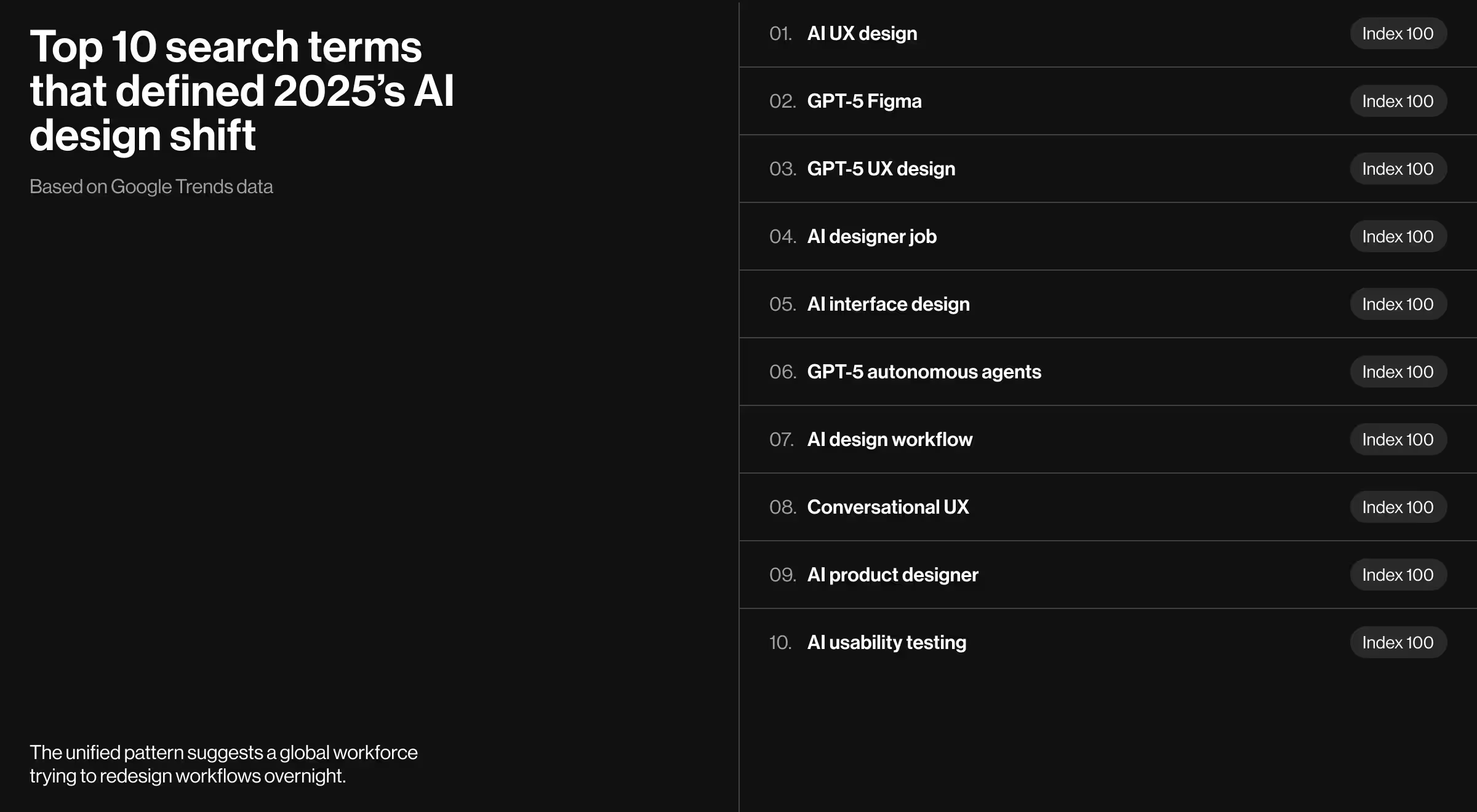
1. GPT-5 ignited the biggest global spike in “AI design” searches ever
Across August 3–9, 2025, nearly every “GPT-5 + design” term hit index 100, the highest possible global search interest.
Notable peaks include:
- GPT-5 AI design (source)
- GPT-5 product design (source)
- GPT-5 UX design (source)
- GPT-5 UI design (source)
- GPT-5 design workflow (source)
- GPT-5 Figma plugin (source)
- GPT-5 app design (source)
The pattern is unmistakable:
designers weren’t just curious about GPT-5 — they immediately searched for ways to use it in real product workflows.
2. AI-enhanced product design became the new default
Between August 10–16, 2025, global interest surged across the entire AI-assisted design toolchain:
- AI UX design — index 100 (source)
- AI UI design — index 100 (source)
- AI interface design — index 100 (source)
- AI design workflow — index 100 (source)
- AI design generator — index 100 (source)
- AI design trends 2025 — index 100 (source)
This shows a transition in mindsets:
Teams were already restructuring how digital products get built with AI at the foundation.
Lazarev.agency sees this daily: AI is already the operating system for modern product teams.
🔍 If you want to understand what this shift means for your next release, explore our guide on how to build better AI products — a playbook for teams that don’t follow trends but define them.
3. Demand for “AI designers” skyrocketed after GPT-5
Searches reveal a dramatic shift in the global talent market.
- AI UX skills — index 100 (source)
- AI design skills — index 100 (source)
- AI designer job — index 100 (source)
- hire AI designer — index 93 → 97 growth (source)
The most explosive growth:
- AI product designer role grew from index 0 to 100 within one month (source).
- AI design portfolio examples went from index 0 to 100 between June and late September (source).
📌 The takeaway: Companies now need designers who understand AI reasoning, model constraints, conversational flows, and agent behavior.
This shift aligns perfectly with Lazarev.agency’s talent model — we defined AI-UX roles long before they appeared on job boards. And if you’re looking for a partner to design AI-native products, you can hire AI designers.
4. GPT-5 pushed agentic and conversational interfaces into mainstream product design
The strongest signal in the dataset is the rise of agentic and conversational design patterns.
Across August 10–16, 2025, the following reached index 100:
- agentic UX (source)
- conversational UX (source)
- conversational design (source)
- agentic interface design (source)
- AI assistant UX (source)
- AI agent workflows (source)
- GPT-5 autonomous agents (source)
This marks a fundamental shift: interfaces are evolving from passive layouts into active collaborators that take initiative.
And Lazarev.agency is already architecting these new paradigms — hybrid prompt/GUI flows, agentic dashboards, proactive assistants, and mixed-initiative systems. If you’re exploring similar capabilities, our dedicated page on AI & ML solutions shows how we build them end-to-end.
🔍 Find out more about our work here.
5. AI fundamentally reshaped the design process
From research to prototyping to audits, designers globally searched for ways to integrate AI into every step.
Peaks include:
- AI wireframing — index 94 (source)
- AI prototyping — index 99 (source)
- AI user research — index 100 (source)
- AI UX audit — index 100 (source)
- AI usability testing — index 100 (source)
This tells us:
- validation cycles are accelerating
- AI is doing early-stage research
- synthetic users are replacing large test cohorts
- prototyping is becoming automated
6. Designers demanded GPT-5 inside their tools
Every major design platform saw a surge in searches for GPT-5 integrations:
7. Meta searches confirm: AI is now seen as the future of design
Searches show that designers worldwide reframed their relationship with AI.
All peaking at index 100:
- AI design revolution (source)
- AI impact on designers (source)
- GPT-5 vs designers (source)
- future of design GPT-5 (source)
The narrative has moved from “AI replaces designers” to “AI enhances design workflows”.
What this means for 2026: five predictions shaped by the data
CEO and founder of Lazarev.agency, Kirill Lazarev, sees these search spikes as a preview of how digital products will be built in 2026. Based on the data and our work with AI-native products, here’s his take on what comes next:
1. AI becomes the default interface layer
Conversational and agentic interactions move from experimental features to standard UX patterns. Interfaces won’t just respond, they’ll initiate, guide, and collaborate.
2. The “AI designer” moves into the mainstream
Teams need specialists who understand both UX and model behavior. Hybrid designers who can shape reasoning flows, model limits, and AI-driven interactions become core hires.
3. Design workflows shift from linear delivery to intelligent iteration
Instead of classic research → design → test cycles, products evolve through continuous, model-assisted loops. AI becomes a co-pilot in ideation, prototyping, and validation.
4. Multi-modal interactions challenge the screen-first mindset
Voice, actions, agents, and predictive automation begin replacing traditional tap-and-scroll patterns. Products will increasingly rely on AI-driven behaviors.
5. AI ethics and explainability define the new design aesthetic
Clarity of reasoning becomes a design requirement. Users must understand why the system acts, not just what it shows. Visuals are no longer enough, designers must communicate model intention and safety.
🔍 If you want to see how these shifts influence the broader landscape of digital products, explore our deep dive on the future of web design — 18 trends shaping how next-gen interfaces will look, behave, and evolve.
Why Lazarev.agency is publishing this research
Because we don’t follow AI UX trends. We create them.
Lazarev.agency specializes in:
- AI-native product design
- conversational and agentic UX
- hybrid prompt + GUI systems
- predictive dashboards
- AI trust, reasoning, and explainability
We’ve spent years designing AI-powered products across fintech, analytics, edtech, wellness, and enterprise platforms — long before these search trends peaked.
Now the data confirms what we’ve experienced firsthand: 2025 was the turning point. 2026 will be the acceleration.
Start your project now. Don’t wait for your competitors to catch up. Contact us.




.webp)