

The website development process is a cycle. If there’s one thing holding this system together, it’s strategy. But not as a rigid methodology. As a foundational framework that informs every development decision along the way.
That’s why the most effective website development projects start with a strategic grounding. Teams must understand what they’re building, who it’s for, and why it matters. From there, the process must stay intentionally flexible, ready to iterate as the market and brand evolve.
In this article, we walk through the website development process step by step. If you’re looking to create a future-proof website, this is where it starts.
Key takeaways
- Website development is a system. Successful websites are built through a repeatable cycle where each step sets up the next.
- Strategy is non-negotiable. Goals, business model, and value proposition must be defined upfront. Without this alignment, decisions drift.
- Most website failures come from skipped steps. Rushed research, vague goals, unclear ownership, and underplanned launches create compounding problems.
- Leading website development partners like Lazarev.agency approach websites as living products. Continuous improvement, data-driven optimization, and scalable infrastructure are prerequisites for long-term growth.
Why is website development more than just being online?
A website going live doesn’t mean it’s doing its job. Here’s what actually makes a website work:
- Strategic personalization. According to McKinsey, companies that get personalization right generate 40% more revenue from those efforts. At the same time, 71% of users expect personalized interactions, and 76% disengage when experiences feel generic.
💡Insight: personalization only works when it’s planned at the process level.
- Optimized performance. Google reports that 53% of mobile visitors leave if a page takes longer than 3 seconds to load.
💡Insight: performance decisions made during development shape acquisition.
- Mobile-first reality. Statista shows that over 62% of global web traffic comes from mobile devices.
💡Insight: websites that aren’t designed and developed around mobile underperform by default.
- AI-driven experience. McKinsey’s next best experience model shows that AI-powered UX can increase customer satisfaction by 15–20%, lift revenue by 5–8%, and reduce service costs by up to 30%.
💡Insight: data, site architecture, UX decisions, back end development, and front end development must be aligned from the start to support performance.
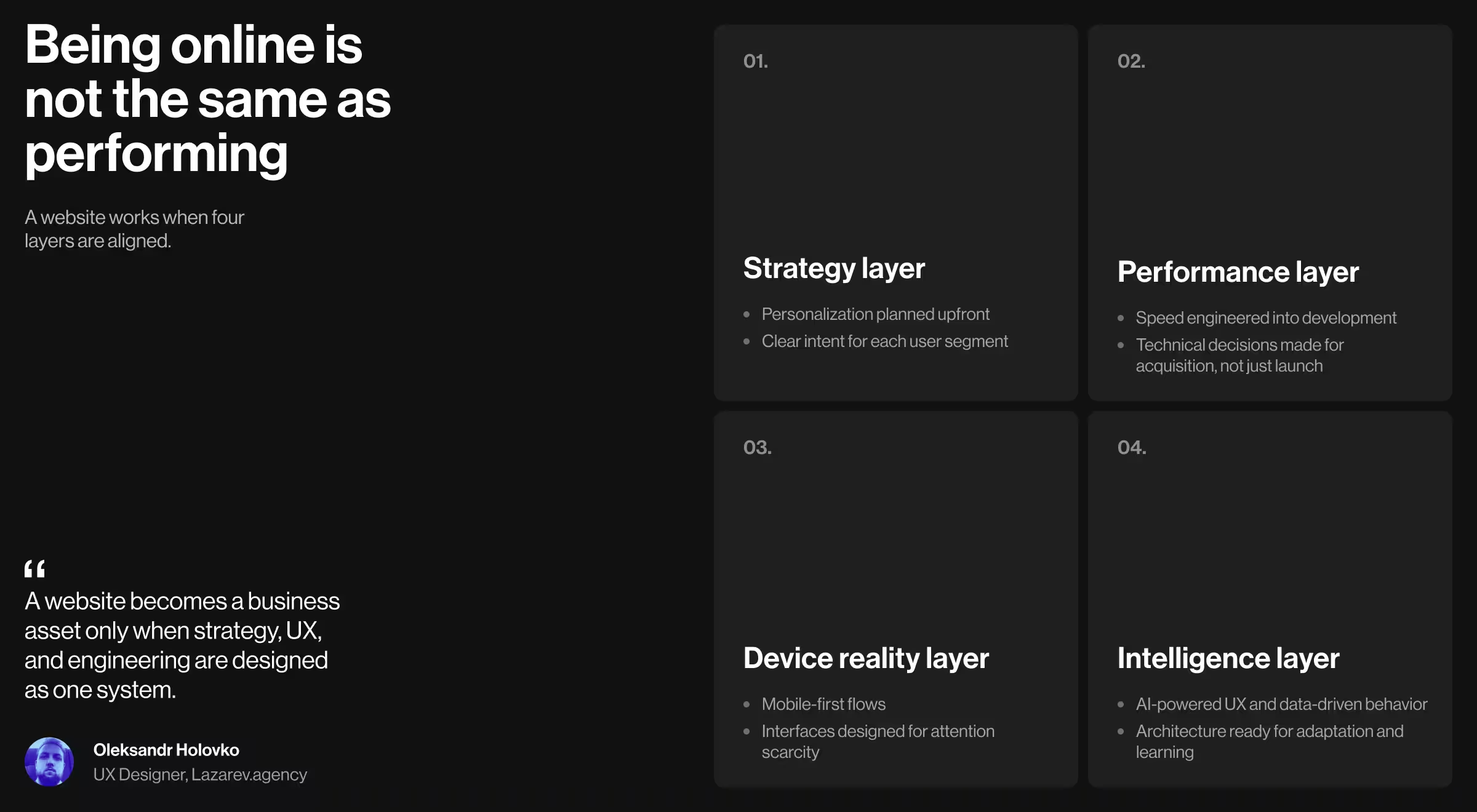
The numbers make it crystal clear that effective website development starts with strategy. Preparation defines what your website can become and what it never will.
Why this basic website development life cycle is your cheat code to success?
Before getting tactical, it’s worth stepping back to see the system you’re building. Scalable websites emerge from a repeatable development cycle that embeds product strategy into the very fabric of execution, creating a canvas your business can use to improve over time.
At Lazarev.agency, we’ve seen that teams who follow this cycle avoid reactive fixes down the line.
Think of these 7 phases as a basic decision framework, where each step answers a different strategic question, and skipping one usually means paying for it later in redesigns.
Here’s how to use this table:
- Scan horizontally to understand what each stage unlocks and the leverage it gives you.
- Scan vertically to spot where your current project is most exposed or under-defined.
- Use each stage as a checkpoint. Don’t move forward until the objectives of the previous step are clearly achieved.
- Treat the “Watch for” column as an early-warning system. If you spot an issue, slow down and fix it.
- Revisit the table post-launch to guide iteration and improvement.
- Use it as a shared reference across founders, PMs, designers, and engineers to align expectations and decision ownership.
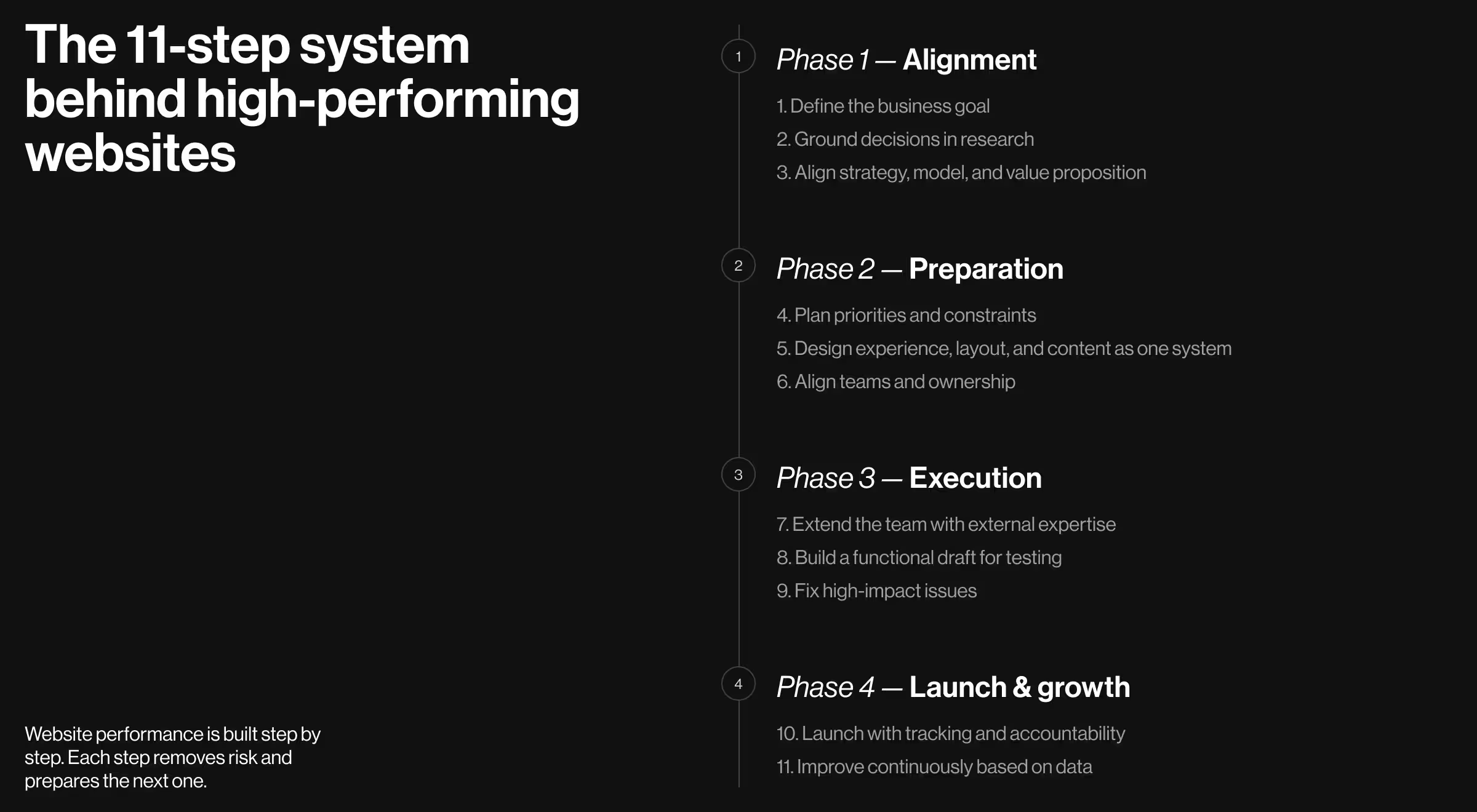
How to build a high-performing website in 11 steps: Lazarev.agency’s version
A strong website is the result of a structured development process where each step sets up the next. Overlook alignment or treat strategy as optional, and operational problems pile up.
Based on how we approach projects at Lazarev.agency, here’s our 11-step roadmap for planning, building, launching, and evolving high-performing websites.
1. Define the goal
🎯 How to approach this step: Define the goal in terms of tangible business outcomes. Any successful website development project starts by identifying where growth is constrained and what must change for the business to move forward.
From our experience working with businesses across industries, strong goals look like this:
- Increase revenue by 15% and reduce user churn by 30% (e-commerce brand).
- Improve user retention by up to 40% (mental health app).
- Grow overall traffic by 120% while increasing user retention by 25% (Web3 platform).
- Drive a 5x increase in user engagement (media platform).
🟨 What usually goes wrong and how to avert it: Teams often define vague goals (“improve UX” or “modernize the site”) or stack too many objectives at once. This leads to diluted focus and conflicting decisions.
To avoid this, commit to one primary outcome and validate it against data. Secondary goals can follow, but only after the main constraint is addressed.
🟩 Output: A goal statement written as:
“Improve [specific metric] for [defined audience] within [timeframe], measured by [clear KPI].”
🔍 Want to go deeper? Explore our guide on setting goals for website redesign.
2. Conduct thorough research
🎯 How to approach this step: Research means replacing assumptions with evidence. The best approach depends on whether a website already exists.
- If you have an existing site: skip brainstorming and start with a site audit.
- Technical assessment: performance (Core Web Vitals), crawlability, indexation, accessibility, and security.
- User experience analysis: conversion paths, drop-off points, mobile vs desktop behavior, navigation friction, and content clarity.
- Pattern identification: where does intent break?
- If you don’t have a site yet: focus on market research and UX research.
- Interview the target audience to understand their goals, objections, decision triggers, and context of use.
- Define user personas.
- Analyze competitors to spot gaps, trends, and overused patterns.
In both cases, the goal is to understand what users do and what the market rewards. Overlooking this step leads to misaligned goals and costly course correction later.
🟨 What usually goes wrong and how to avert it: Teams conduct solid audits, but insights never get to inform business decisions.
To avoid this, force every finding to answer one question: Who hesitates, where, and why? Then range the insights by impact. If it doesn’t change a decision, drop it.
🟩 Output: A concise research summary with:
- The top 3–5 user and business problems worth solving
- Evidence supporting each problem (data, behavior, patterns)
🔍 Make UX research your product’s secret weapon. Consider our UX analysis guide and a roadmap for turning UX audit findings into product wins.
3. Determine the business strategy, business model, and value proposition
🎯 How to approach this step: Website development only works when the site is designed to support how your business creates a unique value proposition for your audience (sounds self-centered, but that’s the point). That means aligning three things early on: business strategy, business model, and value proposition.
Start by clarifying:
- Business strategy: What outcome the business is optimizing for right now (growth, efficiency, market expansion, user retention).
- Business model: How value is monetized (subscription, transactional, usage-based, enterprise sales, hybrid).
- Value proposition: Why a specific audience should choose you over alternatives and in what context.
This step matters more than most teams admit. While 79% of executives say product management is critical to a company’s success, many organizations still operate without strategic clarity.
The gap here is alignment. A strong product strategy framework must connect product vision to business objectives. That way, the website reinforces the business model instead of working against it.
Use proven frameworks to facilitate the process:
- Value Proposition Canvas to sharpen differentiation.
- Business Model Canvas to expose misalignment.
- Jobs to be done to anchor messaging in real user intent.
🟨 What usually goes wrong and how to avert it: A common oversight is designing a website for a business model your product has outgrown.
As a preventive strategy, validate the strategy against reality. If different stakeholders describe the product differently, your strategy isn’t ready. Lock it before moving forward.
🟩 Output: A strategic brief with:
- The primary business objective your website must support
- The business model the site is optimized for
- A one-sentence value proposition
4. Plan everything
🎯 How to approach this step: Planning makes strategy executable. After defining goals, proceed with two artifacts: a product roadmap and a product vision board.
The roadmap answers when and in what order things happen: phases, priorities, dependencies, and milestones. The vision board answers why: what the website must offer users and the business once it’s live. Together, they prevent reactive decisions in design and development.
From there, map:
- Core user journeys (entry → decision → action) and product features
- Constraints (budget, timeline, tech stack, compliance)
- Success checkpoints tied to the goal defined at step 1
🟨 What usually goes wrong and how to avert it: Overplanning the wrong things or the right things in the wrong order. Something along the lines of locking page layouts before validating priorities. On the flip side, underplanning is just as risky. Jumping into design with only high-level goals is a rookie mistake.
Keep planning outcome-driven. If a task doesn’t support business objectives, ditch it. And ensure you revisit the roadmap regularly as new insights emerge.
🟩 Output: A concise planning package with:
- A phased product roadmap with priorities and dependencies
- A product vision board aligning UX and functionality
🔍 Building a scalable product vision can be tricky. Learn how to write, sell, and keep your product vision alive long-term in our guide.
5. Design layout, experience, and content strategy as a unified system
🎯 How to approach this step: Design makes strategy visible.
Treat layout, interaction, content, and visuals as a system that supports usability and makes the website’s performance optimization possible. Prioritize responsive design, embed accessibility standards early, and integrate AI-powered features to stand out as an industry trendsetter.
🔍 Still on the fence about responsive design? These 5 reasons to invest in responsive web design will change your mind.
Express experience logic visually:
- Define information architecture for different screens
- Build UX flows around user intent
- Follow scalable UI design principles
- Embed accessibility from the start (contrast, focus states, readable typography, keyboard navigation)
- Treat content as an interface: headlines, microcopy, and messaging are part of UX.
Where it adds value, introduce AI-powered solutions like conversational UI and anticipatory design patterns.
🟨 What usually goes wrong and how to avert it: Fragmentation bears the greatest risk. Teams design visuals in isolation, add content as an afterthought, and then try to shoehorn UX around it. A confusing interface is the only thing that comes out of it.
To sidestep fragmentation, pressure-test every design decision: Does this make the next user action clearer?
🟩 Output: A design system–driven set of deliverables:
- Responsive layouts tied to real user flows
- Reusable UI components and interaction patterns
6. Align teams and distribute tasks
🎯 How to approach this step: Transform a unified design system into a roadmap for coordinated execution.
Start by clarifying ownership:
- UX/UI owns interaction logic, accessibility, user flows, and brand consistency
- Development owns performance, responsiveness, AI-powered functionality, and integrations
- Product or PM owns prioritization and scope.
🟨 What usually goes wrong and how to avert it: Shared responsibility without decision authority is a common catch.
To avert this trap, map tasks to outcomes. For example, “mobile-first responsiveness” or “AI chatbot integration” should each have a designated accountable party, even if multiple teams contribute.
🟩 Output: A clear responsibility map to minimize ambiguity.
7. Hire outsourced design experts
🎯 How to approach this step: When your internal team lacks senior judgment or specialized skills (e.g., advanced UX strategy, complex UI, accessibility, or AI-driven interactions), outsourcing is a game-changer.
Loop in external partners early. Share business goals, research insights, design system, and success metrics with the entire team, so everyone is on the same page.
🟨 What usually goes wrong and how to avert it: Outsourcing too late limits the potential for impact. Avoid this by integrating external teams into planning and strategy discussions from the start.
🟩 Output: A hybrid team with deep subject expertise.
🔍 Explore our guide for founders and product leaders on hiring a design agency like a pro.
8. Develop a draft website for functional testing
🎯 How to approach this step: Treat a draft website as a working blueprint. It’s where you test whether strategy, design, and engineering hold together under real constraints.
Build it end-to-end: layouts, content structures, interactions, and data flows. The goal is to validate assumptions early on, so decisions are grounded long before launch.
🟨 What usually goes wrong and how to avert it: The common mistake is treating the draft as either throwaway or final. In the first case, teams don’t test it seriously. In the second, they avoid change to protect sunk effort. Both scenarios make learning impossible.
Prevent this by clearly labeling the draft as testable and expected to change. If a decision can’t be validated in the draft, it’s premature.
🟩 Output: A functional website that:
- Covers critical user flows
- Works across devices and screen sizes
- Is ready for structured testing and feedback from users, internal stakeholders, and business owners responsible for outcomes.
9. Fix issues identified during draft testing
🎯 How to approach this step: Once the draft website has been tested, shift from discovery mode to deliberate correction. Triage issues based on risk and impact. Prioritize anything that blocks user journeys, affects performance, breaks accessibility, or undermines trust.
Use a simple rule of thumb:
- Resolve structural issues (confusing navigation, broken flows)
- Address usability gaps (confusing copy, unclear CTAs)
Group issues by theme (UX performance, content, accessibility, integrations) and assign clear owners with deadlines.
🟨 What usually goes wrong and how to avert it: The biggest trap is treating every issue like it’s equally urgent. Teams spend hours sweating minor annoyances while structural UX problems or performance bottlenecks fester unnoticed.
Avoid this by adopting an impact-based mindset. Tackle what affects the system the most, then work your way out to the edges.
🟩 Output: A launch-ready build where:
- All critical issues blocking user goals are fixed
- Core flows are validated
10. Launch the website
🎯 How to approach this step: The website development reaches a critical checkpoint here. Before going live, confirm that tracking and rollback plans are in place.
Launch during a window where teams are available to respond quickly. Speed matters, but so does internal readiness.
Run a final pre-launch checklist:
- Verify analytics and conversion tracking
- Double-check performance, accessibility, and mobile behavior
- Prepare support, content owners, and internal teams for day-one feedback
🟨 What usually goes wrong and how to avert it: A widespread misstep is the absence of ownership after launch. Sites go live, and teams move to another project. When conversions dip, there’s no clear owner to notice or act.
Fix that first. Assign a single launch owner and a defined monitoring window. Accountability ensures issues are caught and addressed immediately.
🟩 Output: A fully trackable website that performs smoothly across devices.
11. Pursue continuous improvement
🎯 How to approach this step: Continuous improvement is how your digital presence compounds value. Treat the website as a breathing ecosystem. Set a regular optimization cadence (monthly or quarterly) focused on UX performance and larger-scale business impact.
Anchor improvements to data:
- Review conversion funnels and engagement patterns like customer churn
- Monitor performance, accessibility, and technical health
🟨 What usually goes wrong and how to avert it: Treating post launch maintenance as optional, or neglecting it altogether. Once the site is live, attention shifts elsewhere until performance degrades, which triggers another expensive rebuild.
Avoid it by assigning clear ownership. If no one owns optimization, it won’t happen.
🟩 Output: A website that evolves, compounds value, and supports long-term growth.
Build a digital presence that keeps getting better
A strong website is engineered through a disciplined development process. When goals are clear, research is grounded, ownership is defined, and iteration is planned from day one, websites function as durable business systems.
In this context, choosing the right agency is a strategic decision in itself. At Lazarev.agency, we approach website development as product building by aligning business strategy, core UX principles, and technology to tackle constraints that slow growth.
If you’re planning a new website or rethinking how your current one performs, let’s talk. The right conversation early saves months of rework later and compounds results faster than most teams expect.