
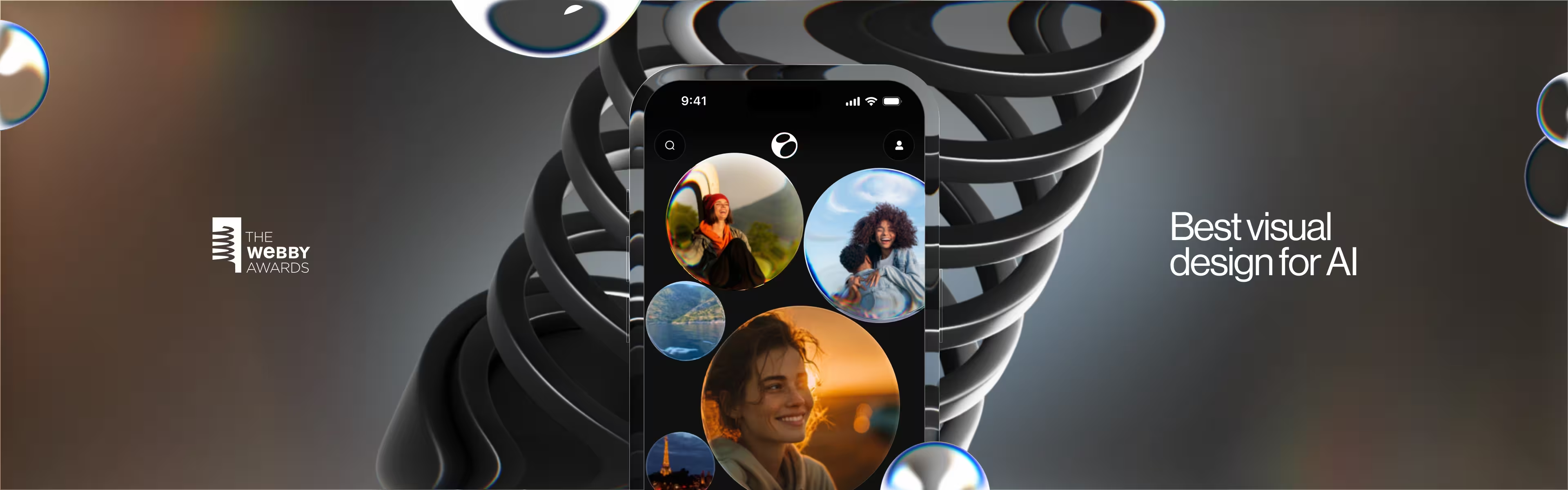
For the third year running, the International Academy of Digital Arts and Sciences has handed a Webby in an AI category to a project designed by Lazarev.agency. The latest is Elva, a voice-first AI video editor the San Francisco-based agency designed end to end. At the 30th Annual Webby Awards in April 2026, Elva took the Visual Design in AI Award, the Webbys' newly expanded suite of dedicated AI categories.
The agency was previously recognized for VT.news in 2025, in the Responsible Technology / Responsible Information category, and for Accern's NoCode Generative NLP platform in 2024, in Features & Design / Best Homepage. With Elva added in 2026, the record now reads three Webby cycles in a row, three different AI products, three different categories, one agency.
Explore how Elva, VT.news, and Accern were built along with the rest of our work in our case studies.
Where this Webby sits
The Webby Awards have honored work on the internet since 1996, and have been called "the Internet's highest honor" by The New York Times. Each season the International Academy receives more than 30,000 entries from over 70 countries. Two paths exist to a trophy: the jury's Webby Winner pick, and the People's Voice Award, decided by a global public vote. The Academy also designates Honorees — the top of the field who placed but did not win.
AI is not new to the Webbys. Back in 2025, the Webbys announced a full dedicated suite of AI categories — split between "AI Experiences & Applications" and "AI Features & Innovation" — to reflect how comprehensively AI has reshaped consumer software since the prior cycle. AI – Visual Design, the category Elva won, lives inside that expanded suite. So does Best AI User Experience. So do Best AI Agent, Best Use of AI Voice & Conversational Interface, and Best Responsible AI Implementation. The point of the expansion was that one or two AI subcategories no longer described what was being built; the Academy now needs the full taxonomy to keep up.
That is the room Elva won in. The 2026 Webby AI honors went to Anthropic's Claude Code (Best Product or Service, AI Features & Innovation), Google Gemini 3 (Best AI Technical Achievement), Waymo Safety Hub (Best Responsible AI Implementation), Flow (Creative Tools, AI Experiences & Applications), and Elva — designed by Lazarev.agency — for AI – Visual Design. It is a peer group made of the largest consumer-AI teams in the world, and Lazarev.agency is in it.
What Elva is
Elva, backed by Roosh, is a voice-first AI video editor for mobile. The user speaks a request — "make a travel reel from last weekend," "put together something fun from the kids' birthday" — and Elva selects clips from the camera roll, cuts to rhythm, scores the cut to a mood, and produces a social-ready video. There is no timeline, no layer stack, no manual editing.
The full product case study covers the brand identity, the AI persona, the agentic conversation design, the voice-first in-app UX, the intelligent in-viewfinder camera, the onboarding funnel, and the context-aware monetization layer — every layer of the product, designed by the same team, shipped together. Want to get more details on the branding side? Check our branding case study.
Why "best UI for AI" is its own discipline
AI product design does not behave like the app design that preceded it. Traditional apps assume a user driving a predictable path through taps on a known interface. AI products invert that assumption: the user expresses intent, and the product reasons, selects, and produces. The UI is no longer the navigation surface — it is the place where capability becomes usable. That makes the interface the highest-stakes layer in the entire build, and it is the layer the Webbys have now repeatedly singled out.
An AI interface has to introduce the model before the user has a mental model of it. It has to ask clarifying questions without breaking flow. It has to show progress on something the user can't see. It has to surface premium features without interrupting. It has to fail without losing trust on the next prompt. It has to explain its own reasoning to a user who needs to override it. Those are AI UX and AI UI questions, and they are the questions Lazarev.agency has now been recognized for answering on the Webbys' biggest stage, three years in a row.
AI-native since 2017 — the longitudinal proof
Most agencies marketing themselves as "AI design agencies" today are months old. Lazarev.agency has been designing AI products since 2017 — eight years before this article was written, and well before "AI-native" entered the design industry's vocabulary. Over that time the team has shipped 30 AI products, more than 500 products in total, and worked with companies backed by Tribe Capital, Allianz Strategic Ventures, Fusion Fund, Plug and Play Ventures, 10X Capital, Viaduct Ventures, and others.
The Webby record is the public, longitudinal version of that argument. Accern in 2024 — recognized for Best Homepage with the launch of Rhea, the agentic research tool that took the company from Series B to an eight-figure acquisition. VT.news in 2025 — recognized in Responsible Information for an AI news platform that scans 130,000 sources and presents three-perspective summaries with a measurable bias scale. Elva in 2026 — Winner in Visual Design for AI Award for the voice-first video product. Different products, different categories, different problems, solved by the same operating system: brand, AI persona, AI UX, AI UI, agentic interaction model, and monetization treated as one decision.
Model quality is no longer the hard part of building an AI product. The interface is. A capable model paired with a confusing UI is a lost product, and across three consecutive Webby cycles the Academy and the public have voted for the same agency to solve that layer.
Kirill Lazarev on the win
"The Webbys expanded the AI category suite because AI products had become the products. We won the Visual Design for AI Award inside that expanded suite — for Elva — and that is on top of three consecutive years of Webby recognition for AI products. We were designing AI products in 2017, when no one was using the word 'AI-native' yet. The interface is the un-automated layer in an AI product. We have spent eight years getting that layer right, and the public just voted on it again."
{{Kirill Lazarev}}
Thank you
Three Webby cycles, three AI products recognized. None of these wins happen without the people who voted, the clients who trusted Lazarev.agency with the full scope of their AI products, and the design, UX, research, brand, and strategy teams who shipped each system end to end.
To everyone who voted for Elva at the 30th Annual Webby Awards — thank you. To the Elva team for trusting us with the entire product, including the brand, AI persona, voice-first UX, the intelligent camera, and the monetization system — thank you. And to every Lazarev.agency team member behind the past three years of Webby-recognized AI work — Accern, VT.news, and now Elva — this record is yours.




.webp)