

AI can be the engine behind better decisions and smarter workflows, be it launching a new product or optimizing systems you already run. Yet, integrating it well takes more than code.
AI consulting firms bring clarity and precision to that process. Adoption itself is no longer the differentiator, since most organizations already use AI in some form. The harder task is turning it into measurable business impact, and that is where the right AI consulting partner earns its keep.
This guide compares seven AI consulting firms from around the world so you can decide who fits your goals for AI solution development.
Key takeaways
- Fit beats fame: the right firm is the one whose expertise, delivery model, and track record match your goals and stage.
- The value spans the full arc of AI strategy and custom builds, integration and team enablement, and ongoing optimization; the build itself is only the starting line.
- Firm type should follow your stage: boutique product studios when AI lives inside the product, global networks for scale and compliance, and specialist engineering firms for cost-conscious growth.
- Vet on evidence: quantified outcomes, verifiable recognition, and transparent engagement terms are what separate strong firms from the rest.
How this comparison was built
A comparison is only as trustworthy as the criteria behind it, so it helps to know how these seven firms were selected before reading the profiles.
Rather than ranking by reputation or brand size, each firm was evaluated against the same four criteria. Together, they separate firms that can point to verifiable proof from those that rely on positioning alone:
- Industry recognition: verifiable, juried awards and independent analyst placements.
- Proven track record: named clients and quantified outcomes.
- Clear industry focus: a defined specialization or set of sectors the firm serves well.
- Transparent engagement terms: a stated minimum project size or engagement model and a visible portfolio, so buyers know what they're signing up for.
The 7 AI consulting firms compared
The table below summarizes all seven firms side by side, covering their core services, the clients they work with, who each one suits best, and where they operate. Use the same lens from the four criteria above as you read across the rows, then dig into the profiles that follow for the detail behind each summary.
1. Lazarev.agency
Headquartered in San Francisco, USA, Lazarev.agency has been an established player in the AI-first design world since 2015. Known for expertise in AI-native UX/UI design, the studio combines creative craft with seasoned technological expertise. With a team of 30+ specialists, it has earned over 120 international design awards.
Key services:
Industry recognition:
- 3× Webby Awards Winner: Lazarev.agency website (2022), Kin Foundation (2023, 2x), Elva (2026)
- 5x Webby Awards Honoree: NODO (2023), Accern (2024), VT News (2025, 2x), and StreamWork (2026)
- 5× Red Dot Awards
- 2022 Designer of the Year Nominee by CSS Design Awards
Notable AI-native product designs: three recent projects show how Lazarev.agency approaches AI-native product design across very different product types.
Elva (agentic AI video editor). Lazarev.agency delivered end-to-end design for a voice-first mobile app that turns raw camera-roll footage into finished, social-ready clips with no manual editing. The work spanned the AI's brand and expressive persona, a conversion-focused onboarding funnel, a zero-tap voice interaction model, and a context-aware monetization storefront, shipped as one connected launch system.

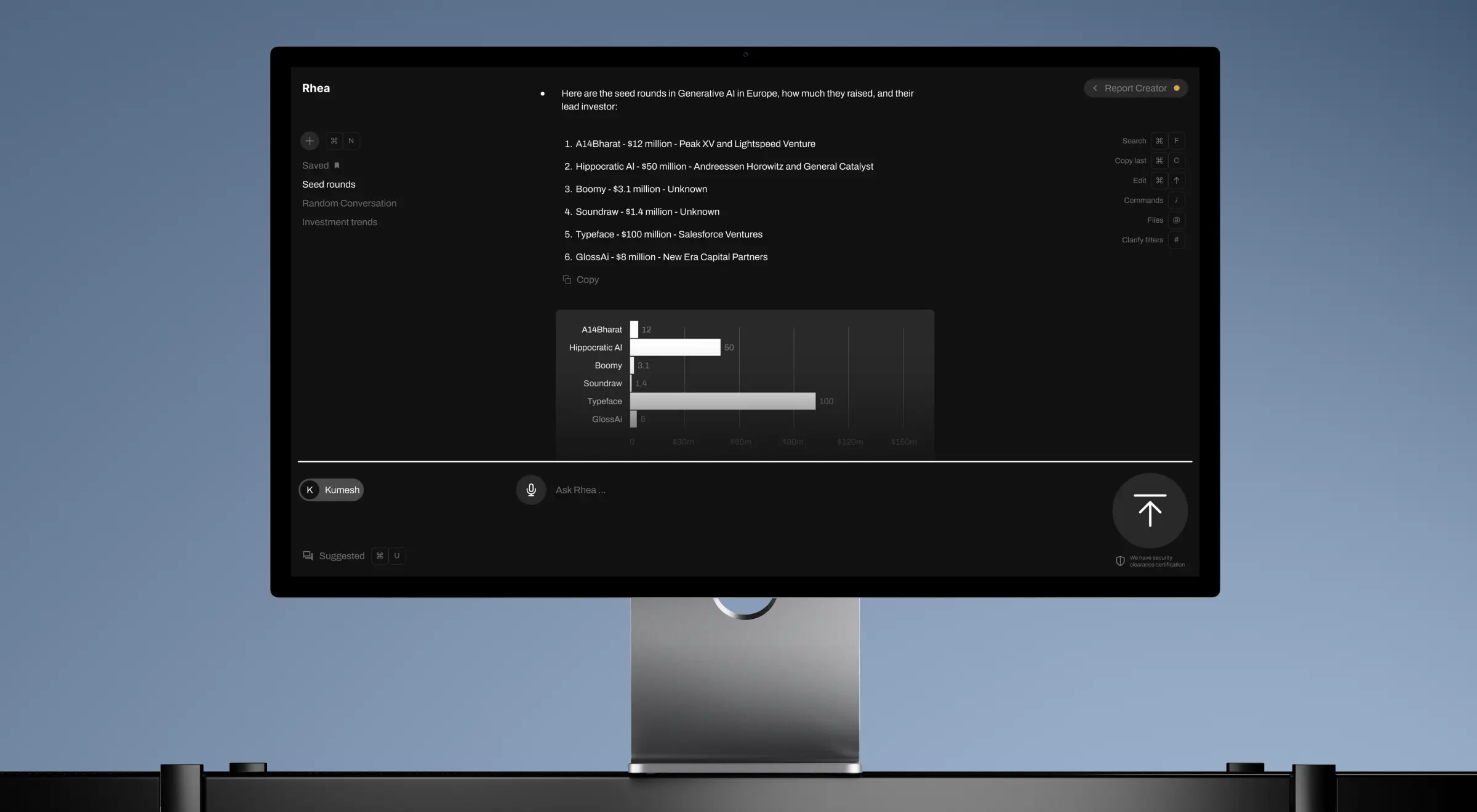
Accern.Rhea (AI financial research tool). For Accern, a leading U.S. natural language processing (NLP) company, Lazarev.agency designed Rhea, an AI research tool for financial analysts, VC investors, and ESG specialists. A hybrid interface pairs prompt-driven AI with dynamic widgets and an adaptive natural-language system that asks clarifying questions, and the product helped propel Accern from Series B to an eight-figure acquisition.
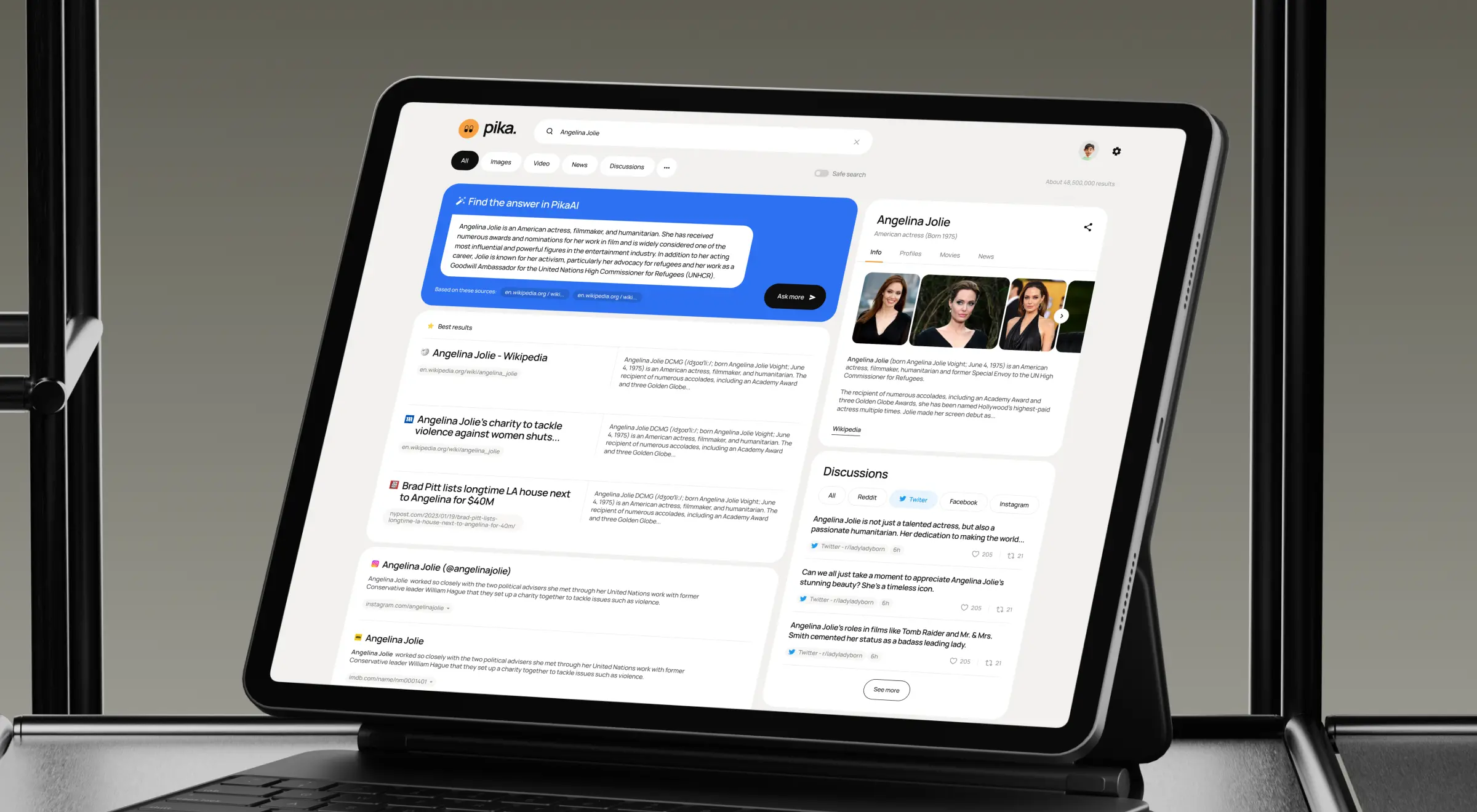
Pika AI (next-gen AI search platform). Lazarev.agency designed the interface for an AI-powered search engine built to shorten the path from query to answer. A familiar, convention-based entry point, an F-pattern results layout consistent across mobile and desktop, a prominently placed AI chat, and an intent-based widget system make the product's advantage visible within a single session.
Firm strengths: The studio is recognized for AI UI/UX proficiency, a strong design portfolio, innovative design approach, proven client outcomes, and a partnership mentality. Its work centers on helping teams design AI products that users understand and adopt.
2. Accenture
Accenture is a global professional-services firm headquartered in Dublin, Ireland, with a team of approximately 779k employees and operations in about 120 countries. Founded in 1989, Accenture offers a wide range of services, including strategy and consulting, technology integration, and digital business transformation.
Services:
- Strategy and consulting
- Technology services
- Operations
- Accenture Song (formerly Interactive)
- Industry X
Awards:
- IDC 2024 Services CSAT Award for Digital Business Transformation
- Named a Leader in the 2025 Gartner® Magic Quadrant™ for Outsourced Digital Workplace Services
Firm strengths: Accenture is distinguished by its global reach, diverse industry expertise, and strong focus on innovation and technology integration.
3. Classic Informatics
Founded in 2002 and headquartered in Gurugram, India, Classic Informatics is a global digital product engineering and technology consulting company with offices in India, the UK, and Australia. With 250+ experts, the firm delivers scalable solutions for startups, scale-ups, and enterprises worldwide.
Services:
- Digital product engineering
- Custom software development
- AI/ML
- Data engineering
- Cloud and DevOps
- CX consulting
- Dedicated development teams
Firm strengths: Classic Informatics focuses on AI-driven engineering, agile delivery, and cost-effective execution. With capabilities in machine learning and data engineering, the firm builds scalable products supported by transparent project management and a product-first approach.
4. Board of Innovation (BOI)
Board of Innovation (BOI) is a global innovation consultancy that helps businesses develop AI strategies and transformative solutions. Established in 2009 with offices across Europe, the Americas, and Asia, BOI works from a vendor-neutral, hands-on approach to consulting.
Services:
- AI strategy and transformation
- Innovation consulting
- Business model design
- Technology development
Firm strengths: Board of Innovation is recognized for deep industry expertise and extensive experience in AI transformation. Its work pairs well with a structured AI transformation roadmap for teams moving from pilot to production.
5. QuantumBlack (a McKinsey company)
QuantumBlack, a McKinsey company, is a global specialist in AI-driven business solutions, combining advanced analytics with machine learning expertise. Founded in 2009 and headquartered in London, the firm was acquired by McKinsey in 2015 and integrates AI into business strategies to deliver measurable outcomes. With a global team of specialists, QuantumBlack's collaboration with McKinsey blends technology with strategic consulting.
Services:
- Advanced analytics
- Machine learning
- AI-driven business solutions
- Data engineering
Firm strengths: QuantumBlack combines advanced AI with human insight, creating a "hybrid intelligence" that supports decision-making and innovation across organizations.
6. PwC (PricewaterhouseCoopers)
PwC is a leading professional-services network with a strong presence in AI consulting, offering a blend of technological and industry expertise. With a workforce of more than 364k professionals across 136 countries, PwC combines global reach with local insight.
Services:
- AI and data analytics
- Digital transformation
- Cybersecurity
- Risk assurance
- Tax advisory
- Industry-specific consulting
Awards:
- #5 on LinkedIn Top Companies United States 2024
- #22 on Fortune's 100 Best Companies to Work For® 2024
- TIME's Best Companies for Future Leaders 2025
Firm strengths: Clients value PwC's ability to integrate AI into business processes while maintaining compliance, efficiency, and strategic growth, which makes it a common fit for regulated industries.
7. Boston Consulting Group (BCG)
Boston Consulting Group (BCG) is a global management consulting firm known for strategic depth and innovative solutions. Founded in 1963 by Bruce Henderson, BCG has grown to over 33,000 employees across more than 100 cities in over 50 countries.
Services:
- AI and machine learning
- Digital transformation
- Business strategy
- Organizational design
- Operations
- Sustainability
Awards:
- #1 in Vault Consulting 50 North America
- #1 for Best Consulting Firms for Benefits
- #1 for Best Consulting Firms for Compensation
Firm strengths: Clients and employees commend BCG for deep industry expertise, an innovative approach to problem-solving, and a commitment to delivering sustainable competitive advantage.
AI consulting vs. traditional IT consulting
Unlike traditional IT consulting, which often focuses on system maintenance, infrastructure, or general tech support, AI consulting centers on applying advanced technologies to drive business transformation. A mature AI practice includes responsible AI frameworks to ensure transparency, fairness, and compliance, especially when implementing AI at scale.
These firms often come with a proven track record, supported by global teams of specialists who use advanced tools to develop and optimize solutions. In contrast to traditional IT, AI consultants focus on unlocking new value, helping companies innovate faster and more intelligently.
How AI consulting delivers value
Data insight: The global AI consulting services market is projected to grow from $11.91 billion in 2026 to $73.89 billion by 2034, according to Fortune Business Insights. That trajectory signals sustained demand for partners who can move organizations from experimentation to results.
AI consulting companies sit at the center of this market transition, helping businesses navigate the complexities of AI transformation. Here's how they deliver value:
- AI strategy development: It starts with a plan. Consultants help define clear business goals, pinpoint where AI will have the most impact, and map a roadmap with measurable outcomes. A well-sequenced AI product roadmap keeps that work tied to business priorities.
- Custom AI solutions: Top firms design and integrate custom AI models that solve specific challenges and drive efficiency.
- Implementation: Integrating AI can disrupt workflows or enhance them. The right partner ensures smooth integration into existing systems, aligning tools with processes and teams.
- Team enablement and training: Even the best AI systems need human champions. Consultants offer hands-on training and support to upskill teams, foster adoption, and build long-term capability. Strong AI change management is often what separates a successful rollout from a stalled one.
How to choose the right AI consulting firm: 4 key steps
Choosing the right AI consulting firm means finding the one aligned with your goals. The ideal partner will help you plan, build, and scale AI solutions relevant to your product. Below are 4 steps to help you make an informed decision:
- Define your goals. Clarify the problems you want to solve and the outcomes you're aiming for. You don't need all the answers, just a clear vision. A structured product discovery process helps surface the right problems before any build begins.
- Compare firms. Talk to multiple providers. Review their track record, ask for proposals, and confirm they understand your business and budget.
- Check their results. Look for case studies that match your needs. A solid portfolio, current AI expertise, and measurable results are strong signals.
- Pick the right fit. There's no universal winner, just the best fit for your challenges. A great AI consulting firm won't only deliver a service; it will help shape your strategy and future-proof your business.
What experienced AI consultants want you to know
Teams that get the most from AI consulting tend to do three things well: they target the highest-value use cases, integrate without disrupting the business, and keep optimizing after launch. Here is how seasoned practitioners frame each one.
1. Target the use cases where AI pays off
The biggest waste in AI projects is building the wrong thing well. Before any development, a strong consulting partner audits your operations to find where AI moves a real metric, then sequences the work by expected ROI so the first project earns trust and budget for the next.
"Before diving headfirst into AI development, it's crucial to identify where it will deliver the most impact. AI consulting agencies act as your strategic compass, analyzing your business from top to bottom to pinpoint the areas ripe for AI integration. This strategic planning helps in identifying where AI will deliver the most impact, ensuring that resources are allocated efficiently."
{{Kirill Lazarev}}
2. Integrate AI without disrupting the business
Adoption fails more often on change management than on technology. The strongest partners map AI into existing systems and workflows, then bring people along with training and clear communication so the rollout enhances daily work.
"Integrating AI into a business is like fine-tuning a symphony: precision is key. AI consulting firms bring deep industry expertise and a custom approach to ensure the process is smooth and disruption-free. They assess your current systems, workflows, and goals to create a roadmap for smooth integration."
{{Oleksandr Holovko}}
3. Keep optimizing long after go-live
An AI system is never finished. Models drift, data shifts, and business goals evolve, so continuous monitoring and tuning are what keep performance and ROI climbing after launch.
"The continuous improvement and support of generative AI solutions, as part of comprehensive AI services, can significantly enhance their effectiveness over time. Performance monitoring is necessary to evaluate the success of an AI strategy post-implementation, ensuring that the solutions remain effective and aligned with business goals."
{{Anna Demianenko}}
These three habits explain why the firms that deliver lasting value stay involved well past deployment. The build is the starting line. Adoption and optimization are where the return compounds.
Find the AI consulting firm that fits your stage
There's no single "best" AI consulting firm, only the best fit for your goals, stage, and industry. The comparison above is built to help you decide, so use the "Best for" column and the selection methodology as your shortlist filter.
- Early-stage and scaling product teams that need AI built into the product experience are usually best served by focused studios with strong product-design and engineering craft.
- Large or regulated enterprises that need global delivery, compliance depth, or management-consulting integration will lean toward the global networks.
- Mid-market companies balancing cost and scale often land with specialist engineering firms.
Before you commit, run each shortlisted firm through this quick checklist:
- Shows quantified outcomes on problems similar to yours.
- Has a clear specialization that matches your industry and stage.
- Offers transparent engagement terms and a delivery model that fits your budget.
- Can point to verifiable recognition such as juried awards, analyst placements, or named clients.
- Covers the full arc from AI strategy and build to integration and post-launch optimization.
- Plans for change management and team enablement alongside the technical build.
- Has a clear approach to data security and responsible AI.
Score each firm against these points, the four selection criteria, and the FAQs below. The right partner turns AI from a line item into real results: smarter decisions, faster growth, and products that scale.
Ready for AI-native UX/UI design? If your team is moving from AI strategy to a product people want to use, Lazarev.agency partners with founders and product teams on the design that makes AI usable, trustworthy, and ready to scale.
Get in touch to see what that could look like for your product.

.webp)