

A solid partner shares a redacted report, explains prioritization, and commits to a handoff plan for the first sprint.
Choose UX audit companies that publish their framework and show deliverables upfront!
That discipline separates audits that move metrics from reports that sit unopened.
Key takeaways
- Start with transparency. Choose UX audit companies that clearly publish their audit framework, severity scales, and sample deliverables.
- Verify proof. Look for real case studies, before/after flows, and redacted reports.
- Expect hybrid methods. Strong partners mix heuristics, analytics, research, and light usability testing.
- Check reviews with context. Clutch stars + review count + recency matter more than score alone.
- Ask for a handoff plan. Good audits end in a prioritized roadmap your team can ship in the next sprint.
How we picked our list of UX audit companies
We focused on 3 important things:
- A visible UX audit process and deliverables (scope, heuristic evaluation, analytics setup, research plan, comprehensive report with severity).
- Proven outcomes in public cases or write-ups (flows simplified, onboarding clarified, user journey friction removed).
- Credible Clutch presence with current ratings and verified reviews.
🔍 When you compare UX audit companies, a quick way to pressure-test proposals is to see how they handle competitive analysis. For a clear, practical walkthrough, use our guide: “How to run competitive audit UX: framework, methods, tools, and real-world example.”
Top UX audit companies to consider in 2026
1) Lazarev.agency — AI UX design agency offering product growth audits for AI, fintech, SaaS
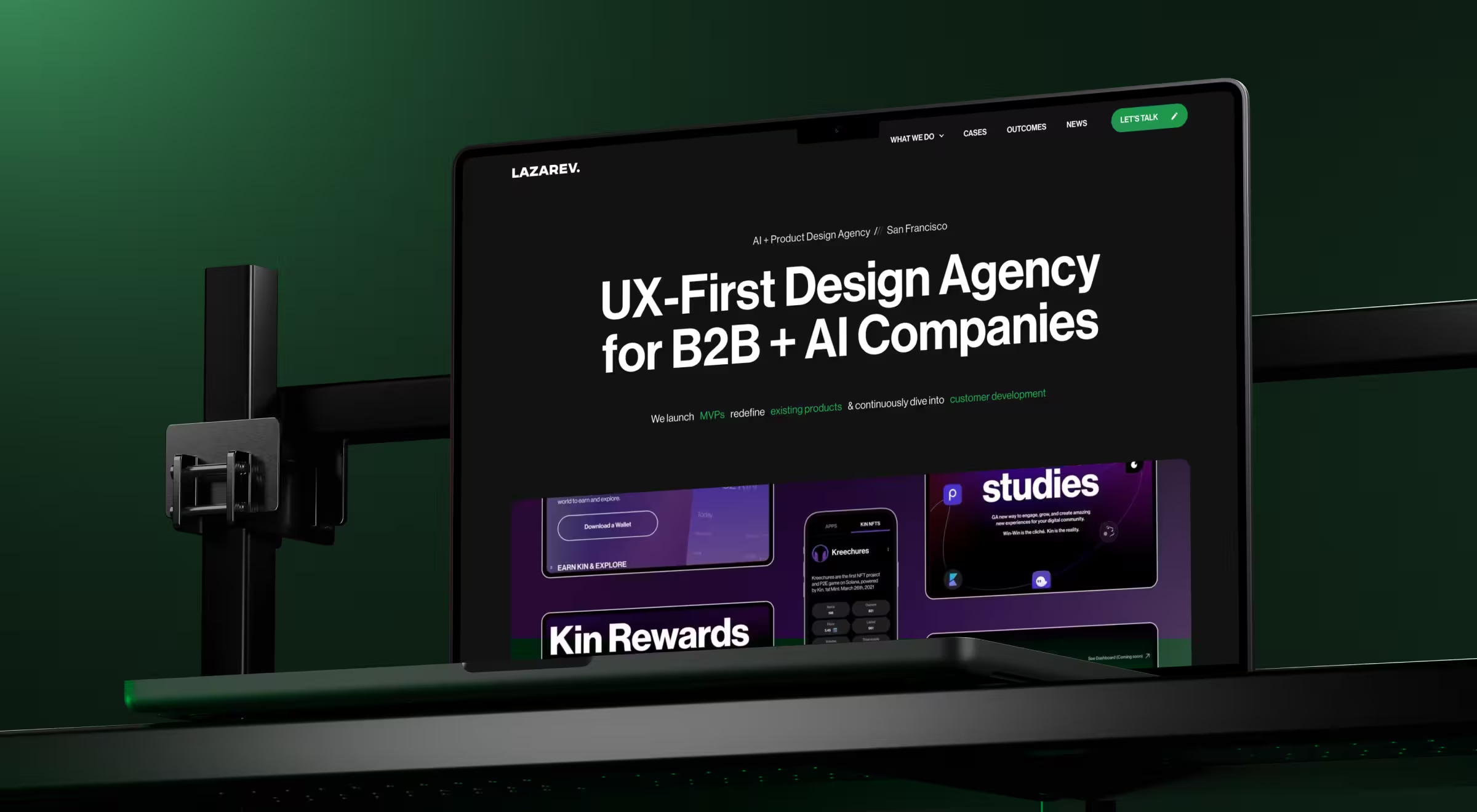
If you need a UX audit that bridges design craft and business outcomes, start here.
Lazarev.agency publishes a clear UX audit scope and pairs findings with product strategy, information architecture, and usability testing when needed. See the UX audit service page for scope, artifacts, and engagement format; plus dedicated UX research services and usability testing services pages if you need deeper studies alongside the audit.
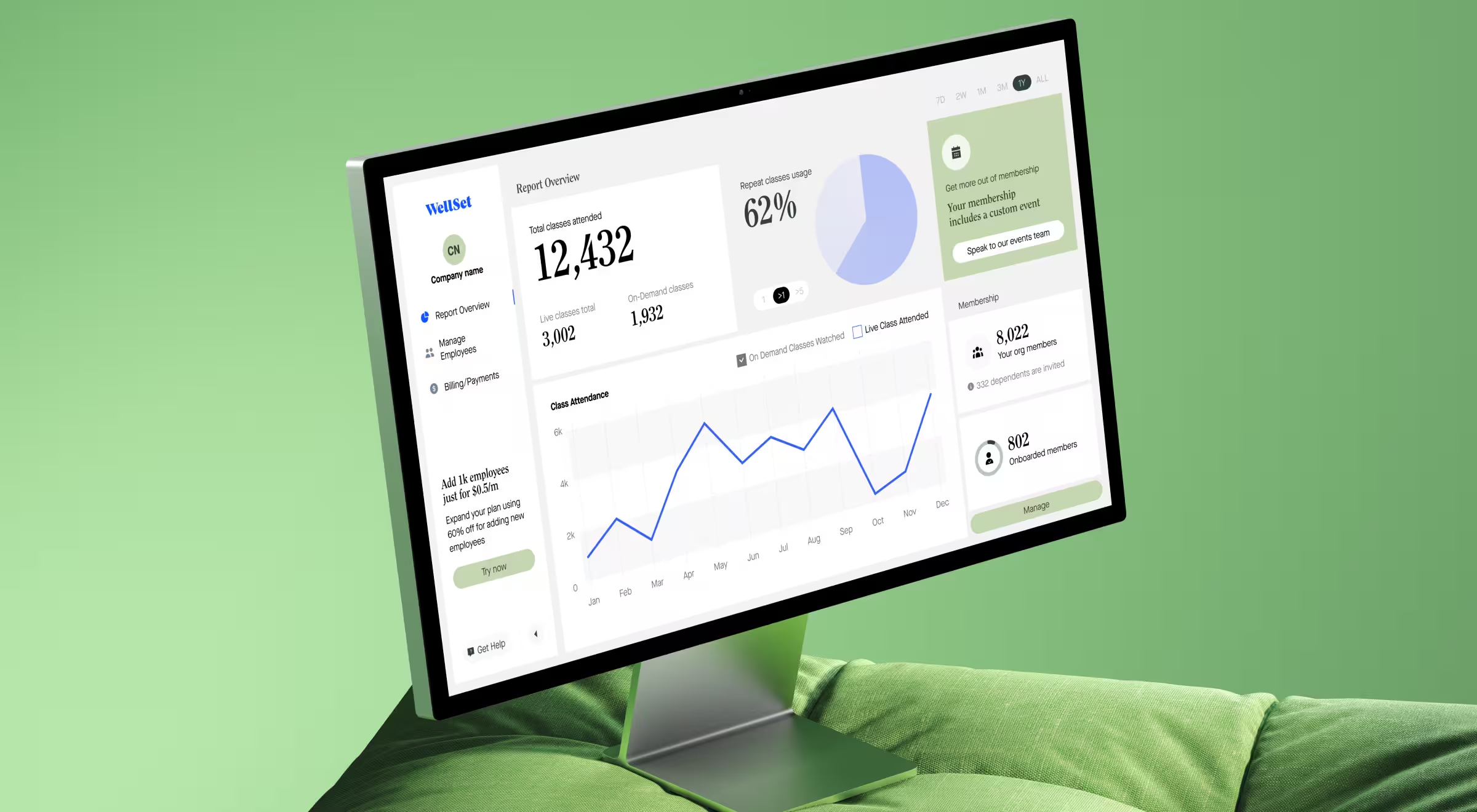
Relevant work: The WellSet platform redesign (500K+ users) shows how research-driven design lifted engagement and retention.
“A UX audit only works if it brings decisions. Tie every finding to a business lever — Adoption, Activation, Retention, Monetization — or it’s just trivia.”
{{Kirill Lazarev}}
Where Lazarev.agency fits: early MVPs before a pivot, post-PMF cleanup, or enterprise UX where user flows and error handling have grown complex. You’ll get a clear set of fixes tied to your goals and plugged into the roadmap.
Clutch rating: 5.0 (19 reviews). See case studies.
2) Clay — enterprise-grade design systems and validation
Clay is a San-Francisco firm known for product design and design systems at scale.
Clay focuses on enterprise product design and design systems. In audits, they review key user journeys and UI states, pattern consistency, then deliver a short, prioritized fix list.
Clutch rating: 4.8 (31 reviews). See case studies.
3) Ramotion — structured audit content and UX metrics thinking
Ramotion publishes practical content on how to conduct a UX audit and UX metrics, which shows up in their engagements.
If you want a report that blends heuristics with measurement and user behavior analysis, this philosophy helps.
Clutch rating: 4.9 (29 reviews). See case studies.
4) Momentum Design Lab — complex, data-heavy products
Momentum Design Lab is a long-standing product design shop with depth in enterprise software and data-rich interfaces.
If your team needs a partner comfortable with gnarly workflows and interactive elements, add them to your RFP.
Clutch rating: 4.8 (93 reviews). See case studies.
5) Eleken — SaaS-focused audits with clear report formats
Eleken runs transparent UX audits for SaaS, shares report structures, and explains when audits vary depending on constraints (timeline, scope, resources).
If you need fast audit insights that still land as actionable recommendations, they’re worth a look.
Clutch rating: 4.9 (111 reviews). See case studies.
6) UX studio — research-heavy approach and dedicated audit offer
UX studio explicitly lists UX audit under services, with language about exposing pain points, usability issues, and quick wins.
Solid fit when you want heavier user research and user interviews baked into the review.
Clutch rating: 5.0 (39 reviews). See case studies.
7) Adam Fard UX Studio — quick, focused reviews
Adam Fard UX Studio publishes a lot about audits, including rapid formats and heuristic analysis.
If you need to conduct a UX audit quickly before a pitch or a sprint, this style can help.
Clutch rating: 5.0 (34 reviews). See case studies.
8) Qubstudio — strong delivery record and audit engagements
Qubstudio shows consistent feedback on quality and velocity, plus examples of visual/design audits for fintech.
Will be helpful when visual design consistency is your primary gap.
Clutch rating: 4.9 (86 reviews). See case studies.
How to compare UX audit companies
- Fit your context — B2B digital products, consumer mobile applications, or enterprise software have different constraints and user expectations.
- Scope and speed — do you need a thorough UX audit (4–6 weeks) or a faster pass to unblock new features?
- Evidence — ask for an outline of their audit process and how the report serves prioritization.
- Clutch star rating plus count, and how recent the feedback is — that combination is a better proxy than stars alone.
🔍 For additional guidance on selecting the right partner, here’s a concise breakdown on hiring a design agency.
What to expect from UX audit services today
A good partner will:
- Align the audit to your business objectives and prioritized outcomes.
- Combine heuristic evaluation with analytics review and lightweight usability testing or ad-hoc user interviews where it matters.
- Trace findings through the user journey, surfacing critical usability issues and gaps in information architecture, visual design, and user flow logic.
- Deliver a comprehensive evaluation and a final report that ranks severity, lists actionable insights, and sequences UX enhancements on your product roadmap.
- Call out where conversion rates and customer satisfaction are at risk.
💡 Pro tip: Ask to see a redacted report sample before you sign. You need clear communication, screenshots with annotated issues, and actionable recommendations that your internal teams can ship in sprints.
What a UX audit report should look like with UX audit report examples from leading standards
A UX audit is only as strong as the report it produces, and the best UX audit companies follow well-established patterns defined by institutions such as Nielsen Norman Group, Baymard Institute, W3C Web Accessibility Initiative, and GSA’s Usability.gov guidelines. When evaluating agencies, ask to see redacted UX audit report examples — it’s the clearest way to assess their methodology, depth, and clarity.
What a professional UX audit report includes
Based on widely recognized UX research standards (in particular we base this section on approaches of NN/g, Baymard, and Usability.gov), a report should contain:
1. Executive summary with high-value findings
A concise, decision-ready layer that outlines the most severe usability issues, the affected user journeys, and predicted impact on conversion, activation, or support load.
2. Clear problem statements supported by evidence
Each issue should include:
- annotated screenshots
- heuristics violated (e.g., Jakob Nielsen’s 10 heuristics)
- affected user scenarios
- analytics proof (bounce rate spikes, drop-offs, rage clicks if available)
3. Severity rating tied to business KPIs
Not all issues are equal. Leading audit frameworks (NN/g + Baymard metrics) classify issues using:
- severity score (0–4 or 0–5)
- frequency
- impact on task completion
- business cost (conversion loss, user frustration, support load, churn risk)
The best UX audit companies map findings to Activation, Retention, Monetization, LTV uplift, or funnel stages.
4. Recommendations with prioritized roadmap
A UX audit report is a decision tool. Do not consider it as one more document. Top agencies provide:
- fast-fixes (“week 1–2 sprints”)
- structural redesign recommendations (“next quarter”)
- system-level improvements (design system, IA restructuring)
5. Accessibility review (WCAG 2.2)
A professional audit report includes accessibility findings mapped to:
- WCAG 2.2 levels A, AA
- color contrast issues
- keyboard navigation failures
- missing ARIA roles
6. User behavior validation
When available, leading UX audit companies embed:
- insights from usability testing
- quick interviews
- session replay analysis (Hotjar/FullStory)
💡 The GSA Usability Guidelines explicitly recommend combining qualitative and behavioral data for higher accuracy.
How to evaluate UX audit report quality in five minutes
Use this checklist derived by Lazarev.agency UX designers from NN/g, Baymard, and Google’s UX playbooks:
- Does every finding include visual evidence + context?
If not, implementation will fail. - Are severity ratings tied to business metrics?
Best-in-class audits map usability issues to conversion or retention. - Is there a clear recommended product roadmap?
Reports without prioritization do not move product metrics. - Does the report mix qualitative, quantitative, and heuristic insights?
Pure heuristic audits are outdated — hybrid evidence is now the standard. - Did the agency provide UX audit report examples before the contract?
Transparency signals maturity. Top companies (including Lazarev.agency) always show samples.
Where Lazarev.agency stands
Our UX audit reports follow the combined standards of:
- NN/g heuristic evaluation principles
- Baymard Institute’s validated UX research patterns
- Google UX Research frameworks
- WCAG 2.2 accessibility compliance
And enhance them with AI-driven diagnostics:
- automated pattern detection
- heatmap and interaction anomaly prediction
- system-level consistency scanning
- business-impact scoring powered by machine learning
The outcome our clients get is UX audit reports that product teams can implement immediately.
AI is now out-punching checklists in UX audits, if you know how to use it
The core value of a UX audit is prioritizing the right ones, at the right time, in the right context. Today’s best audits are powered by AI.
At Lazarev.agency, an AI UX design agency, we treat AI not as a fancy add-on but as a diagnostic accelerator for our partners.
Here’s how AI raises the bar:
- Automated pattern detection at scale. AI models ingest clickstreams, rage-click incidents, session replays, and prototype versions to spot hidden systemic issues — duplicate components, misaligned states, navigation loops — long before they manifest as user complaints.
- Predictive prioritisation rather than guessing. Leading UX-research institutes (like Baymard Institute) found that generic generative-AI audits yielded accuracy rates below 20%. Our method combines human-expert judgment + AI-driven metrics to assign severity scores tied to business metrics (activation, retention, LTV).
- Intelligent governance and learning loops. We leverage our role as an AI-driven design agency to feed audit outputs back into component libraries and design systems enabling continuous learning. The audit doesn’t end at “fix these issues” — it evolves the system so the next sprint hits harder and smarter.
Best-practice guardrails from Lazarev.agency AI designers:
- Always validate AI-generated findings against qualitative user research and domain context. AI flags, humans judge.
- Build explainable feedback. Research on human–AI collaboration in UX evaluation shows that AI tools deliver far better outcomes when they provide explanations and allow human synchronisation.
- Use AI as a co-pilot. The most valuable UX insights still come from empathy, domain knowledge, and strategic framing — AI just accelerates what you can do.
If your digital product has plateaued, an audit is a low-risk, high-signal move. It replaces “we think” with “we know” and gives you a prioritized list to fix usability issues, keep users engaged, and enhance customer satisfaction.
Planning your next UX audit? Let’s start with a quick discovery call!