

Strategic legal tech UX overhaul accelerates critical case wins and transforms research workflows for litigation teams.
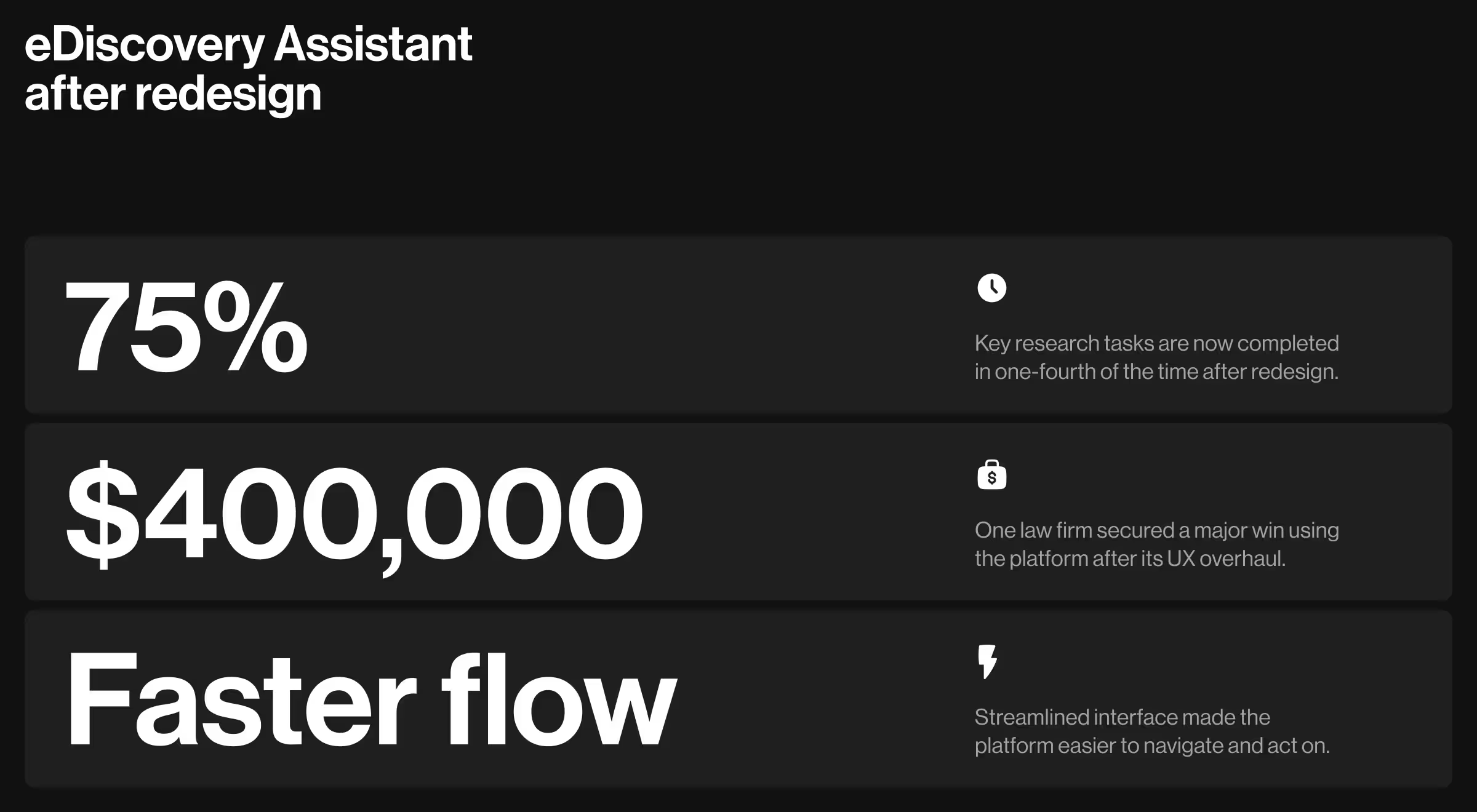
eDiscovery Assistant, a legal research platform built for litigation professionals, partnered with Lazarev.agency for a website revamp. The results were immediate and significant: a faster research flow, a 75% time reduction on key tasks, and a law firm using the platform secured a $400,000 case recovery after redesign.
Making legal search work at litigation speed
Legal teams face mounting pressure to act fast on expanding case law. Finding specific, high-stakes decisions buried in complex databases without wasting hours on broad keyword queries becomes burdensome.
eDiscovery Assistant, rebranded into Minerva26 in March 2025, recognized this bottleneck and identified the need to create a platform that delivers precise results in seconds, not hours.
Designing complexity into clarity
We approached this challenge strategically, offering actionable legal tech solutions to balance usability with the depth required by expert litigators. Key improvements covered basic design principles in the legal tech industry and included:
- One-click access to complex workflows like legal holds and conferences.
- An issue-based navigation system that replaces noisy keyword search with structured legal logic and a 2-tier dropdown menu.
- Optimized UI hierarchy enabling users to find relevant rules, cases, and checklists in under 3 clicks.
- Integrated learning resources (glossary, forms, checklists) to enhance user experience.
“In high-stakes litigation, clarity and speed are non-negotiable. We designed an interface that thinks like a legal expert and moves faster than one.”
{{Kirill Lazarev}}
Redesign that delivered a $400K legal win
With the new experience in place, eDiscovery Assistant went beyond a search tool. It became a litigation advantage. The redesigned platform empowered a law firm to navigate complex case law with speed and accuracy, directly contributing to a $400,000 case recovery.
Following our website redesign, eDiscovery Assistant delivered measurable improvements in both performance and user outcomes.
Key results include:
- 75% reduction in research time due to optimized workflows and intuitive issue-based navigation.
- From 45+ minutes to under 2 minutes to find relevant case law to leverage legal professionals’ daily productivity.
- Three-click access to critical legal insights that eliminated guesswork and improved accuracy in fast-paced litigation.
- Improved adoption among litigation teams due to simplified legal workflows and on-demand educational tools.
- $400,000 recovery secured by a law firm using the redesigned platform, which served as a direct outcome of clearer and more targeted legal research.
When UX translates to case wins
eDiscovery Assistant’s case study proves that experience design offers more than a usability upgrade. It becomes a distinct competitive advantage. Lazarev.agency turned legal complexity into a structured design solution, supporting faster decisions, improved outcomes, and real-world wins for legal teams.