

If your team is doing a lot of design work but still arguing about priorities or struggling to explain how design drives business forward, your problem is strategy. Or rather, the lack of one.
Design strategy is not an ephemeral mood board brainstormed on a Friday afternoon with no concrete metrics attached. Nor is it a 40-page PDF saturated with techno-babble that makes sense to a few members of your entire team (the tech-first guys, probably).
In this article, our AI UX designers delve into the anatomy of a future-proof design strategy. We break down what it is, when you need one, and how to use it without turning your team into a process cult.
Without further ado, let’s dig in.
Key takeaways
- The best design strategies start with intent. Clear business goals and evidence-based insights prevent design churn and misaligned work.
- While design strategy adapts to different industries, the core logic remains constant. E-commerce, SaaS, Web3, and AI-first products require different optimizations, yet the rigor stays the same.
- When design strategy is done right, it compounds. Leading design strategy firms like Lazarev.agency demonstrate that a strategic design framework strengthens the business value proposition, reduces risk, and transforms design into a repeatable competitive advantage.
What’s the anatomy of a design strategy, and why does it matter now?
In 2026, design strategies evolved from focusing on visual appeal to becoming core business engines.
Of course, that paradigm shift didn’t happen overnight. Design has been moving upstream for years, steadily taking a seat at the strategy table.
Look at category leaders like Google or Figma. They operate in entirely different industries, yet both share a defining trait: alignment between business vision and brand identity.
That kind of coherence is the compound interest of a sustained design strategy. And yes, it pays off. Research backs this up.
💡Research insight: McKinsey found a strong correlation between high McKinsey Design Index (MDI) scores and superior business performance. Top-quartile MDI companies outperformed peers by 32% in revenue growth and 56% in total returns to shareholders over five years. Treat design strategically, and it becomes economic leverage.
At its core, an effective design strategy is a decision-making system. It ensures that every design action, like UI tweaks and AI UX patterns, reinforces tangible business outcomes.
A useful way to frame it is through three foundational questions:
- What business outcome are we optimizing for?
- Whose behavior are we trying to influence?
- How will design decisions consistently move both forward?
From these questions emerge the essential components of a design strategy:
- Business objectives: Revenue growth, customer retention, efficiency, and trust.
- User context: Needs, motivations, constraints, decision moments.
- Design principles: Rules guiding trade-offs under pressure.
- Execution system: Briefs, workflows, ownership, review criteria.
- Measurement: Metrics that tie design outputs to outcomes.
Why does it matter? Because without a design strategy, teams end up designing features. With one, they design outcomes.
What’s the difference between design strategy, UX strategy, business strategy, and product strategy?
Teams often use these terms interchangeably. Well, that’s a bummer. And a business risk.
Each strategy operates at a different altitude, solves a unique problem, and produces its own set of outputs.
Here’s a quick way to tell them apart:
As you may see, design strategy acts as the connective tissue. It takes raw business intent and reformulates it into cohesive design decisions.
🔍 For a deeper dive into how these frameworks differ, explore our expert guides on UX strategy glow up and product strategy framework.
Do you need a design strategy?
Most teams assume a comprehensive design strategy only starts to matter once growth kicks in and coordination becomes painful. Convenient story. Also wrong.
The signals show up much earlier.
“The moment design decisions start affecting revenue or how fast things run, not having a strategy starts to show. Typically, it unfolds like this: priorities get blurred, ownership fades, and cross-team decisions grind to a halt. It’s rarely about skill (people do know what to do) but about the absence of a shared framework guiding those decisions.”
{{Oleksandr Holovko}}
Not every project needs a heavy strategy deck, but when strategy does matter, teams often miss the signs. What looks like a hiccup in execution is usually something deeper.
We often see teams come to us when business goals and design decisions already drift in different directions. When that happens, design no longer drives progress. It (slowly but surely) starts holding your business back.
If you’re unsure where you stand, this checklist will make it obvious.
- Design decisions stall due to conflicting opinions.
- Features ship but don’t move key metrics.
- Design work feels reactive instead of directional.
- Brand consistency breaks across channels.
- Teams argue about execution instead of outcomes.
If two or more apply, the issue is the lack of a shared decision system. At that point, a design strategy is already overdue.
Good news, with the right research and strategy tools in place, the damage is reversible.
How do you create a design strategy for your next project?
“A design strategy is a decision framework developed to align teams before execution begins and keep design work anchored to outcomes when pressure mounts.”
{{Kirill Lazarev}}
Quite an action-driven definition, right? Like any tactical tool, design strategy is a forward-looking entrepreneurial approach with actual gains seen only in the rearview mirror. But the scenery that unfolds along the way is worth the drive.
We’ve seen it, we’ve built it. And we continue to pursue it with our clients.
Still, the mistake most teams make is jumping straight to solutions (layouts and product features) before agreeing on intent.
A strong design strategy reverses that order. It defines what business success looks like and how design choices will consistently move your business forward.
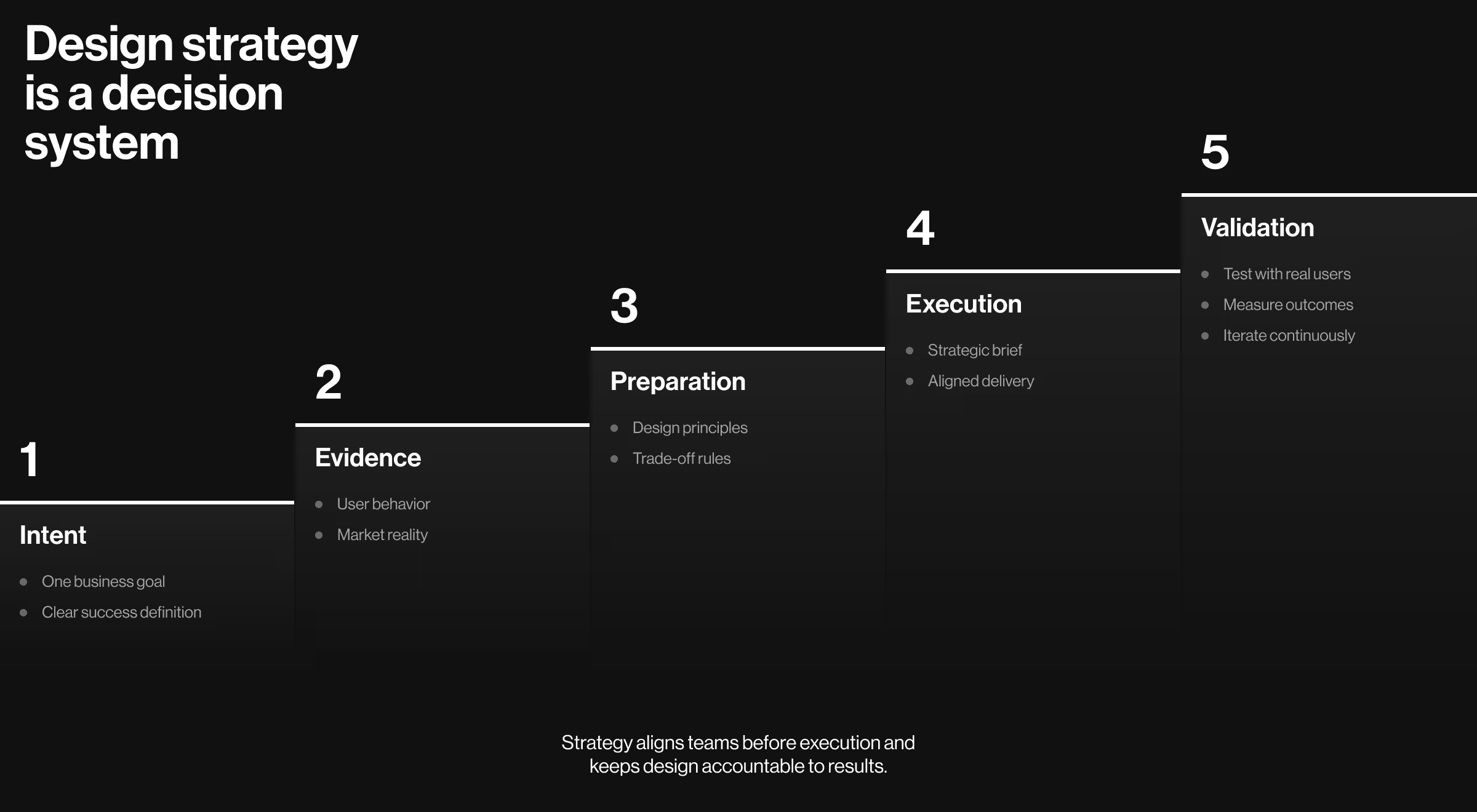
The steps below follow a deliberate progression:
1. Intent → 2. Evidence → 3. Preparation → 4. Execution → 5. Validation.
1. Define your chief business goal
🎯 Goal: Establish a single, non-negotiable outcome for design to support. This prevents debates and reframes design as a business lever.
Many teams claim they set business goals, but often stop at listing vague points that seem more like general company ambitions. The missing step is being specific and brutally focused.
📋 How it could look:
- Increase revenue by 15%.
- Double client capacity without increasing headcount.
- Shorten time-to-value for new users.
📗 Desired outcomes:
- Design decisions are evaluated against impact.
- Stakeholders align early on to avoid revisiting scope later.
- Design focuses on what actually needs to be done.
2. Gather evidence
🎯 Goal: Carry out market research and UX audit to elucidate how your target audience makes decisions in the industry-wide context. This step ensures that your future strategy aligns with competitive reality as well as real user preferences.
📋 Examples:
- Mapping where users abandon a flow (and why) and analyzing how those patterns compare to market benchmarks.
- Identifying decision bottlenecks.
- Analyzing behavior differences between new and returning users.
📗 Desired outcomes:
- Interfaces designed to minimize cognitive load.
- Fewer low-impact product features.
- Design decisions grounded in observed behavior and validated against market trends.
🔍 Curious about which UX research tools are right for your team? Read this expert guide to find out.
3. Set design principles to guide decisions
🎯 Goal: Create a small set of principles acting as guardrails when trade-offs are unavoidable.
📋 Examples:
- Clarity over novelty for conversion-driven products.
- Explain before automating for AI-powered interfaces.
- Speed beats completeness for MVP-stage platforms.
📗 Desired outcomes:
- Consistency across screens, features, and teams.
- Reduced design churn when priorities shift.
4. Create a strategic project brief
🎯 Goal: Convert your strategic intent (backed by gathered evidence, as we’ve mentioned above) into something designers, developers, product managers, and stakeholders can act on immediately.
📋 Examples of what a strong brief defines:
- Target audience and context of use.
- Product roadmap.
- Business goal and success metrics.
- Constraints (technical, legal, time).
- Known risks and assumptions.
- Explicit non-goals (what success does not look like).
📗 Desired outcomes:
- Fewer misaligned iterations.
- Clear ownership and accountability.
- Focused design work.
5. Test and validate
🎯 Goal: Avoid the trap of framing testing as the final step. Ensure the strategy survives contact with real users and real data. Treat validation as an ongoing part of a design process.
📋 Examples:
- A/B testing key interaction patterns.
- Measuring activation or completion rates post-launch.
- Reviewing support tickets and qualitative user feedback for friction signals.
📗 Desired outcomes:
- Evidence-based iteration instead of subjective debate.
- Measuring activation, retention, and task completion.
- Early detection of strategy gaps.
- A design strategy that improves with every release.
This structure forces alignment before execution and learning after launch. It defines design as an evolving system.
When followed consistently, design strategy becomes a repeatable way to ship better products, faster, and with more (backed-up) confidence.
How does design strategy adapt across products and industries?
Design strategy is not a universal template you apply once and reuse everywhere. It’s a context-sensitive system that depends on such variables as user intent, your business model, product vision, and risk tolerance.
What design optimizes for in e-commerce is fundamentally different from what it must solve in AI-first or Web3 products.
Below are industry-specific examples (with some grounded in Lazarev.agency’s hands-on work) showing how design strategy changes shape while staying outcome-driven.
1. E-commerce brands
E-commerce design strategy lives or dies by one thing. And it’s purchasing confidence. Users arrive with intent, but hesitation around value or trust kills conversion.
In this category, design strategy primarily optimizes for:
- Decision clarity (What am I buying? Why this one?)
- Emotional pull (Desire, identity, lifestyle fit)
- Speed to checkout (Minimal friction between intent and purchase)
A strong e-commerce design strategy typically looks like:
- Product-first layouts with minimal informational noise.
- Structured comparison paths instead of forcing users to self-navigate.
- Mobile-native flows, especially for repeat purchases.
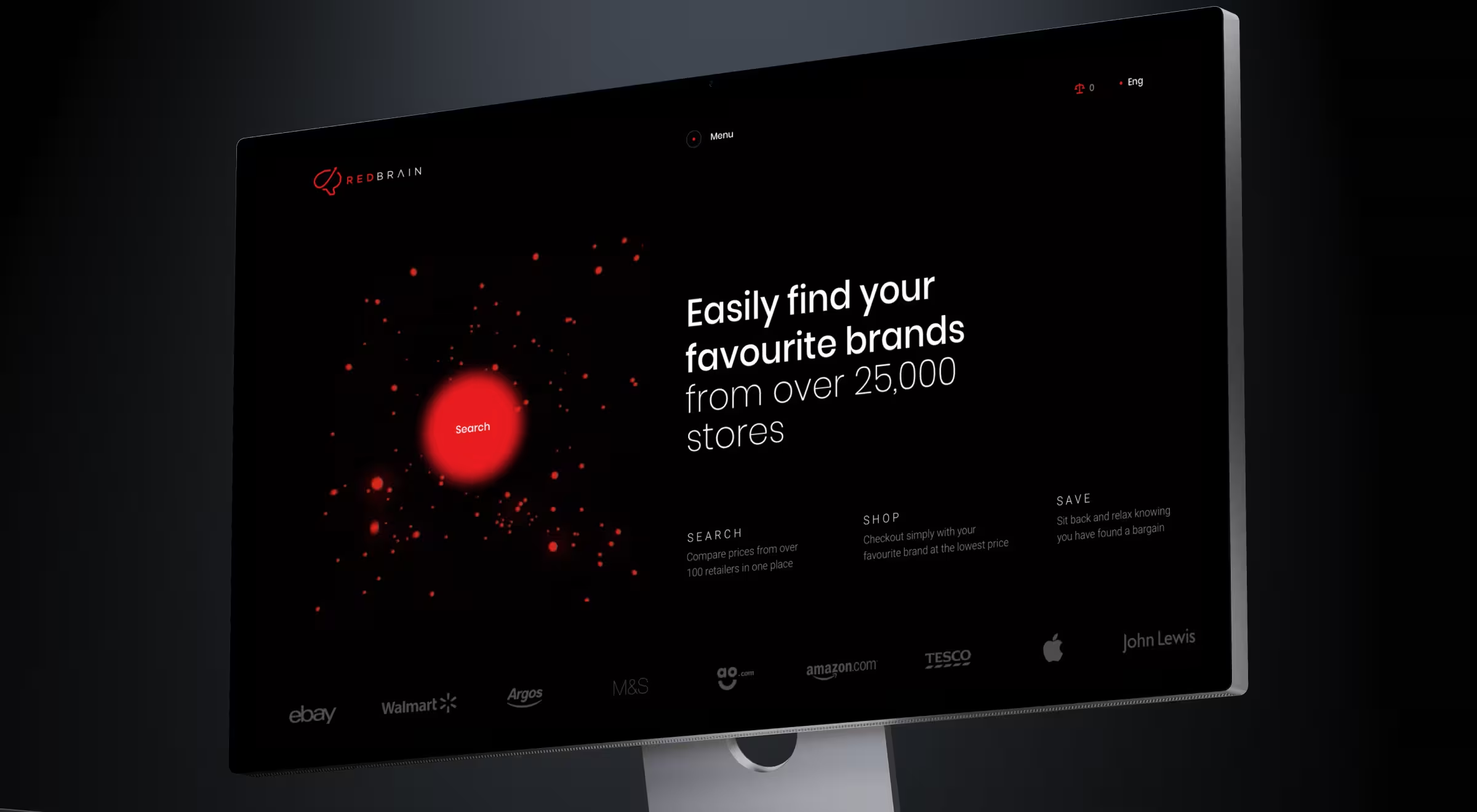
📋 Case in point: For Redbrain, Lazarev.agency rebuilt the product experience around guided choice based on user needs and market expectations. Product pages let users switch between models, motion visuals illustrated the product’s performance, and the checkout was broken into clear steps to optimize the intent–to–purchase flow.
2. Entertainment brands
Entertainment platforms sell time and attention. The design strategy challenge is not access to content, but helping users decide what’s worth their attention right now.
Here, the design strategy optimizes for:
- Discovery efficiency (reducing choice paralysis)
- Personal relevance (making the platform feel “curated for me”)
- Habit reinforcement (daily or weekly return loops)
Effective strategies in this space rely on:
- Behavioral data driving interface structure.
- Predictive personalization.
- Visual hierarchy.
📋 Case in point: Netflix’s design strategy centers on user behavior. Personalized recommendations, adaptive layouts, and preview-driven browsing all minimize the transition time intent (“I want to relax”) and action (“Press play”).
3. SaaS brands
In SaaS, especially utility-driven products, design strategy is about getting out of the way. Users want to complete a task with minimal effort and zero confusion.
SaaS-focused design strategies optimize for:
- Time-to-value (how fast users achieve their goal)
- Predictability (interfaces that behave as expected)
- Trust under pressure (especially during critical workflows)
Common strategic patterns include:
- Minimalist interfaces with strong visual affordances.
- Clear system feedback at every step.
- Progressive disclosure instead of feature dumping.
📋 Case in point: Zoom’s design strategy prioritizes reliability and immediacy. Joining a meeting takes seconds, controls are discoverable without instruction, and the interface stays stable even under high cognitive load. The product’s success stems from strategic elimination of reasons to fail, which is a hallmark of a scalable SaaS sales strategy.
4. Web3 platforms
Web3 users operate in environments where infoglut and financial risk collide. This means that the design strategy must find a balance between data density and cognitive safety.
Here, design strategies optimize for:
- Trust and transparency
- Direction over noise
- User control
That usually translates into:
- Modular, customizable dashboards
- Clear data hierarchies and visual cues
- Filter-based search systems
- Explicit feedback loops
📋 Case in point: For Blockbeat, we structured vast streams of crypto news and market data into a customizable dashboard with filters, asset profiles, and AI-tagged insights. Users could pause feeds, personalize views, and compare assets without drowning in information. The strategy made navigating the platform intuitive, which is critical in Web3.

5. AI-first businesses
AI-first products introduce a new challenge: systems that think and act on behalf of users. Thus, the design strategy must define boundaries of autonomy.
AI-driven design strategies optimize for:
- Explainability: why the system acts
- Guided interaction: help users ask better questions
- Workflow acceleration
Effective AI design strategies often include:
- Hybrid interfaces (GUI + prompt-based interaction).
- Context-aware UI elements that adapt to intent.
- Systems that recover from ambiguity.
📋 Case in point: With Accern.Rhea, Lazarev.agency designed a hybrid prompt-and-widget interface tailored to financial researchers. Instead of a pure chat UI, the product surfaced charts, datasets, and report builders based on user intent. The AI guided users with clarifying prompts and suggestions. This design strategy became a market benchmark and directly supported Accern’s growth from Series B to acquisition.

Create a design strategy reflective of your brand identity and business goals
Design strategy is where brand intent meets business reality. It’s the mechanism that ensures what users experience on screen is consistent with who you are as a company and where you’re going.
With a design strategy as the North Star, it’s much easier to clarify business priorities, enforce smart trade-offs, and scale decision-making as products and teams grow.
This is where choosing the right design strategy partner matters.
At Lazarev.agency, we build operational strategy systems grounded in research, sharpened by real product constraints, and tested across AI-first platforms, SaaS products, Web3 ecosystems, and high-performance e-commerce.
If you are on the lookout for a UX design agency to accelerate your brand growth, get in touch. Let’s develop a design strategy that stuns.