

Strategic UX/UI overhaul helps Accern launch Rhea, redefining financial research and propelling the company toward a major acquisition.
When Accern, the US-based leader in natural language processing (NLP) for financial services, decided to build a next-generation AI research tool, they turned to Lazarev.agency to lead product design. The collaboration didn’t just yield an innovative platform. It helped Accern secure over $40 million in funding and advance from Series B to acquisition.
How an NLP pioneer became an AI powerhouse
Accern was already making waves as a Forbes Under 30 honoree and one of the first players to harness AI for real-time financial news and insights. But in 2024, amid fierce competition and the AI boom, they aimed higher: creating a flagship research product that would serve analysts, VC investors, and ESG professionals.
Why Lazarev.agency?
Accern partnered with Lazarev.agency because of the firm’s proven record in AI product design. The two had previously collaborated in 2022, when Lazarev.agency developed design solutions that set the standard for the industry and are now used by Anthropic, ChatAI, and other top AI players.
In 2024, Accern was looking for expert assistance that only a partner with AI-first UX expertise could deliver. The company returned to Lazarev.agency to redefine how professionals engage with complex datasets. The vision to make research workflows faster, more intuitive, and AI-powered put the company on a bold, mission-driven trajectory.
5 design solutions
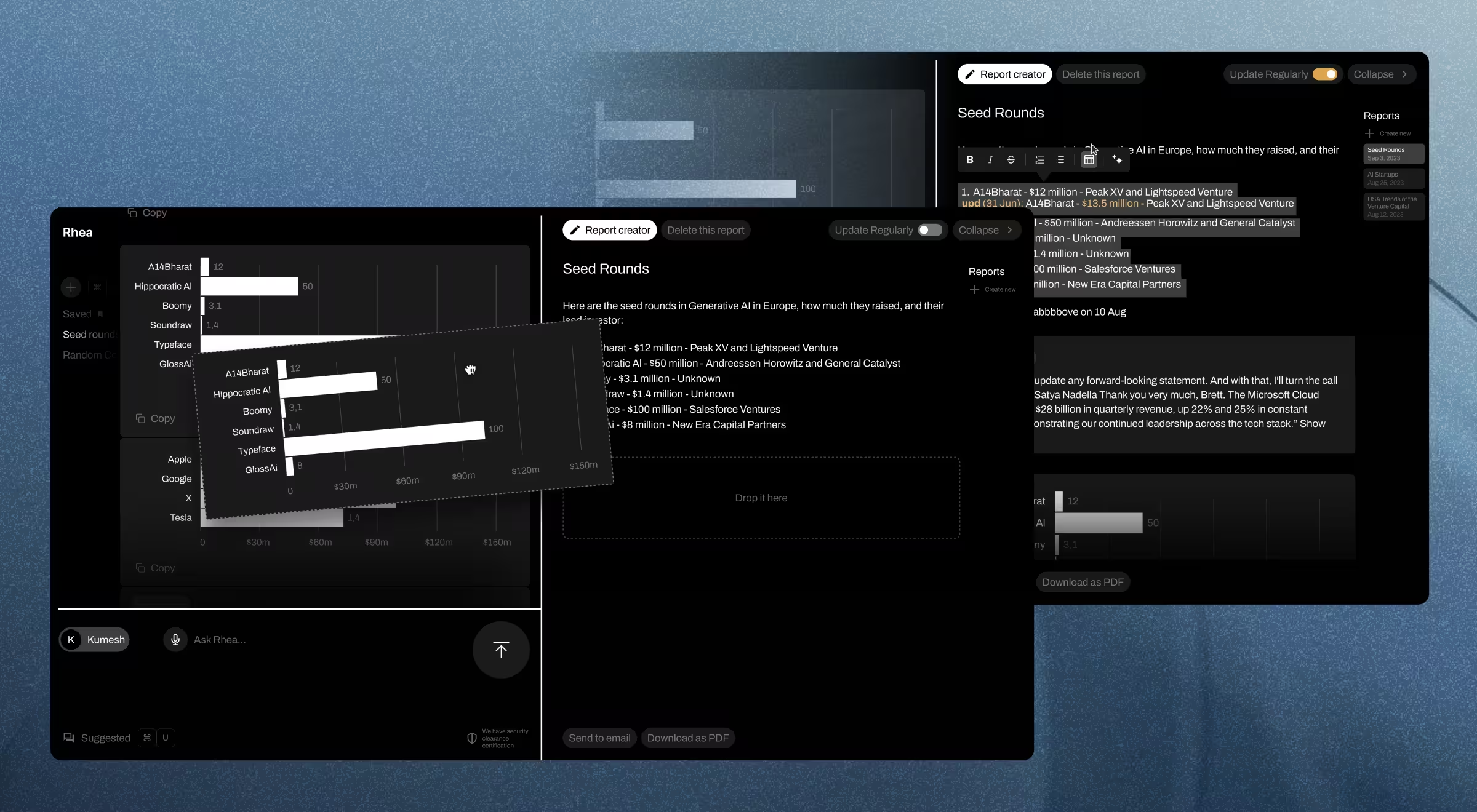
Lazarev.agency took a non-traditional approach to UX for Rhea, rejecting chatbot gimmicks in favor of advanced functionality and intuitive design. The team focused on five core innovations:
- Multi-purpose input field designed for both natural language queries and structured commands.
- Adaptive natural language communication to let users interact with the AI like a colleague without a machine vibe.
- Hybrid GUI/prompt interface for a mix of visual tools and text-based interaction, offering users control and speed. A dynamic interface now showcases references, charts, footnotes, and quick action buttons that adapt to the context of the conversation.
- Split screen report creator mode to allow analysts to generate polished outputs directly within the platform.
- Integrated datasets and file management to simplify how users navigate large data repositories. Financial researchers can use pre-configured data sets (Lenses) or link their datasets through Accern’s NLP Platform.
Turning strategic design into tangible growth
The impact of the Lazarev.agency-led design was both measurable and market-moving:
- $40M+ raised across multiple funding rounds following the launch of the redesigned platform.
- Acquisition milestone achieved, with Accern moving beyond Series B as Rhea gained traction.
“Our goal was to make Rhea feel less like a tool and more like a trusted research partner. By designing around real analyst workflows, we gave the AI purpose, structure, and usability.”
{{Kirill Lazarev}}
A template for AI-driven transformation
The Accern-Rhea case signals a broader trend: in the high-stakes fintech industry, design is a strategic move. Lazarev.agency’s role in redefining how AI integrates into core workflows shows what’s possible when UX, product vision, and business strategy align.
As Accern transitions into its next phase post-acquisition, Rhea stands as a blueprint for what AI-first design can achieve not only in fintech but in any domain where insight and speed create a competitive edge.