
.avif)
Founders who close enterprise deals and raise the next round in 2026 aren't winning just on UI. They're winning on the specific, ownable thing about what their product means — AI product positioning.
This article is for founders and CEOs of AI-native B2B startups who can feel the gap between the demo their team gives on a whiteboard and the story on their website. The ones whose investors say "the story is great", while customers hesitate, "I don't really understand what this does." The ones who suspect (and correctly so) the next round depends on fixing this before the pitch tour starts.
In this article, we’ll cover three failure modes most AI product positionings fall into, the seven-question audit, the 12-week sprint for closing the gap, and the four execution paths to choose between.
Key takeaways
- AI startups raise at a 38% Series A valuation premium over non-AI peers. The gap widens the further a category-defining AI company gets from seed, reaching +193% at Series E+ for AI companies investors believe are core rather than bolted on, Carta informs.
- Your website is the sales call. B2B buyers spend less than 5% of their purchase journey with the winning vendor. If your surfaces don't pre-sell, sales is fighting for shrinking minutes against a half-decided buyer.
- Design-led companies grow revenue 32% faster and return 56% more to shareholders. Strategic AI product design is key to a strong product positioning.
- Lazarev.agency's AI positioning work ships outcomes investors and buyers react to. Elva: Webby Award for Best Visual UI in AI. VTnews.ai: 85,000 users in month one, 90% saying it helped them step out of bias bubbles. DragonGC: entered 2024 as the trusted, market-ready legaltech platform for compliance-minded enterprises.
What AI product design delivers for founders and CEOs
AI product positioning is a specific, ownable, true story about what your product means, expressed coherently across product, website, demo, and pitch so prospects arrive pre-sold and investors see a category instead of a feature list.
At Lazarev.agency, we model AI product positioning as a single equation:
Clear narrative × coherent surfaces × conversion-ready demo = pricing power + win rate.
.avif)
Here’s how to interpret each variable:
- If the narrative isn't clear, the rest of the system has nothing to express.
- If the narrative is clear but the surfaces of your product’s digital presence (site, product, deck, demo) say slightly different things, sales spends every call re-aligning the buyer.
- If the demo doesn't perform under pressure, the work everything else did to get the meeting evaporates in 20 minutes.
When the equation holds, a founder's day-to-day reorganizes around:
- shorter sales cycles because prospects arrive understanding what you do
- defendable premium pricing because premium is a perception before it's a price point
- sharper investor decks because the same narrative powers product, brand, and pitch
- a story your team tells consistently when you're not in the room.
Data insight: McKinsey's multi-year study of more than 300 publicly listed companies found the top quartile of design-led companies outperformed industry peers by 32% in revenue growth and 56% in total returns to shareholders. It’s the financial upside founders are fighting for in any positioning sprint.
Positioning is an AI product strategy problem before it becomes a brand problem. Founders who try to fix it by changing visuals first pay for the same work twice: once to make it pretty, once to make it true.
AI company go-to-market strategy examples from Lazarev.agency’s portfolio
The fastest way to see what the equation looks like in practice is in two AI-native products Lazarev.agency designed end-to-end.
Proof #1: Elva
The positioning problem. Elva is a voice-first agentic mobile video director: speak a request and get a finished, social-ready clip with no timelines or taps. For an entirely agentic product, the challenge was to make "zero taps" feel trustworthy within the first 60 seconds.
.avif)
What Lazarev.agency built:
- Brand identity built around an AI persona. A signature blob served as Elva's face, paired with a vibrant palette engineered for the App Store, friendly typography, and a motion language carrying the personality across every touchpoint.
- Conversion-optimized onboarding. A personalization quiz with FOMO prompts ("How many unused videos are sitting on your phone right now?") made users feel the cost of inaction before the first generated clip. Trust factors and a "how it works" sequence reduced drop-off screen by screen.
- Agentic in-app UX. The blob expressed processing states, emotions, and capabilities through motion and color. The voice flow asked clarifying questions when intent was ambiguous, presented drafts for approval, and learned preferences over time.
- Camera as a retention engine. Real-time directional hints over the viewfinder ("level the horizon", "film from above") put Elva inside the creative process from the moment a phone points at something.
- Context-aware monetization. A storefront surfacing premium features inside the editing flow at the exact moment they added value, alongside free alternatives, so every upsell doubled as a product demo.
Outcome. A Webby Award for Best Visual UI in AI. Brand, activation funnel, agentic UX, and monetization delivered as an interconnected engine.
Proof #2: DragonGC
The positioning problem. DragonGC is a legaltech AI platform helping companies strengthen shareholder relations and stay compliant across 500+ disclosure topics. The technology was strong. Yet the brand was holding it back. The website failed to communicate core benefits, and there was no cohesive system to carry the brand across investor decks and marketing campaigns.
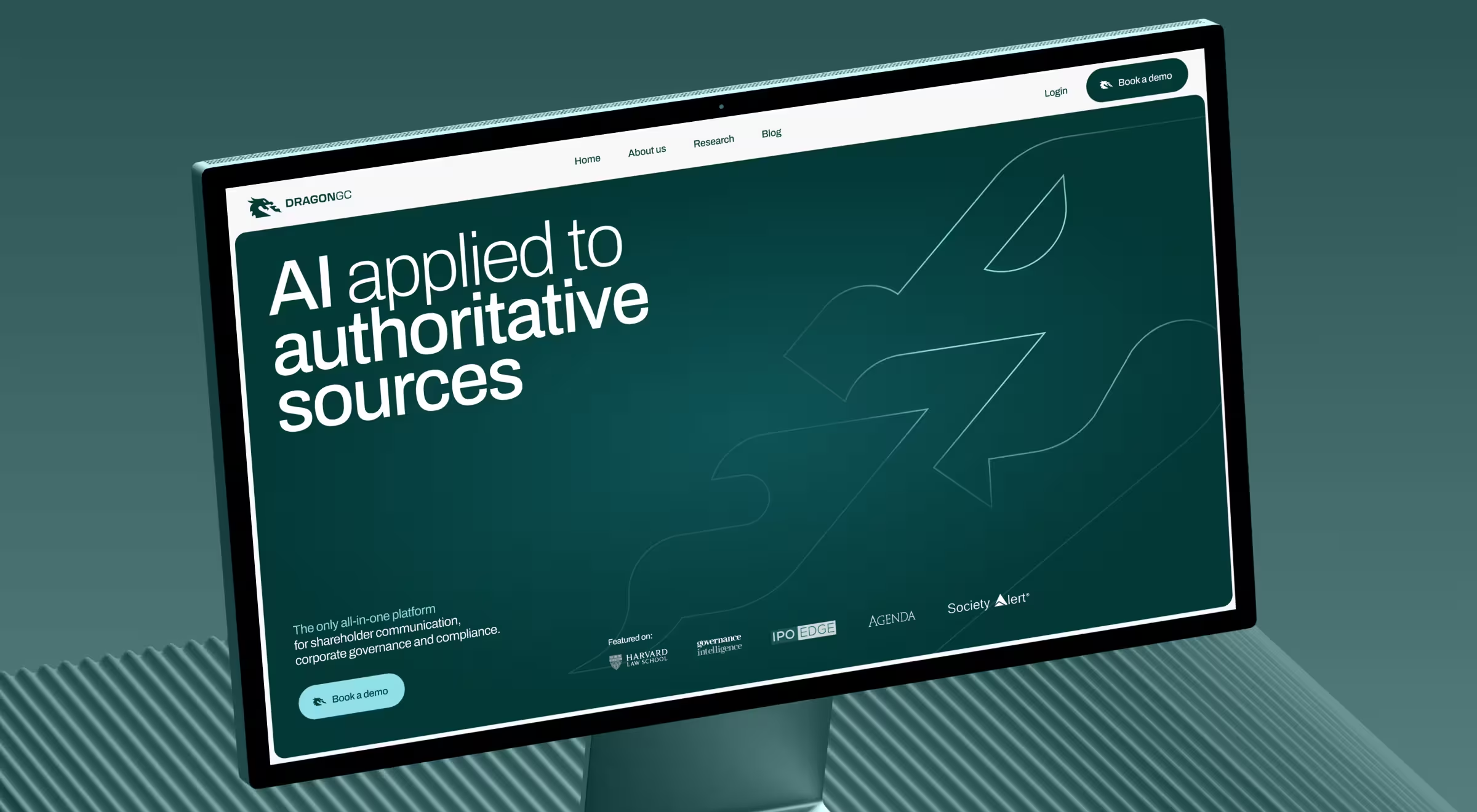
What Lazarev.agency built:
- Aligned brand strategy. Reframed DragonGC as the go-to choice for compliance-minded enterprises, with messaging built around the outcomes legal teams buy on: faster due diligence and stronger deal confidence.
- Outcome-led website. Rebuilt around real legal-team use cases with testimonials from recognized companies layered in for immediate social proof.
- Conversion-driving product moment. A Report Preview feature, adapted from paywalled-media UX, let visitors filter and view a portion of the platform's analytics before purchase.
- Human layer for enterprise trust. A redesigned About section put the team's biographies and photos front and center, signaling real experts behind the platform.
- Unified design system. Pitch deck, social, signage, and brochures shipped under one style.
Outcome. DragonGC entered its 2024 marketing push as a trusted, market-ready legaltech platform, winning the credibility signal high-value clients and investors buy.
Why "we have AI" is no longer a positioning statement
Three years ago, putting AI on the homepage was a differentiator. In 2026, every B2B SaaS product has an AI tab and an AI pricing plan. The phrase has been laundered to the point of meaninglessness, and buyers know it.
The 2026 AI-buyer reality, by the numbers:
- 83% of B2B SaaS providers now bundle AI features into their core product, FTI Consulting reports.
- 40% of enterprise apps will ship task-specific AI agents by the end of 2026, up from less than 5% in 2025, according to Gartner.
- Ungoverned, over-claimed genAI is expected to cost B2B companies more than $10 billion in lost enterprise value in 2026, with "evidence of success outweighing brand prestige", Forrester reports.
- Only 6% of organizations qualify as "AI high performers" with more than 5% of EBIT attributable to AI, McKinsey found.
.avif)
The data explains why three AI positioning failure modes recur across founders heading into 2026. Below is how each one serves as a different way of letting "we have AI" do the talking.
Failure mode 1: the feature dump
The pattern. The website lists what the product does without saying what changes for the customer.
What it sounds like:
- "AI-powered insights"
- "Intelligent automation"
- "Advanced ML models"
- "Built-in machine learning"
Why it fails. Every competitor's site says the same things in a slightly different order. Buyers leave the page knowing what the product contains and nothing about what it delivers.
The reframe. Replace each feature claim with the change it produces. "AI-powered insights" becomes "Cuts monthly board prep from eight hours to forty-five minutes."
Case in point. Granola leads with "The AI notepad for back-to-back meetings" — naming the pain point and the change it removes — instead of fronting transcription models, summarization pipelines, or accuracy scores. Every line of homepage copy reinforces what the founder's day looks like after installing it.
Failure mode 2: the hype lean
The pattern. The narrative leans hard into AI as a category, never reaching a specific claim about what this product does the next AI product can't.
What it sounds like:
- "The future of [category]"
- "The AI revolution in [vertical]"
- "Next-generation intelligence for [function]"
- "Reimagining [workflow] with AI"
Why it fails. This is the exact failure mode Forrester is pricing in when it warns of $10B+ in lost enterprise value from ungoverned genAI claims. Buyers in 2026 read "future of" copy as a signal the team has nothing specific to claim.
The reframe. Trade category language for a defensible claim about a single workflow your AI changes. Lead with the one job no other product on the buyer's shortlist does as well.
Case in point. VTnews.ai, the AI news platform Lazarev.agency designed with Patrick Bet-David, replaces category-level hype with a precise, behavioral claim. The positioning shift is named directly in the case: from "reading news" to "being a part of what happens in the world".
The sentence does what "the future of media" never could. It describes the behavioral change the product produces. The proof is built into the AI itself. Real-time bias analysis across 130K+ sources and a three-perspective overview (left, center, right) for every story. Adoption confirmed the positioning landed: 85K users onboarded in month one, 90% reporting the platform helped them step out of bias bubbles.
Failure mode 3: the technology-led pitch
The pattern. The story starts with model architecture and technical sophistication. The buyer's eyes glaze over because the buyer doesn't care about the architecture.
What it sounds like:
- "Built on a fine-tuned 70B-parameter LLM"
- "Powered by retrieval-augmented generation"
- "Trained on 100 million proprietary documents"
- "Multi-modal transformer architecture"
Why it fails. Buyers care whether their job gets easier and their numbers go up. Given only 6% of enterprises see meaningful AI EBIT impact, most have already been burned by an AI pitch heavy on architecture and light on outcomes.
The reframe. Move the technology to the back of the conversation. Lead with the customer outcome. Surface the model architecture when a technical buyer asks for it.
Case in point. Cursor is one of the most technically sophisticated AI products on the market. Its homepage opens with "The AI code editor… built to make you extraordinarily productive." Nowhere on the landing page do you read about model size or context-window engineering. The entire surface is built around what changes for the developer's day. Technical buyers find the depth in the docs. Everyone else gets sold on the outcome.
The Jobs principle: start with the customer, work backward to the technology
All three failure modes share the same root cause. And Steve Jobs named it almost thirty years ago. At WWDC 1997, he was asked how he'd reorient Apple around its new strategy. His answer became one of the most-cited principles in product strategy:
"You've got to start with the customer experience and work backwards to the technology. You can't start with the technology and try to figure out where you're going to try to sell it." — Steve Jobs
The principle applies almost exactly to AI products in 2026. The technology is impressive and worth describing later in the conversation. It isn't the lead. The lead is the specific, ownable, true thing your product means to the person paying for it — AI product positioning.
Quick positioning check-up. Read your homepage aloud to a stranger who isn't in your industry, and ask them to say in one sentence what the product does and who it's for. If they can't, that's the gap, named. The rest of this article exists to close it.
The AI product positioning audit: 7 questions before you write a word
Before any new copy gets written, work through these seven questions with your founding team. The answers should be specific and drawn from real customer language. If a question is hard to answer in one or two sentences, that's the work.
- Who specifically is this for, and who is it not for?
Naming the "not for" is more useful than naming the "for" because it forces real boundaries. The output is the UX persona every later positioning decision tests against: a named role, a named workflow, and a named pain your product changes.
- What does this product change for them in the first week of use?
Not in year one. Week one.
- What were they doing before, and why is it now insufficient?
The before-state is where the urgency lives.
- Where does the AI sit in the workflow, and where does it deliberately not?
"Everywhere" is the wrong answer. Naming what the AI doesn't touch increases trust — and trust is increasingly the differentiator: by 2030, 75% of B2B buyers will prefer sales experiences prioritizing human interaction over AI, Gartner found.
- What do your best customers say after they finally "get it"?
That language usually contains the positioning, in their words, before yours.
- What does the founder pitch on a whiteboard the website never says?
The whiteboard version is almost always sharper than the published version.
- Which competitor's story sounds the most like yours, and what would make yours impossible to confuse with theirs?
If your buyers can't tell you apart from the alternatives, they default to doing nothing. The market research here is tactical: open the homepages, demos, and pricing pages of the next five companies on a buyer's shortlist, read all six side by side, and the lookalikes show up in seconds.
Most founders walk in expecting these questions to confirm what they already think. Questions four and seven do the opposite. They force a subtraction: a public account of what the AI deliberately doesn't do, and an honest read of how interchangeable the company looks next to the nearest five competitors. Positioning sharpens through what founders are willing to leave out of the pitch, and four and seven are where the cuts get made.
Why your product, website, and demo say three different things, and what it costs you
“Founders who feel something is off with their positioning are usually right. The symptom is almost always the same. It’s a narrative drift across surfaces. The product tells one story in the UI. The website tells a slightly different one in the hero copy. The demo tells a third one in the live walkthrough. Each was written at a different time by a different person and never reconciled.”
{{Oleksandr Koshytskyi}}
Buyers experience the drift Kirill describes as confusion. In 2026, confusion has a measurable cost. When your surfaces don't pre-sell, sales is fighting for shrinking minutes against a buyer who has already half-decided.
Two Gartner findings put numbers on the cost:
- 67% of B2B buyers prefer a rep-free buying experience entirely, up from 61% in 2025 (Gartner, 2026 survey).
- 69% of buyers report inconsistencies between information on the company's website and what sellers tell them (Gartner, 2025 survey).
The two findings compound. Buyers want the surfaces to do the selling, and they notice every moment those surfaces don't agree, which makes narrative drift the highest-leverage fix.
Here’s what unified messaging looks like in practice:
- Perplexity calls itself "the answer engine" on its homepage. The product UI is a search bar returning cited answers. The demo is opening the site and asking it a question. Three surfaces, one sentence.
- Lovable holds the same discipline for AI app builders. The hero ("Build something Lovable"), the prompt-to-app product flow, and every demo video reinforce a single behavioral promise about shipping ideas without code.
Reading the homepage, opening the product, and watching a demo gives the buyer the same story three times in a row. Each layer builds on the one above it. Skipping a step is how founders end up paying for the same work twice.
The 3-month positioning sprint: what to do this quarter
Diagnosis is the easy half. The hard half is closing the gaps before the next pitch tour or enterprise sales push in one quarter, end-to-end.
The framework below is the 12-week sprint Lazarev.agency applies with client partners: three sequenced phases turning the audit's answers and the demo and investor principles above into one coherent product, website, demo, and pitch.
.avif)
Phase 1: Discovery and narrative
Timeline: Weeks 1–3.
Key tasks: Structured sessions with the founder, sales, and customer success. Where possible, two or three best customers join the room. The work pulls apart what closes deals vs. what kills them, and surfaces the language buyers already use after they "get it".
Deliverable: A narrative brief with a positioning statement, core message, voice, and the story against which every later deliverable will be measured. Your team reads it and recognizes itself.
Founder time: High. Narrative work requires founder presence because vision can't be delegated.
Phase 2: Identity and site
Timeline: Weeks 4–8.
Key tasks: Translate the narrative into a visual language: typography, color, motion, iconography. Then rebuild the website audience-in: information architecture first, wireframes with real copy second, visual design third.
Deliverable: A brand identity system and a build-ready website with full specs ready for engineering handoff.
Founder time: Medium. High-leverage decision-making between strong alternatives — day-to-day execution lives with the design team.
Phase 3: Demo and sales materials
Timeline: Weeks 9–12.
Key tasks: Design the demo flow as a product design problem — sequence, pacing, the AI moment, exit feeling. Build the pitch deck and sales collateral on the same visual and narrative logic as the site. Document the brand bible so the team can extend the system after handoff.
Deliverable: Working demo, pitch deck, sales collateral, and brand bible. The salesperson hired last week can run any of it without you in the room.
Founder time: Medium. Final review and approval on materials your team will run with you out of the room.
When to bring in a partner vs. hire vs. DIY
The sprint above is the what. The remaining decision is who runs it. The right answer depends on your stage, your deadline, and how much founder time you can spare on project management.
Four paths show up consistently at late Seed through Series B, and each one suits a different situation.
The freelancer path looks cheapest until you count the founder hours spent integrating four different visual languages into one coherent product.
The hiring path is the right long-term bet, but at late Seed through Series B, the ramp time often costs more in lost deals than the hire saves.
The DIY path works for exploration but doesn't survive contact with an enterprise buyer.
The integrated-partner path solves a specific problem: you need product UX, site, pitch, and demo to be the same system, told the same way, managed by a team experienced with AI-native products specifically. It's the right call when the next round or the next enterprise deal won't wait for a long hire-and-ramp cycle.
Take your AI positioning from audit to launch
You've now seen the diagnosis, the seven-question audit, the cost data, and the 12-week sprint for closing the gap. The hard part for most founders is execution speed. The next round won't wait three to six months for a senior hire to ramp, and a freelancer won't deliver one coherent system across product, site, pitch, and demo.
That gap is what Lazarev.agency's Brand, Website & Demo service is built to close. One team, narrative-first, four-to-eight months end-to-end, built specifically for AI-native B2B founders heading into a serious sales cycle, fundraising round, or new market entry.
Prefer a direct conversation? Get in touch, and we'll map the sprint to your specific deadline.




.webp)