

Having a strong design strategy is like building a house on a solid foundation. Should you treat this step as optional, you get yourself into the trouble of keeping the building intact when the wind starts blowing with unexpectedly strong gusts.
For AI-first products, being strategic is the only way to withstand competition. AI is the embodiment of innovation, and innovation, by definition, brings continuous change. At first glance, that level of change makes strategy seem too restrictive. But it’s not about rigidity. Strategy means creating a system that allows you to respond to change in a structured, sustainable way.
In this article, we look at what strategy stands for in the design world, why every AI product needs one, and how to build it so your product is set up for success.
Key takeaways
- AI products fail less from poor execution and more from undefined positioning.
- Speed in design without strategy leads to iteration loops.
- Trust in AI is an interaction and communication problem.
- Differentiation in AI comes from focus: what you solve, for whom, and what you intentionally leave out.
Design strategy vs. design brief vs. design execution
“Most founders come to us saying they need design. What they really need is strategy plus design — the core expertise of AI UX strategy partners. Without a solid strategic framework, design is an expensive iteration lacking a clear direction. Strategy defines how you win. Design communicates why it matters.”
{{Kirill Lazarev}}
AI product teams get tempted to compress strategy, briefing, and execution into a single step. The output of such compression is predictable. While you do achieve a relatively fast output, the resulting unclear positioning leads to repeated redesign cycles.
Here’s what each layer stands for.
When these concepts blur, companies default to building stuff. Screens get redesigned, and features get added. But the product itself remains undefined and hence poorly fits the real market conditions.
Data insight: CB Insights reports that 43% of startup failures stem from a lack of product–market fit (PMF). In most cases, the issue is the absence of a clear strategic foundation specifying who the product is for and why it should exist.
Design strategy exists to ensure PMF. It defines how the product should exist in the market before defining how it should look or behave.
Below are the essential components of a strong design strategy:
- Market positioning — A clear answer to who you are relative to competitors.
- Target user — A precise definition of who the product is for.
- Value proposition — The specific problem the product solves.
- Design principles — The behavioral and experiential rules guiding the product.
- Design language — The visual and interaction system conveying the strategy.
- Product roadmap or, more specifically, AI product roadmap — A structured sequence of what gets built and when.
Why every AI product needs a strategy
The AI product market is expanding faster than companies can claim their place within it. New tools launch daily. And while most promise similar capabilities, only a few communicate a distinct reason to exist.
“As of now, the AI market is crowded and largely undefined. Everyone's building with AI at some level and at some capacity. Differentiation isn't ‘we use AI’. It's ‘we use AI to solve this specific problem for this specific user in this specific way.’”
{{Oleksandr Holovko}}
The numbers prove this dynamic:
- According to Grand View Research, the global AI market is projected to grow from $390 billion in 2025 to $3.49 trillion by 2033, a rise reflecting sustained expansion.
- Stanford HAI reports that U.S. private AI investment reached $109.1B in 2024, significantly outpacing other regions around the globe.
- McKinsey found that 88% of companies report AI usage in at least one business function, yet most remain in pilot or experimentation stages.

These statistics introduce a split environment. On one side, AI adoption is indeed widespread. On the other hand, most products are not yet fully defined or properly scaled. Many teams are building capabilities without a clear product narrative to support them.
This is where product strategy becomes decisive.
In AI, technology alone does not differentiate. Positioning does. The ability to define a specific problem, for a specific user, in a specific way determines whether a product is understood or ignored.
How to develop a design strategy for an AI product
Developing a design strategy presupposes integrating business philosophy, user understanding, team dynamics, and market context into a unified direction for product growth.
“With AI-first products, a clear product strategy is non-negotiable because the technology itself can easily dominate internal conversations. Teams get so absorbed by models and technical potential that the product’s market role slips from focus. A sound design strategy prevents that by encouraging teams to tie the product’s functionality to business goals and ultimately translate the full scope of its technical capabilities into a clear market position.”
{{Anna Demianenko}}
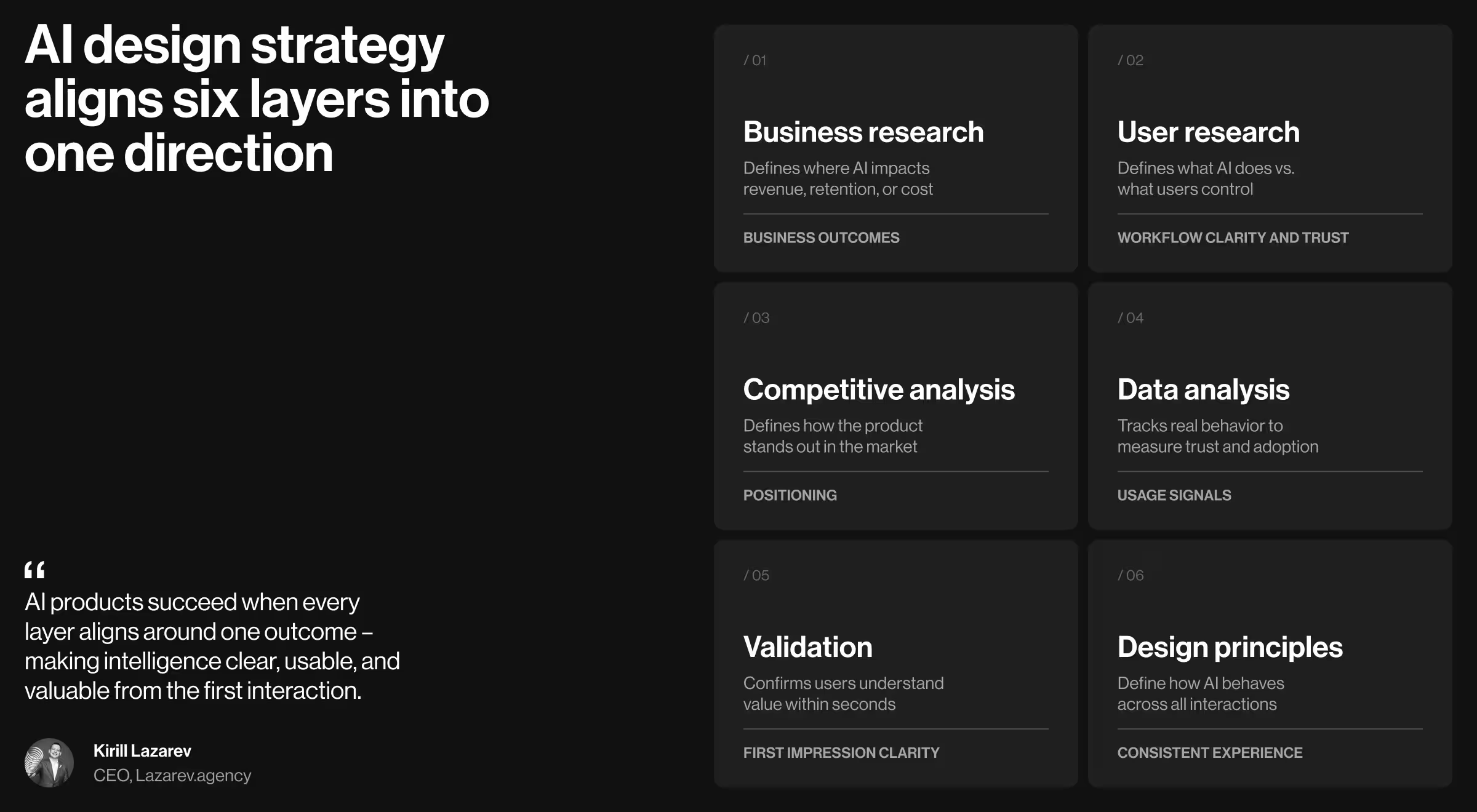
Each component we discuss below contributes a different (yet equally critical) layer of insight. Together, they form a coherent design strategy.
1. Business research
Start with a strategic constraint: where does AI have the greatest business impact?
AI expands what a product can do. Business research defines what it should do.
The goal is to identify specific use cases where intelligence directly influences revenue and user retention, and only then design solutions to enhance those metrics.
In practice, this means treating AI strategically. Each capability must justify its place in the product by strengthening a specific part of the model: acquisition efficiency, conversion optimization, expansion, or operational cost.
Why it matters for an AI product: AI is easy to overbuild and hard to justify. Without business grounding, teams invest in capabilities that make the product multi-functional yet keep its performance suboptimal.
✅ Make it actionable:
- Map each AI capability to a business lever (conversion, retention, cost reduction).
- Quantify where AI reduces time and effort in the user journey.
- Make AI value visible by prioritizing use cases that move users to value faster.
- Eliminate non-essential features with limited impact on KPIs.
What happens if this is omitted? The product accumulates intelligence without direction. It becomes harder to position, harder to sell, and harder to scale.
2. User research
Research and strategy go hand in hand.
For AI products, user research defines the boundary between what humans take responsibility for and where the system can confidently step in without breaching user trust. Poorly defined roles lead to over-automation in critical moments or unnecessary manual work where automation is expected.
Why it matters for an AI product: AI reshapes workflows. If the shift is not intentional, users hesitate, override outputs, or avoid the feature altogether.
✅ Make it actionable:
- Break down current workflows into discrete steps and decisions.
- Identify where time is spent and where uncertainty appears.
- Define for each step what to replace (AI acts), where to assist (AI suggests), and what to leave manual (user decides).
- Align interaction patterns with this logic (auto-actions, recommendations, confirmations).
What happens if this is omitted? AI fails to optimize product functionality.
🔍 Explore our hub for a better grasp of why skipping user research derails business growth and why conducting one is a key step in building AI products users understand.
3. Competitive analysis
Treat competitive market analysis as a positioning exercise. It helps reveal how the category communicates value and where that communication has already become predictable. The goal is to identify where intentional differentiation is possible.
Why it matters for an AI product: Technical features become similar across competitors in a short time. What feels advanced internally is often already expected externally. Without a defined stance, the product becomes interchangeable.
✅ Make it actionable:
- Conduct market research to map how competitors position themselves (who they target, what they emphasize, what they overlook, how they frame AI).
- Identify repeated claims and interface patterns across the category.
- Isolate one dimension to compete on (e.g., precision over speed or control over automation).
- Align your product behavior and design language with that choice.
What happens if this is omitted? The product enters the market without a distinct identity. It competes on execution quality, which is difficult to sustain.
4. Data analysis
AI transformation isn’t just tech — it’s a trust preservation test.
In AI products, behavior signals are irreplaceable. Users usually refrain from articulating why they distrust/ ignore a system. Their behaviour does it instead through overrides and drop-offs. These signals indicate whether users understand and trust the product’s intelligence.
Why it matters for an AI product: Even a high-performing AI product fails when trust gets sabotaged.
✅ Make it actionable:
- Track acceptance vs. override rates of AI outputs to measure reliance.
- Identify where users pause, repeat actions, or revert to manual steps.
- Analyze time-to-decision and time-to-completion around AI-assisted flows.
- Adjust interaction patterns (explanations, confirmations, controls) based on behavior.
What happens if this is omitted? The team optimizes model performance while ignoring where users choose not to use it.
5. Validation
A strategy is only useful if it is understood without explanation. Validation checks whether the product communicates its purpose and value in seconds.
Why it matters for an AI product: AI introduces unfamiliar concepts and interactions. If the product’s role is not immediately apparent, users hesitate, misinterpret its purpose, or disengage altogether.
✅ Make it actionable:
- Test first impressions on landing screens and onboarding flows.
- Measure time-to-understanding.
- Refine messaging and interaction cues until the product explains itself.
What happens if this is omitted? The product reaches the market with a positioning that works internally but breaks down on first contact with users.
6. Design principles
Established design approaches guide strategy. They define how the product behaves in every interaction.
Why it matters for an AI product: In AI products, this is where positioning becomes tangible. UI design principles determine whether the system feels precise or vague, assistive or intrusive. Without defined rules, the experience fragments across flows and features.
✅ Make it actionable:
- Define how AI outputs are introduced (suggestion, default action, or automated result).
- Set rules for explanation depth: when to show reasoning, when to stay concise.
- Establish boundaries for automation vs. user control across flows.
- Ensure interaction patterns consistently reflect the product’s positioning.
What happens if this is omitted? Different flows handle AI in different ways: sometimes assertive, sometimes passive, sometimes opaque. As a result, users cannot form a stable mental model of how the system behaves or when to trust it.
Common mistakes to avoid when developing a research strategy
Strategic mistakes in AI products don’t look like mistakes at first. They appear as reasonable decisions made when time is limited — your team has to launch faster and add new features per user request, all the while introducing refinements to the interface.
🔍 Have a look at our Lead Designer’s guide on how to achieve the right balance between speed and quality in product design.
Across 30+ AI-first products, we’ve seen how teams invest in building and refining the product’s digital presence before agreeing on what it stands for. So, design becomes a stage for iteration, and the product struggles to communicate its role in the market.
Here’s a breakdown of some of the most common strategy-related mistakes to avoid.
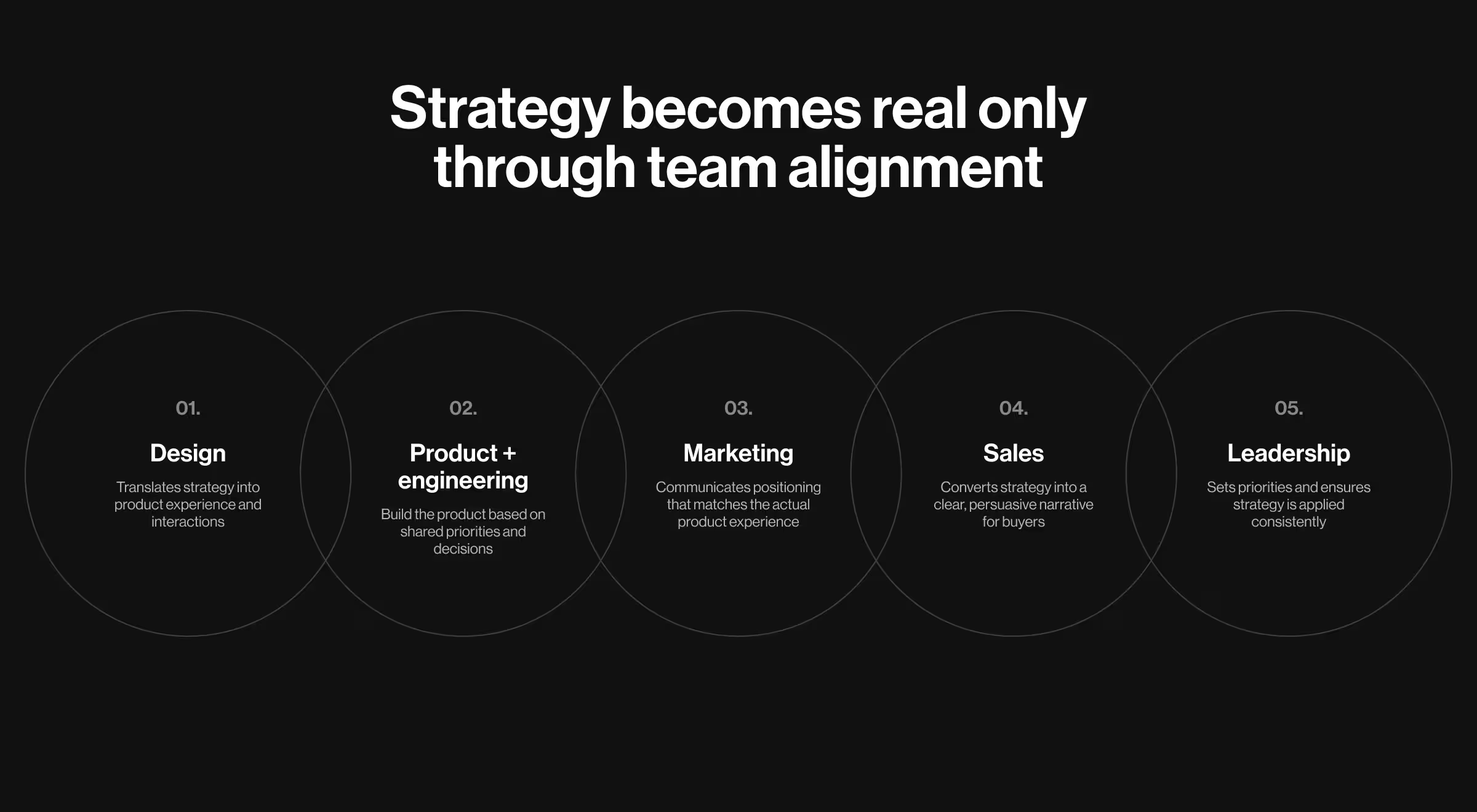
Align your team around strategy
A defined strategy is as effective as your team’s alignment around it. Without it, even strong strategic thinking breaks down in execution.
- Design must be part of product decision-making. Design shapes how strategy becomes tangible. Involving design early ensures consistency between intent and outcome.
- Product, design, and engineering must align. These functions define and build the product together. Shared understanding prevents divergence in priorities and execution.
- Marketing communicates strategy. Messaging should reflect product positioning. If marketing tells a different story from the product experience, trust fades away.
- Sales sells strategy. Buyers respond to relevant experiences. A clear strategic narrative is more persuasive than an impressive list of capabilities.
- Leadership reinforces strategic thinking. Strategic alignment starts at the top. Leadership decisions define whether the strategy is applied consistently or overridden by short-term priorities.
Pave the way for sustainable AI growth with a strategy-first design
An AI product is more likely to fall flat when it lacks strategic footing.
When teams rush to designing interfaces and workflows, they miss a key step — defining why and for whom they’re doing it. The result is fast output irrelevant to market demand.
A strategy-first approach introduces a different logic to design work. It defines how the product should exist before defining how it should look.
If you’re building or scaling an AI product, ask yourself this: Does your design communicate a position or just functionality?
If the answer isn’t straightforward, it’s worth taking a closer look.
Explore our AI design services to see how we turn strategy into products people trust and choose on repeat. Reach out to discuss how that reality of understandable AI can become your product’s future.





.webp)