01
Keywords with verified volume
The classic layer: search terms with real traffic numbers behind them, pulled from keyword databases and checked against what actually ranks.
Every rank tracker shows you the same thing: keywords with search volume. Your buyers also type phrases no tool reports, ask full questions, and describe their situation to an assistant in three sentences. Our method follows from that gap.
Each cluster holds four kinds of demand: keywords with measurable volume, the phrases your own team uses that no tool tracks, the full questions buyers type, and the prompts they give AI assistants.
The classic layer: search terms with real traffic numbers behind them, pulled from keyword databases and checked against what actually ranks.
Phrases from your own briefs, strategy documents and sales calls. No tool reports volume for them, and they describe exactly what you sell.
The full questions buyers type, including everything the People also ask boxes reveal. They follow from the first two layers and read the way people actually search.
One sentence, two sentences, a short paragraph. The short ones behave like keywords. The long ones sound like a buyer describing their situation to an assistant.
Our portfolio encompasses a wide range of digital designs essential for the growth of modern businesses.
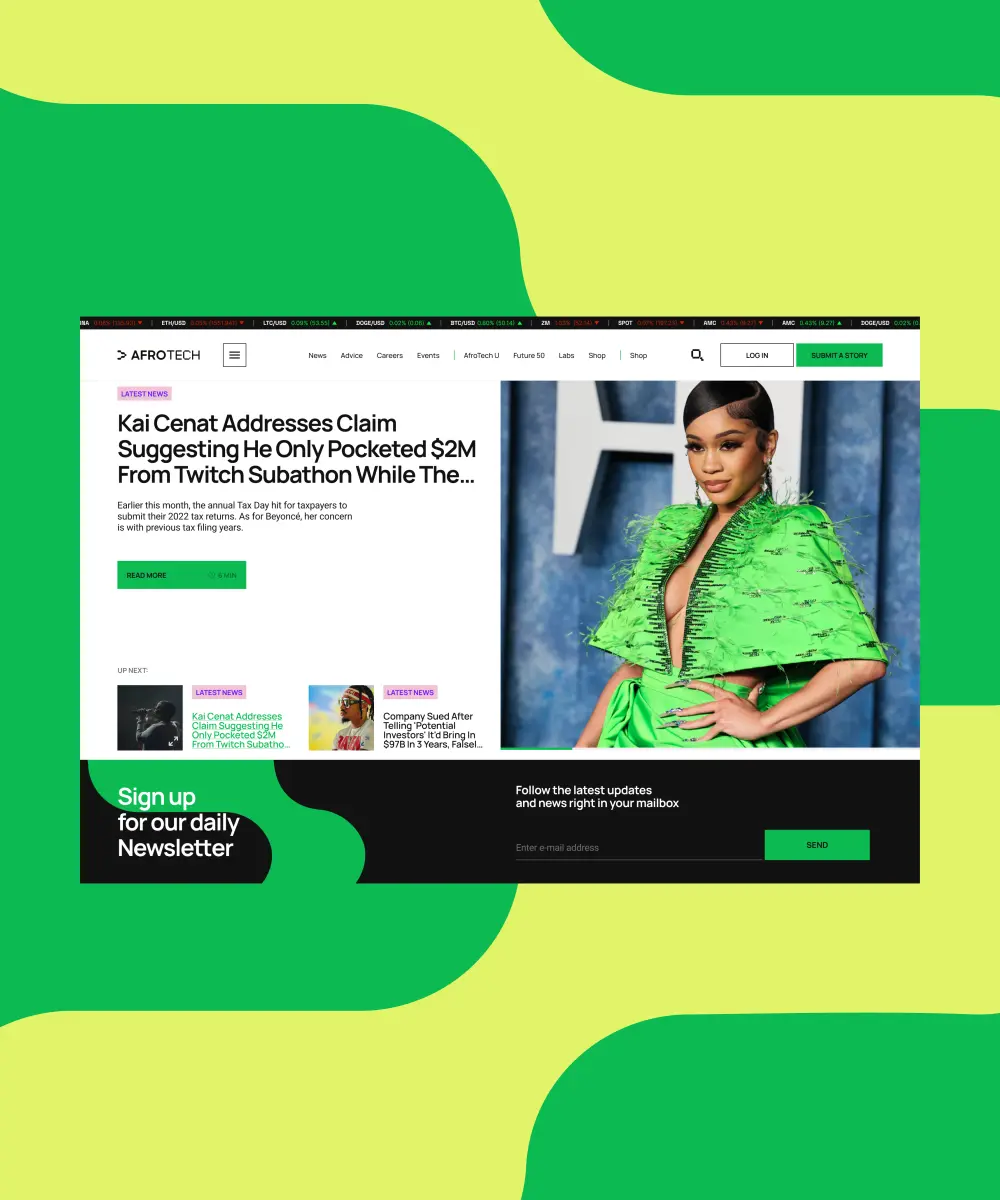
AfroTech evolved from a media platform into a thriving technology community. Lazarev.agency designed a scalable digital ecosystem that helped grow the audience from 500 to 20,000 members while supporting new media formats, events, and five sub-brands under one unified experience.
Lazarev.agency is more than about making profits for us and our clients. We're committed to saving lives in Ukraine, taking on pro bono projects, championing diversity, equity, and inclusion.
in funding secured for our clients
awards backing our excellence
founded, 10+ years of experience
AI product design agency
from user research to production-ready design systems
Among our clients:








We’re a UX/UI web design agency with 140+ awards that helps AI‑native and AI‑ambitious B2B teams translate complex products into clear, conversion‑ready websites.

Webby Awards x10

Red Dot Design Award x6

Awwwards x16

FWA x5
We exist for B2B teams under pressure to turn an AI roadmap into visible product usage, expansion, and a safer story in front of the C‑suite and investors. If design isn’t moving revenue, adoption, or retention, it’s decoration. We design to avoid that. Since 2015, we’ve shipped 600+ products and earned 140+ awards for work on complex, data-heavy tools: fintech platforms, AI copilots, decision engines, and vertical SaaS. Our work has helped clients turn “we have AI features” into “our customers actually use and pay for them.”
We started designing AI products in 2017, long before “AI-native” became a buzzword. With 30+ AI products shipped, we focus on the hard part most teams struggle with: making complex intelligence feel simple, trustworthy, and obviously valuable in a demo, a POC, or a QBR. We’re a 40+ person team of UX strategists, product designers, and analysts who treat design as a business function.
What sets us apart from a typical agency or a single in-house hire is pattern recognition at scale. We’ve seen what works – and what quietly kills adoption – across hundreds of AI and data-heavy products. That lets us spot failure modes early, bring proven interaction patterns to your team, and reduce the risk that your next AI release is another unused toggle in a settings menu.
We start with research not because it’s “best practice,” but because designing without understanding your users, your market, and your revenue model is just guessing with nicer pixels. From there, we collaborate with your product, AI, and design leaders to define where AI should show up, how it should behave, and how to make it obvious, safe, and monetizable.
If you’re a Head of AI, Product, or an AI-native founder who needs AI capabilities to be seen, understood, and used now, not someday, we’re built to be that partner.
At this stage, clients engage us for 4–6+ month AI & data product UX redesign programs, treating us as their primary product design partner for the core platform.
of experience in UI/UX design
Trusted by over 600 companies of all sizes
international industry awards
projects successfully completed
Seeds from your material, tool expansion, AI filtering, competitor matching and a manual cut — clusters built from what survives.
We generate seed keywords per cluster from your briefs, strategy papers, and sales material.
The seeds go through keyword databases for matching terms, related terms, and volume data, and come back as one consolidated report per cluster.
A model scores every term against your company profile and drops what you do not sell, which turns out to be most of the raw list.
We pull the keywords your search competitors and your AI citation competitors already win, and fold in the ones you have a right to contest.
A human walks the remaining list and cuts it to a few thousand keywords worth ranking for. Your clusters are built from that list and nothing else.
How we work, scale, and deliver measurable outcomes.
Because volume measures competition as much as it measures demand. The high-volume head of your category is where every agency sends every client, and outranking that crowd is slow and expensive. The four-layer model wins on the terms your buyers use at decision time, many of which show little or no volume, and takes the contested head terms only where the verdict says the fight is worth having.
Then a volume-only methodology would tell you search isn't for you, and it would be wrong. New and narrow categories live almost entirely in layers two through four: business keywords from your own documents, long-tail questions, and prompts. Buyers there ask assistants more than they scroll results pages, which makes the prompt layer your biggest asset instead of an afterthought.
You do. The extended cluster grouping report goes to your team as a strategy argued in plain language, and nothing gets built until you sign off on the clusters. That includes site structure: pages, information architecture and storytelling are all downstream of the approved map, so there is no moment where content appears that nobody agreed to.
They become the brief for everything downstream. Site structure and page templates get built against them, and the publishing loop in continuous demand generation works through them in the sequence you approved. The clusters are also where measurement attaches, so share of voice gets reported per cluster instead of as one number for the whole site.
Let's talk about your AI adoption challenge