

Free trials don’t live up to their potential when the product doesn’t earn commitment fast enough (or clearly enough) during the trial window.
At this stage of the user journey, there’s no need for substantially higher traffic or louder lifecycle messaging. You need sharper decisions about what the trial is meant to prove, for whom, and when a user should feel confident enough to pay.
In this article, our design team offers a detailed breakdown of how free trial to paid conversions work, why they stall in otherwise strong products, and how to fix them with focused, experience-level strategies.
Let’s dig in.
Key takeaways
- High-performing trials prove one outcome decisively. Focused experiences convert better than feature-rich explorations.
- Conversion moments should be earned. The right time to upgrade is after meaningful progress.
- Fix one constraint per cycle. Diagnosing where commitment stalls beats stacking changes and guessing what worked.
What free trial to paid conversions measure
Free trial to paid conversion rate tracks the share of trial users who become paying customers. On the surface, the metric looks straightforward. In practice, it compresses several business realities into a single number.
A conversion does signal willingness to pay. But more importantly, it predicts the customer lifetime value that follows — whether the trial set the user up for sustained, paying engagement.
With free trial to paid conversions, benchmarks vary widely by product motion. According to Lazarev.agency internal data, self-serve SaaS products often convert in the low single digits — somewhere between 2–5%. Sales-assisted or niche B2B tools land in the 8–15%+ range. That’s why comparing across categories rarely helps.
What does come in handy is understanding where conversion breaks:
- Before activation: the trial fails to deliver early relevance
- After activation, before upgrade: value is felt but not justified
- At the decision moment: confidence collapses when payment is introduced
Why do free trials fail to convert in real products?
Most trial failures are inherited from earlier stages, and the SaaS funnel breakdown shows where they originate.
The table below maps the most common failure patterns, what they indicate, and where teams should intervene first.
Use this table as a diagnostic. Start by identifying the row (1–7) that best matches your current data pattern. Fix that constraint before touching pricing, messaging, or lifecycle tactics. Conversion improves fastest when uncertainty is tackled at the right place.
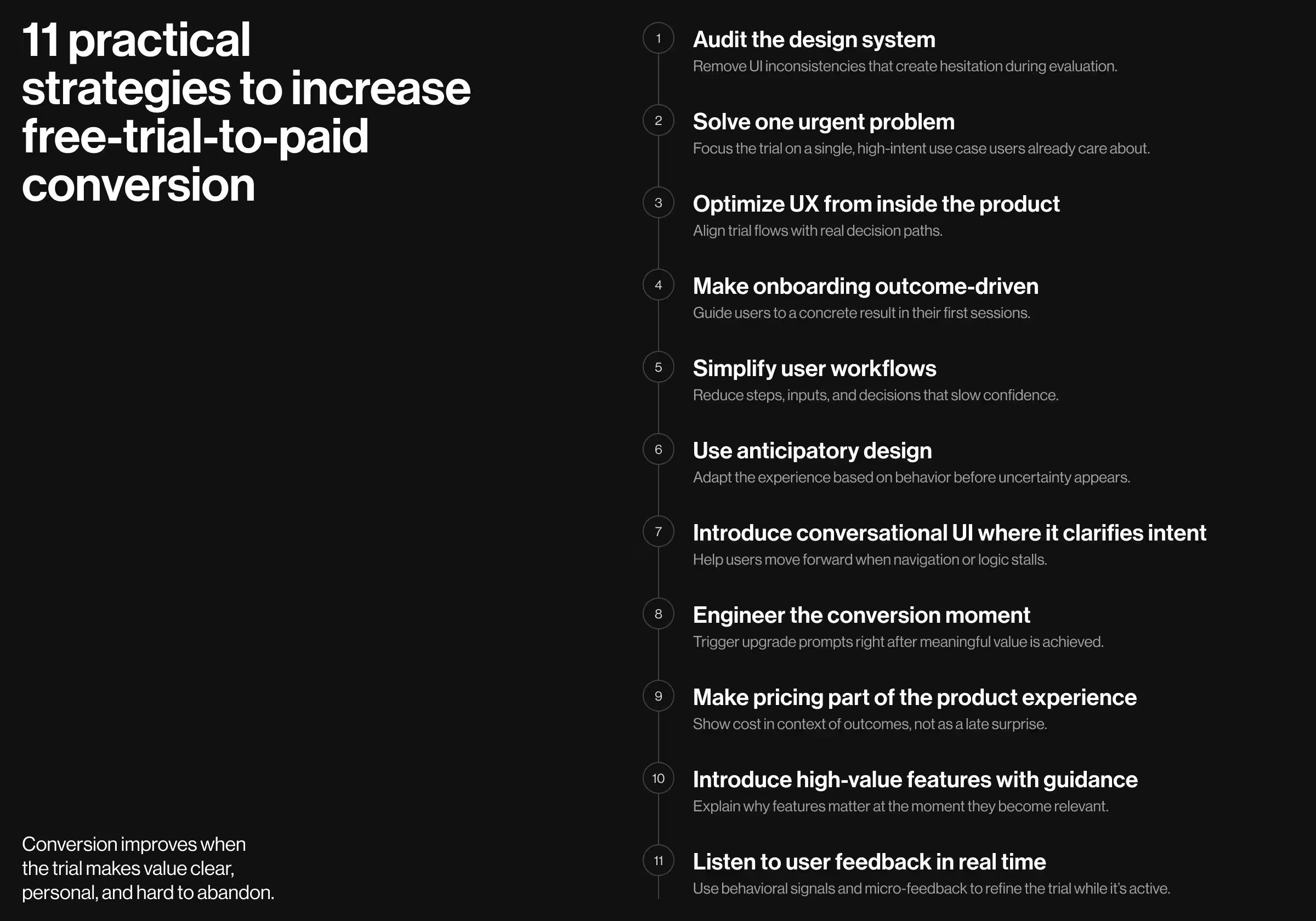
11 strategies to improve free trial to paid conversion rates
Improving conversion is about shaping the trial so that value becomes almost personal and hard to walk away from.
Below, our AI UX design team has shared 11 practical strategies for a conversion rate boost that lasts and supports your business performance in the long run.
1. Start with a design system audit
Every trial inherits the logic of the system behind it. A design system audit exposes inconsistencies and barriers between components that hinder effortless decision-making.
By identifying where users hesitate or lose context, teams surface issues that no onboarding flow alone can fix.
What to audit first:
- Tokens: spacing, typography, and color roles that vary across key trial flows
- Components: identical elements that behave differently (buttons, inputs, modals)
- States: empty, loading, error, and success states that lack clarity or consistency
- Patterns: one-off UI solutions replacing reusable logic in the onboarding process or setup
🔍 Explore our detailed guide on how to carry out a strategic design system audit.
2. Ensure the trial solves one clear, urgent problem
When a trial attempts to represent the full product, users spend time exploring instead of deciding. High-converting trials make a deliberate trade-off here. They narrow the experience to one problem the user already recognizes as urgent and solve it top to bottom.
How to define the trial’s core problem:
- Identify the moment users seek the product most actively
- Isolate the task that signals serious intent
- Exclude secondary use cases, even if they test well
What the trial must deliver within that scope:
- A visible before/after state the user can recognize
- A result that would be costly or time-consuming to recreate manually
- A clear sense of what improves after upgrading
3. Optimize UX from within the product
Optimizing UX from within the product means aligning the trial experience with how users navigate their customer journeys and make decisions.
Optimization starts by replacing assumptions with clear models: who enters the trial, what they’re trying to confirm, what barriers interrupt progress, and where confidence breaks before commitment.
Anchor UX optimization in 4 internal assets:
- UX personas: define users by decision context
- Customer journeys: map the exact path from first action to evaluation moment
- Product roadmap: prioritize changes that shorten the path to perceived value
- Product page optimization: sharpen the page where intent turns into action
Where to focus inside the trial experience:
- Decision-critical flows: onboarding, first setup, primary task completion
- Moments of hesitation: repeated actions, backtracking, idle states
- System feedback: loading, success, and error states that signal progress or uncertainty
🔍 Consider our design team’s perspective on what UX optimization done right looks like.
4. Make onboarding outcome-driven
An effective onboarding experience escorts users to a result. The faster users reach a meaningful outcome, the sooner they can decide whether the product deserves a place in their workflow.
Define the outcome onboarding must deliver:
- A tangible result the user immediately recognizes
- A moment that answers “This works for me”
- Evidence that continuing would compound value
Signals that onboarding is doing its job:
- Users complete a core action in the first session
- Repeated exploration decreases after initial use
- Upgrade prompts feel expected
🔍 Explore how to design a new customer onboarding that guides customers to value fast.
5. Simplify user workflows
Elaborate workflows introduce doubt. When actions feel layered and overly manual, users question whether the product will remain manageable after the trial.
Products like SolarDrive demonstrate a simple principle: when the same outcome requires fewer steps, users perceive higher quality and greater control (even when functionality is unchanged).
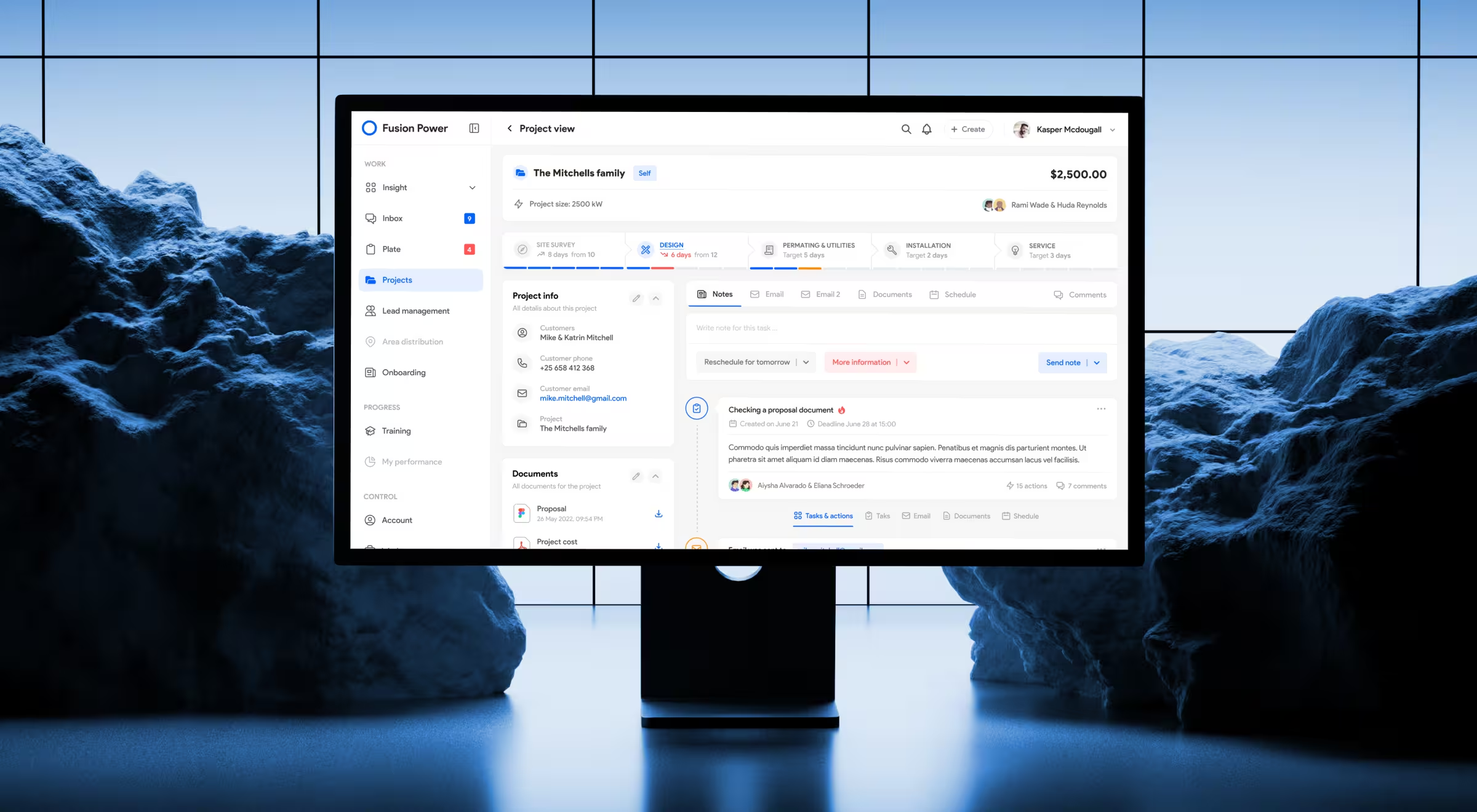
Where to simplify first (trial-critical paths):
- Primary task flows: the action users repeat to validate the value
- Set-up sequences: configuration steps that delay visible progress
- Decision points: moments where users must choose between options without context
A quick workflow sanity check:
- Does each step change the user’s understanding or outcome?
- Can any input be inferred, prefilled, or deferred?
- Is the next action obvious without instruction?
6. Use anticipatory design to personalize experience
Anticipatory design earns its place in a free trial when it reduces user effort before uncertainty sets in. Instead of waiting for input, the product interprets behavioral and contextual signals and adjusts the experience in advance.
Products like Pika AI apply anticipatory logic to make value feel personal from the first interaction. The interface adapts to what the user is trying to achieve next. As a result, progress feels guided — a key to winning user trust when it comes to trials.
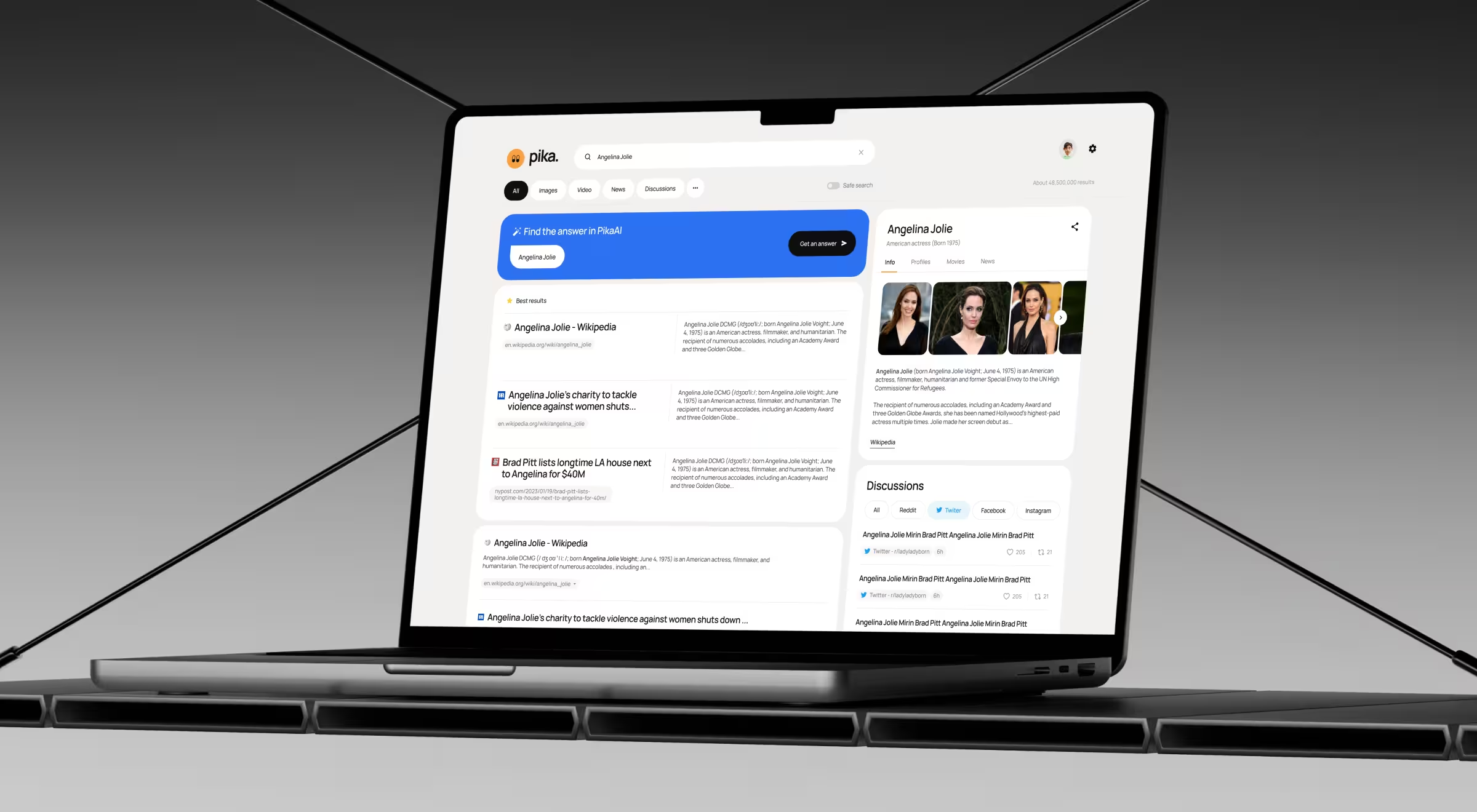
Where anticipatory design matters most in a trial:
- Early sessions: pre-empt common setup choices with sensible defaults
- Moments of hesitation: surface the next logical action without prompting
- Evaluation points: highlight outcomes the user is likely trying to confirm
Signals worth acting on:
- Repeated actions or backtracking
- Idle states after key screens
- Partial completion of core tasks
- Patterns shared by users who eventually upgrade
7. Introduce conversational UI where it clarifies intent
Conversational interfaces reduce cognitive load when users are unsure what to do next. Used strategically, they guide exploration and surface relevant actions.
In complex products, this strategy is a shortcut to value.
Where conversational UI has the highest impact in trials:
- Exploration bottlenecks: users scanning multiple sections without committing
- Complex tasks: actions that require multi-step setup or complex interpretation
- Evaluation moments: “Can this do X?” questions users struggle to validate on their own
Patterns that work well in trials:
- Intent prompts: “What are you trying to achieve right now?”
- Multi-turn guidance: breaking a large task into manageable steps
- Context carryover: resuming unfinished work without re-setup
8. Engineer the conversion moment intentionally
High-performing trials align upgrade moments with completion of meaningful actions. The upgrade prompt should arrive when the user has enough evidence to say yes.
What qualifies as enough evidence:
- Completion of a core task tied to the trial’s primary promise
- A visible before/after state that the user recognizes as substantial
- Repeated customer engagement with the same high-value action
Where the conversion moment belongs:
- Immediately after a meaningful outcome
- Inline with the workflow the user just completed
- Framed as continuity: keeping progress, context, history, and capability intact
9. Make pricing part of the product experience
Pricing works best when it’s contextual and visible early. When your target audience understands cost alongside value, price becomes predictable.
Embedding pricing logic into the product experience reduces late-stage hesitation.
Where pricing belongs inside the trial:
- Alongside outcomes: showing the cost next to what the user just achieved
- At natural limits: when usage approaches a meaningful threshold
- Within workflows: clarifying what continues and what expands after the upgrade
What to surface before the upgrade prompt:
- The plan required to sustain current results
- The specific capability unlocked at the next tier
- A clear distinction between what pauses and what persists
10. Introduce high-value features with guidance
New features increase conversion only when users understand why they matter. Clear guidance helps users connect features to outcomes.
Without that link, product features remain unused, no matter how advanced they are.
Where feature guidance has the most impact:
- Immediately after users complete a related action
- When they hit a natural limit or workaround
- At moments where outcomes plateau without deeper capability
What useful guidance looks like inside the product:
- One-line intent framing: what this feature enables next
- Inline examples using the user’s own data
- Visual previews that show the result
🔍 Learn more about how to make new functionality stick using proven feature adoption strategies.
11. Listen to user feedback
Trials generate high-signal feedback. Users tell you where value breaks. However, they often do so indirectly.
Teams that improve conversion don’t wait for surveys to pile up. They listen in real time and respond while the trial experience is still forming.
Where high-signal feedback surfaces during trials:
- Abandoned setup steps
- Repeated actions that don’t lead to progress
- Feature use without follow-through
- Support questions phrased as “Can I…?” or “Is it possible to…?”
How to collect feedback without disrupting the trial:
- Short, situational prompts after key actions
- Passive signals from usage, retries, and backtracking
- Lightweight text input tied to moments of uncertainty
🔍 Explore our guide for a deeper dive into how to collect and interpret user feedback.
A decision framework for improving free trial to paid conversions
With strategies at your disposal, the next step is focus.
Most teams try to improve free trial to paid conversions by adjusting multiple variables at once. Optimizing user onboarding, messaging, pricing, and lifecycle prompts becomes a matter of a single KPI improvement project. Such an ambitious approach spreads effort thin and makes causality hard to read.
A more effective path is to diagnose where conviction breaks inside the trial experience, then intervene with intent and strategy. This framework helps isolate the failure point before choosing a solution.
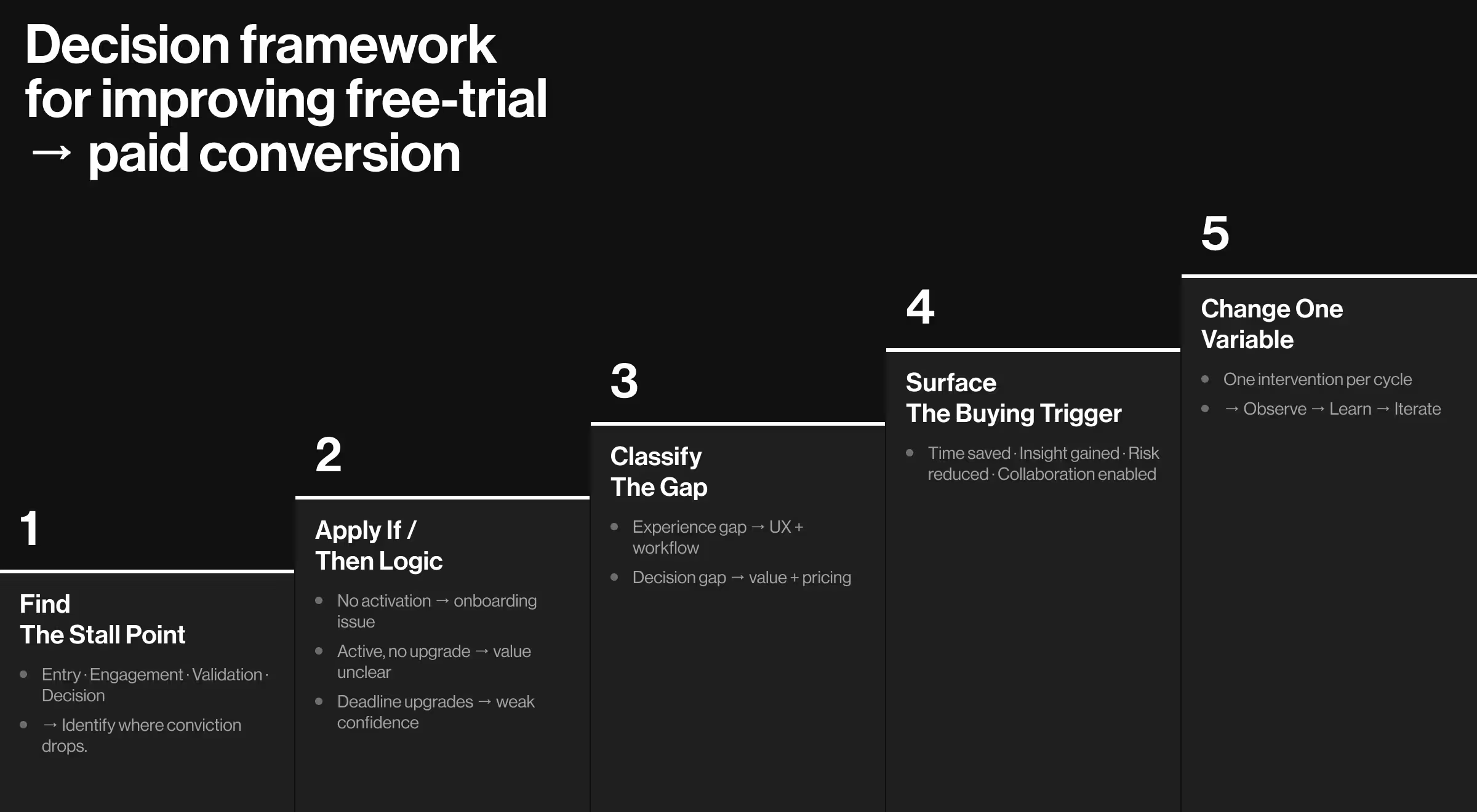
Step 1: Identify where commitment stalls
Every trial user moves through 4 implicit stages:
- Entry – why they signed up
- Engagement – what they tried
- Validation – whether it worked for them
- Decision – whether continuing feels justified
Step 2: Apply if/ then logic to prioritize action
Use conditional logic to guide focus:
- If users never activate ▶️ then onboarding and workflow design are the bottleneck.
- If users activate but don’t upgrade ▶️ then the paid value isn’t clear early enough in the experience.
- If users stay active until the trial ends ▶️ then the product is useful, but the decision moment lacks urgency/ clarity.
- If only teams convert ▶ ️ then individual value isn’t strong enough without a collaboration context.
- If upgrades cluster at the deadline ▶️ then urgency exists, but confidence is fragile.
This logic prevents teams from fixing downstream problems with upstream tools.
Step 3: Distinguish between experience gaps and decision gaps
Not all conversion issues are experiential. Some are decisional.
Experience gaps occur when:
- Users struggle to complete meaningful actions
- Workflows feel heavier than expected
- Outcomes require too much setup
These call for UX simplification, anticipatory design, or workflow compression.
Decision gaps occur when:
- Users achieve outcomes but hesitate to commit
- Pricing feels disconnected from value
- Paid benefits feel abstract
These call for better value framing, clearer upgrade moments, and pricing visibility.
Treating a decision gap like an experience gap leads to overbuilding. Vice versa, approaching an experience gap like a decision gap leads to irrelevant pressure tactics.
Step 4: Align trial design to the actual buying trigger
Every product has a specific buying trigger. And it’s often different from what teams assume. Some users buy after:
- Saving time
- Gaining insight
- Reducing uncertainty
- Enabling collaboration
- Avoiding future risk
The trial should be structured to surface that trigger explicitly. When the trigger remains implicit, users leave undecided, even if satisfied.
Step 5: Choose one intervention per cycle
High-performing teams resist stacking fixes. They change one variable, wait for users to experience the change, observe behavior, and iterate. Consider the following examples of this mindset:
- Redesign the first session before adjusting trial length
- Clarify paid-only value before introducing discounts
- Surface pricing earlier before adding reminders
This keeps learning clean and conversion improvements compounding.
Free trial conversions improve when commitment feels reasonable
Free trial to paid conversion breaks because the trial fails to resolve uncertainty at the right moment.
When users experience real value, understand what improves after upgrading, and feel the price aligns with what they’ve already gained, the decision to pay feels natural.
The teams that win here don’t push harder. They design trials that make walking away irrelevant.
If your trial experience isn’t doing that yet, it might be time to rethink the system behind it. Talk to our team to explore how AI UX, anticipatory design, and conversion-focused strategy improve your business performance.



.avif)