
When Nike wanted to deepen its connection with customers, it built the Nike Run Club app. This digital companion tracks runs, offers coaching, and connects users through challenges. Suddenly, workouts turned into habits, and customers kept the brand in their pocket every single day.
That’s what the best app design can do. It transforms products into experiences and businesses into part of a customer’s routine. In this article, we’ll look at why apps matter, share the numbers that prove their impact, point you to the best places to seek inspiration, and highlight the best designed apps that show how smart digital solutions drive growth.
Key takeaways
- Design is the make-or-break factor. An intuitive flow can turn a struggling brand into a market leader.
- Inspiration without execution is useless. The winning edge comes from combining bold design ideas with the right tools, testing, and frameworks.
- Lazarev.agency, an AI design agency, sets the benchmark. With apps like Happiness, GoPingu, Activote, and Mappn, we prove design can double retention and dominate competitive markets.
What does an app do for businesses across industries?
Before diving into design itself, it’s critical to understand why apps matter for businesses. Mobile apps have evolved into ecosystems that increase customer retention and business revenue.
And the numbers prove it. Consumers spent $36.2 billion on mobile apps in just one quarter of 2024. The industry itself is exploding, climbing from $252 billion in 2023 to a projected $626 billion by 2030.
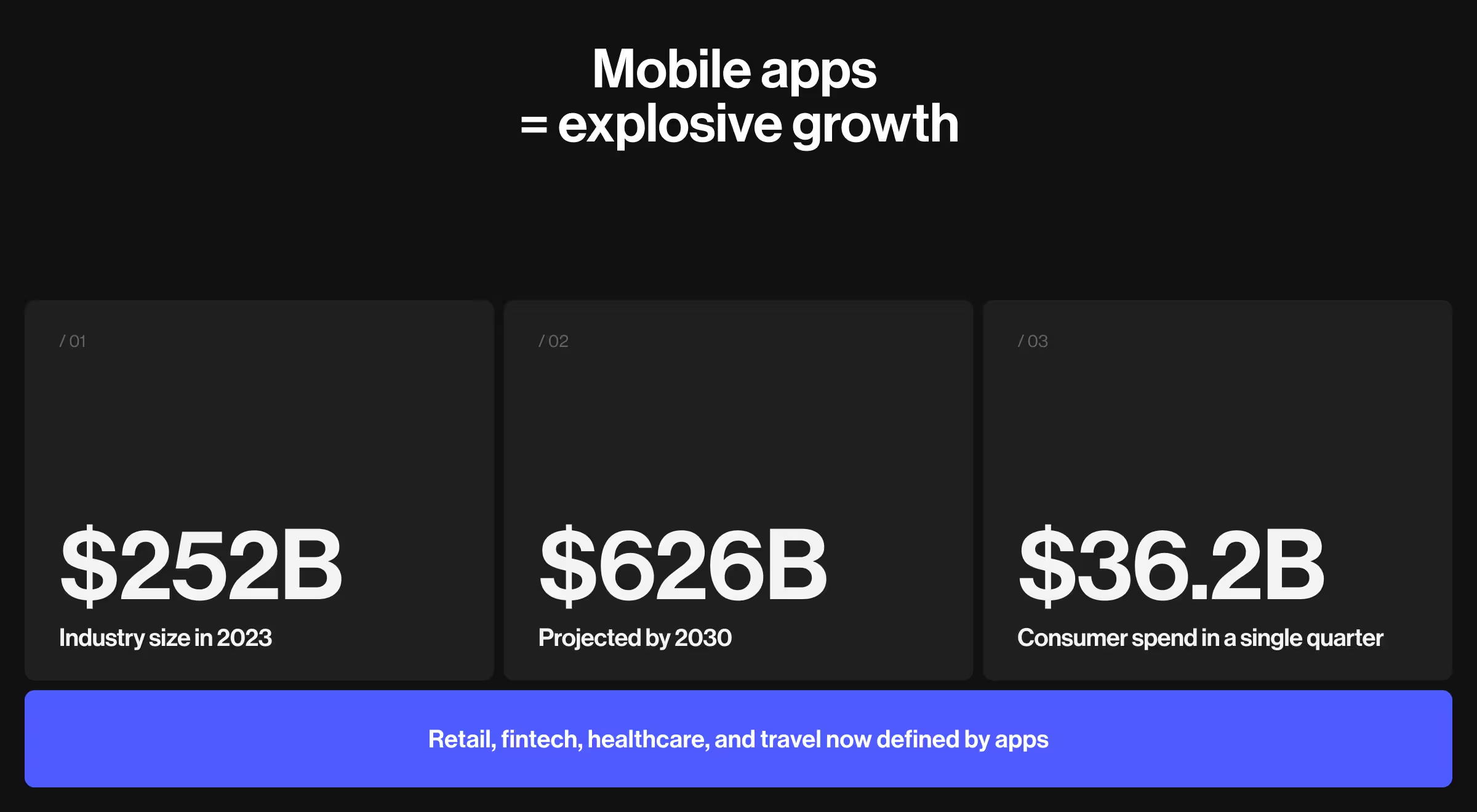
Across industries, the story is the same. Retail apps drive buying, fintech apps transform complex financial transactions into a swipe, healthcare apps put doctors in your pocket, and travel apps make booking as effortless as a tap. In short, if you’re not meeting your customers in their app ecosystem, someone else will.
Does your business need an app?
Knowing the potential is one thing. The real question for decision-makers is whether an app makes sense for your business today.
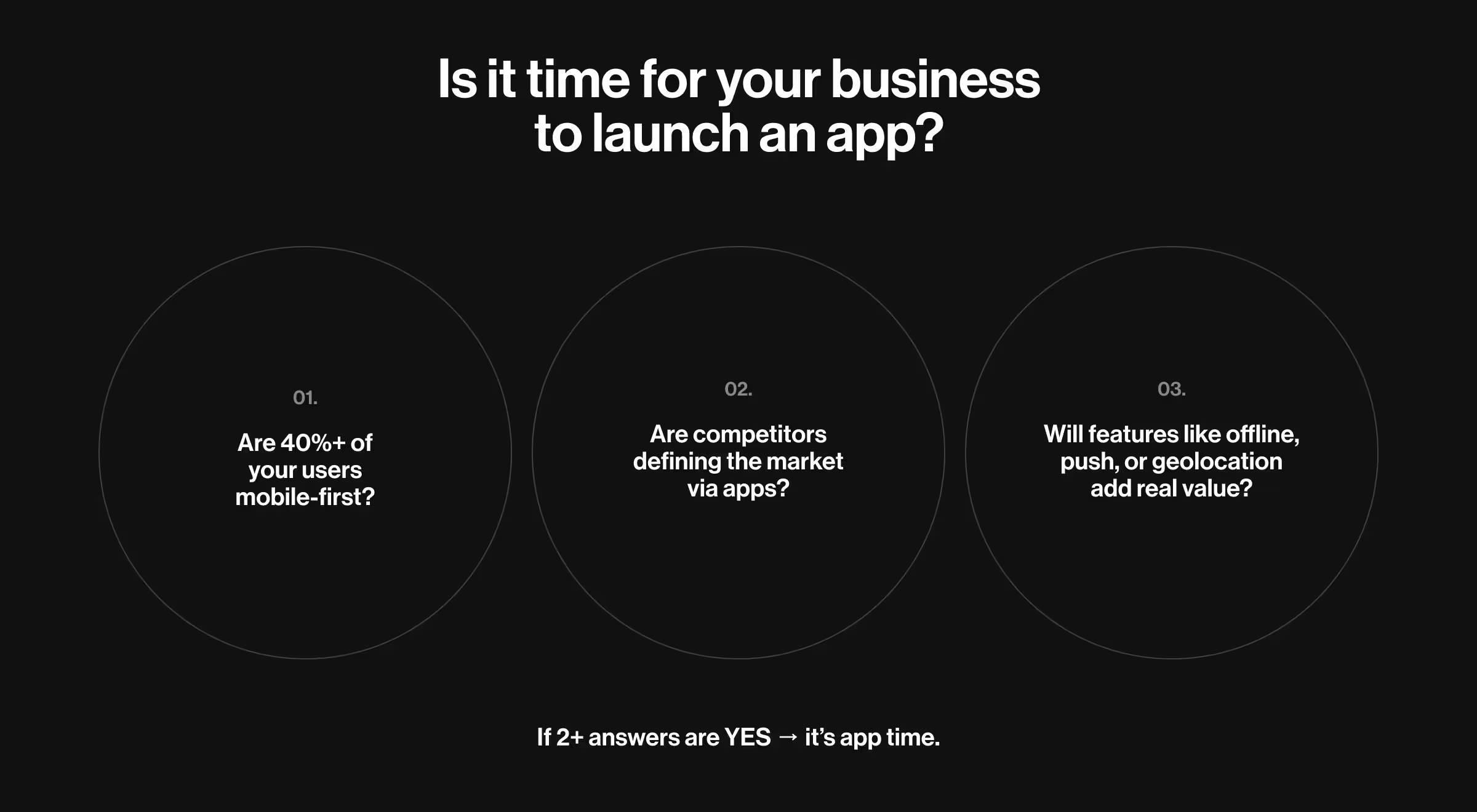
Not all companies need an app immediately. But for many, it becomes the natural next step in scaling digital presence. Here’s how to evaluate:
- Audience behavior: If 40% or more of your users are mobile-first, an app can meet them where they already are.
- Industry standards: Retail, fintech, healthcare, and travel industries are increasingly defined by apps. Here, falling behind can mean losing relevance.
- Value-add vs. website: Ask if an app will deliver benefits that a website alone cannot. Think of offline access, notifications, geolocation, and extra integrations.
When weighing the decision, balance the benefits against the drawbacks. On the positive side, apps boost retention, enable personalization, and strengthen brand presence by becoming part of a user’s daily routine.
On the flip side, they require substantial upfront investment, ongoing maintenance, and leave you partially dependent on app store ecosystems and their rules.
“You’re ready for an app if mobile dominates your traffic and your business model thrives on repeat engagement.”
{{Anna Demianenko}}
🔍 A quick way to derisk the decision is testing core use cases through mobile site optimization experiments before investing in a full app build.
Where to look for modern app design inspiration?
If you’ve identified the need, the next challenge is knowing how to design it well. And that starts by studying the best in the market.
Inspiration doesn't come out of thin air. It's built by analyzing the best work in the industry, which is the method behind our practitioner's guide to UI examples.
Fortunately, there are platforms dedicated to curating modern app design:
- Behance for deep case studies with full user experience flows.
- Dribbble for experimental app UI and motion concepts.
- Mobbin for practical mobile patterns from real-world apps.
- Pttrns for categorized UI design solutions for onboarding, checkout, and more.
- Awwwards for award-winning digital design, including app landing pages.
Professional designers use these platforms to create swipe files: collections of layouts, user flows, and ideas they can later analyze and adapt.
14 best designed apps making history across industries
The best way to learn what makes an app unforgettable is to study those that define industries.
Below, we group 14 exceptionally good app design examples to show how design transforms digital products into daily rituals, trusted tools, and even billion-dollar businesses.
Best mobile app landing page examples
Landings are where users decide if your app is worth their time. The mobile app landing page examples listed below illustrate how to make that first impression count.
- Airbnb – With its minimalist booking flows and rich imagery, Airbnb makes exploring and booking effortless.
- Dropbox – A productivity tool that thrives on its no-frills landing flow. The interface guides users directly to core actions like file storage and sharing.
- Happiness by Lazarev.agency – Designed as a six-week gamified wellness journey, Happiness starts building trust from the landing page. Instead of pushing features, the promo page sells the value of balance and transformation, making change feel achievable before signing up.
Best financial app design examples
Financial app design rests upon principles of transparency and a sense of control.
- Revolut – Makes multi-currency transactions intuitive with clean dashboards and real-time updates.
- Robinhood – Simplifies investing for beginners through gamified flows and straightforward visual cues.
- Cash App – Its design is praised for ultra-minimalism. Users can send money, invest in stocks, or buy Bitcoin with just a few taps. The clean typography and bold CTAs make complex financial actions feel effortless.
Best chat app UI design examples
Messaging and collaboration apps succeed when design removes friction and makes conversations feel fluid.
- Slack – Friendly colors and structured channels support team communication.
- WhatsApp – Proof that global-first simplicity and clean UI win.
- GoPingu by Lazarev.agency – A project management platform redesigned into a lively, collaborative hub. Our UI and UX designers transformed it from a utilitarian tool into an interactive workspace with Kanban-inspired flows, team modules, and mobile-first adaptation. The design redefined task management as something intuitive, even delightful.
🔍 Studying top apps is only step one; choosing a partner capable of designing at this caliber starts with the vetted teams in our best app designing companies breakdown.
Other category-defining apps
Beyond landing pages and finance, many apps illustrate how design principles carry across industries.
- Spotify – Personalization meets fluid navigation and keeps engagement high.
- Google Maps – Shows how vast data can still feel simple through a clear hierarchy.
- Pinterest – Visual discovery powered by intuitive grids and infinite scroll.
- Medium – A masterclass in readability through typography and focus.
- Mappn by Lazarev.agency – Built to stand out in a crowded entertainment market, Mappn engages users through interactive maps, filters for nightlife and social discovery, 3D animations, and curated recommendations.
What makes the best app design: key principles
So what principles do these industry-defining apps share? Let’s extract the DNA of great design. Across industries, the same principles repeat in the most successful apps.
The principles show up most clearly on one screen; see app home screen patterns for the teardowns.
Tools and frameworks for best app design
Principles are the “why”. But execution depends on the “how”: the tools and frameworks that bring design to life.
It all begins with the design environment. Modern design tools offer collaborative spaces where teams visualize and prototype.
- Figma: The industry standard for the collaborative design process. Allows designers, developers, and stakeholders to co-create and test flows simultaneously.
- Sketch: Lightweight and intuitive, often the go-to for wireframing and rapid iteration.
Once ideas are on the canvas, they need to move beyond design silos. That’s where real time collaboration frameworks come into play.
- Design sprints: Condense the cycle from idea to clickable prototypes into 5 days. Helps teams validate assumptions before making a significant investment.
- Lean UX design: A philosophy that emphasizes experiments and user feedback over heavy documentation.
- Agile integration: Keeps design and development synchronized, reduces handoff, and ensures iterations are grounded in user research findings.
But design is only as good as the feedback it receives. Before a product goes live, it must be tested rigorously with real users. Testing and validation tools accelerate this feedback loop and make it data-driven.
- Maze: Enables remote usability testing.
- Lookback: Records real user sessions, exposes existing barriers and moments of confusion.
- Hotjar: Delivers behavioral insights through heatmaps and analytics, showing how users actually navigate screens.
Finally, great designs must survive translation into working products. That’s where development frameworks come in, bridging the gap between vision and execution:
- Flutter: A cross-platform solution that allows one codebase to deliver near-native performance on both iOS and Android.
- React Native: Popular for its flexibility and vast ecosystem, which makes it easier to scale products quickly.
- SwiftUI: Native frameworks for iOS. Offers the deepest integration and platform-specific performance.
Together, these tools and frameworks form an end-to-end ecosystem. Design tools bring clarity, collaboration methods create alignment, testing reduces risk, and development frameworks ensure delivery at scale. This cycle is what transforms a promising app idea into one of the best app designs on the market.
🔍 Even the best tooling stack won’t matter unless your team understands what drives early-stage stickiness; our mobile app retention breakdown helps teams design with that maturity in mind.
Build the next category-defining app with Lazarev.agency
The best app design is the difference between being an icon on a user’s home screen and becoming part of their daily routine. The companies that embraced it rewrote their future.
At Lazarev.agency, an AI UX design agency, we’ve done the same for our clients. Our work proves that design is strategy in motion. With $500M+ raised across client projects and a track record of turning products into leaders, we know what it takes.
Don’t settle for functional. Contact us to build the best mobile app design your business deserves.

.avif)