

Most startups fail when growth finally starts working, and the rest of the business can’t keep up.
The pattern is similar across the industries. Users are coming in, the team is busy, and revenue looks promising. Then progress slows, and the product feels somehow heavier. Scaling begins to look harder than building ever was.
Now look at Dropbox. It didn’t chase growth early on. Only after the product proved it could handle growing demand did Dropbox raise Series B and scale into a multi-billion-dollar company.
How to scale a startup isn’t about pushing harder. It’s about knowing when your product, systems, and team are ready, and what to fix before growth magnifies the cracks.
This article breaks scaling down into clear stages, signals, and practical actions, with a sharp focus on where most startups stall and how digital product design can help your business achieve unseen highs.
Key takeaways
- Scaling and growing aren’t synonyms. Growth adds effort. Scaling removes it through systems, automation, and repeatable decisions.
- PMF is necessary, yet not sufficient. 78% of startups with PMF fail to scale because structure (not demand) breaks first.
- Design is your scalable infrastructure. Strong UX, product logic, and design systems reduce decision cost and operational drag — outcomes Lazarev.agency has consistently delivered across industries.
- Stage awareness prevents costly mistakes. Scaling too early amplifies chaos. Scaling too late hands the market to competitors.
How does scaling in a startup world look like in 2026?
“We’ve seen it first-hand: scaling a business is a matter of strategy. Approach it like a bet, and chances are 50/50. Treat it as a system where tactics follow strategy, and the odds are much more likely to be in your favor.”
{{Kirill Lazarev}}
It’s not yet another baseless assumption. It’s a direct repercussion of having a clear brand identity reinforced by an actionable product vision and a feasible product strategy.
The startup world is highly saturated. Standing out in 2026 means navigating dense markets and rising user expectations, while knowing exactly where your company is headed and why.
And the numbers back this up:
- The startup industry is overcrowded. According to Forbes, nearly 305 million startups are launched each year globally.
- Product–market fit (PMF) does not guarantee scale. McKinsey finds that 78% of companies that reach PMF fail to scale, typically plateauing or exiting before meaningful growth.
- Most scaling failures are organizational. McKinsey reports that even companies with successful products face an 80%+ failure rate, and 65% of those failures are driven by HR and organizational breakdowns.
- Artificial intelligence (AI) is now a baseline expectation among investors. According to PwC, over 60% of investors expect tangible productivity and profitability gains from generative AI within the next 12 months.
- Scaling in 2026 prioritizes human capability as much as automation. PwC informs that 74% of investors expect increased investment in upskilling, and AI is just as likely to increase headcount (32%) as reduce it (32%). This proves that scale depends on capable teams.
- Digital presence defines credibility. Research shows that 94% of users assess a business’s credibility based on the quality of its online presence, making UX performance and design scaling requisites.
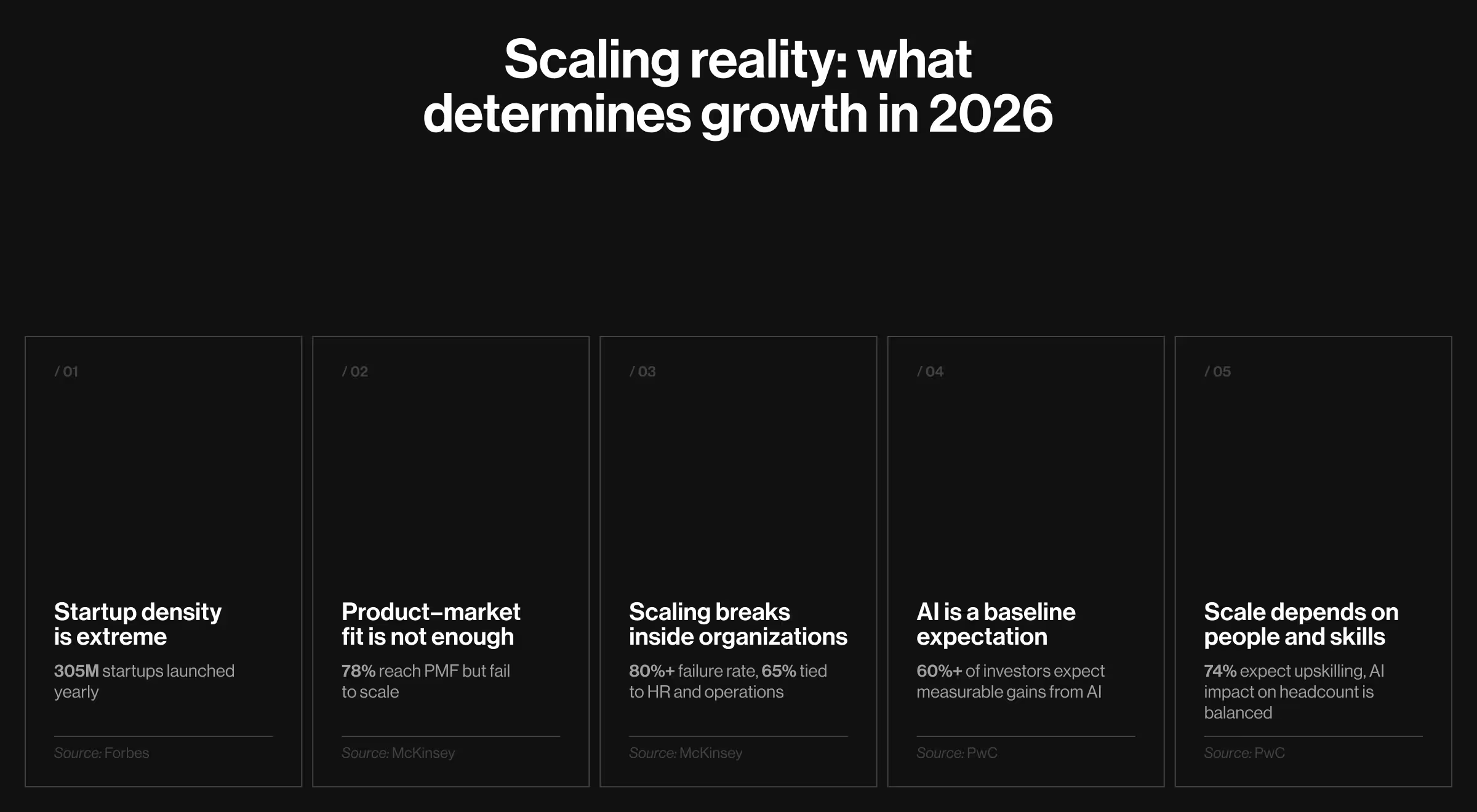
Taken together, these signals paint a clear picture of what scaling looks like in 2026:
- The market is crowded.
- Capital is cautious.
- AI transformation is more than welcome — it’s expected.
- Human talent remains the primary limiting factor.
- The company’s digital presence determines whether users and investors trust it enough to stay.
Scaling is about building systems that let skilled workers, technology, and experience reinforce each other without breaking under their own weight.
The challenge is real. Fortunately, so is the solution.
What does scaling a startup mean?
Let’s clear out a bit of theory before diving into practical guidelines.
Scaling a startup means increasing revenue without increasing costs at the same rate. It’s often confused with growth, but the two operate on different logic.
When a startup scales, its processes and decisions are designed to handle more demand without proportional increases in effort or budget.
Here’s how Lazarev.agency’s CEO, Kirill Lazarev, defines the difference:
“Growth is additive. Scaling is multiplicative.
When a startup grows, revenue increases because inputs do. You hire more people, add more tools, open new markets, spend more on acquisition, etc. The business moves forward, while costs follow closely behind.
When a startup scales, revenue increases because leverage already in place. Processes are automated. Decisions are repeatable. The product delivers value with minimal marginal cost.”
To make the distinction more concrete, here’s how growth and scaling compare across key dimensions.
Both approaches are valid. They just solve different problems.
Mechanics behind startup scaling
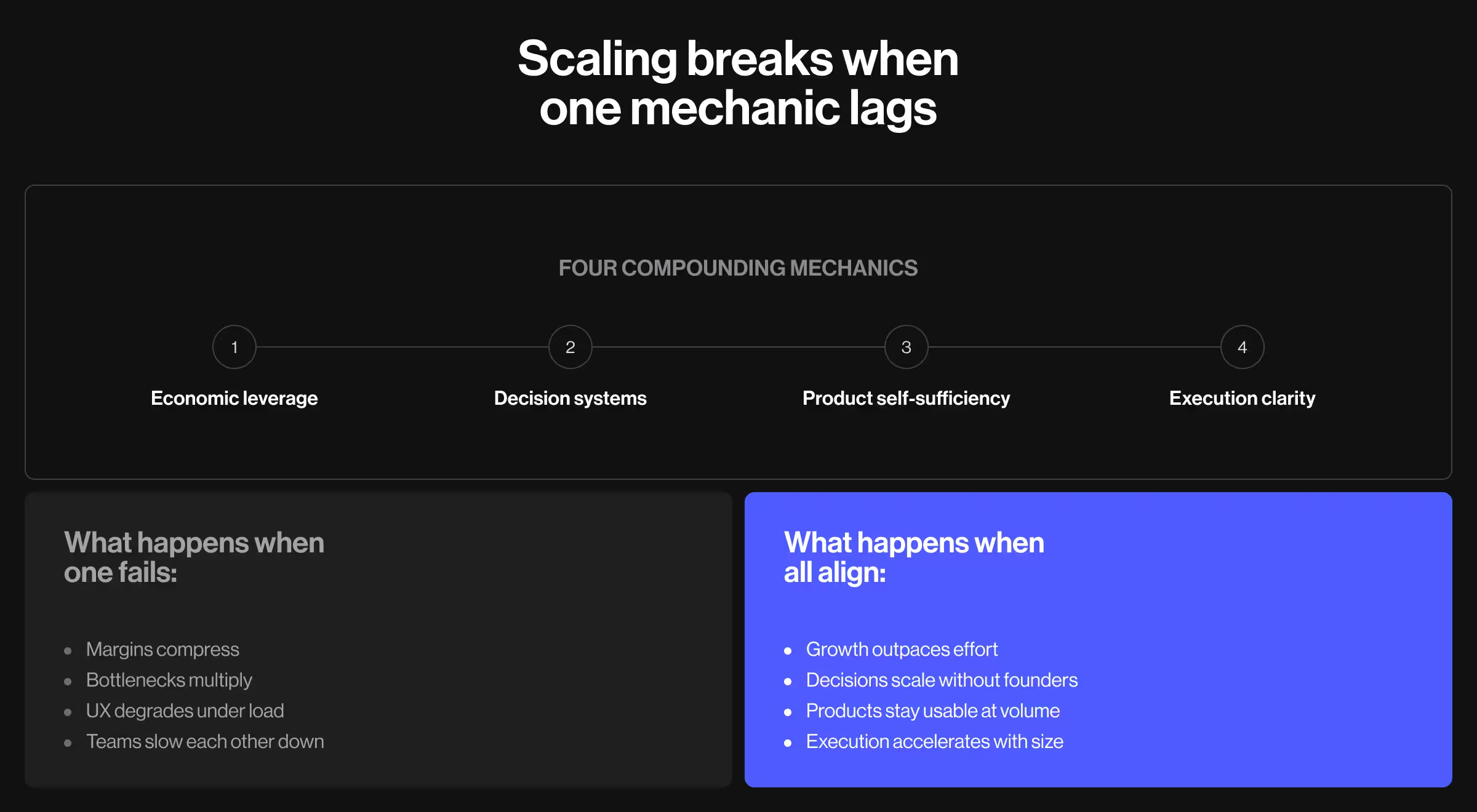
Scaling is the result of four compounding mechanics working together.
1. Cost decoupling
Scaling begins when revenue is no longer tightly coupled to effort. If doubling new customers requires doubling support or sales, the business is still in growth mode.
Examples of cost decoupling:
- self-serve onboarding instead of manual setup
- standardized pricing instead of custom deals
- automation replacing coordination
2. Repeatable decisions
At scale, decisions can’t live in people’s heads. They have to live in systems. That requires:
- clear ownership
- documented principles
- predictable trade-offs
If every launch or feature requires founder involvement, scaling stalls.
3. Product leverage
A scalable product stays intuitive and reliable even as demand grows. It:
- teaches users how to succeed
- prevents misuse by default
- anticipates and handles edge cases
This is why UX strategy glow up and information architecture matter more at scale than piling on new features.
4. Organizational clarity
Most scaling failures are internal. As companies grow, roles blur and execution grinds down. That’s usually where things unravel.
Scaling requires:
- fewer handoffs
- managers who own outcomes rather than tasks
- teams aligned around problem-solving and not isolated product optimization
When even one of these mechanics breaks down, scaling becomes problematic if not downright impossible.
When is a startup ready to scale?
Now, is your startup ready to scale?
If demand increases and teams compensate with manual work or rushed fixes, the company is in growth mode. Scaling only works when leverage is already in place.
Use this checklist to assess readiness across the areas that most often break under scale.
How to interpret the result:
- 70–80% green → scale deliberately
- Below that → fix structure first
Scaling amplifies what’s already there. If the foundations aren’t solid, it exposes cracks.
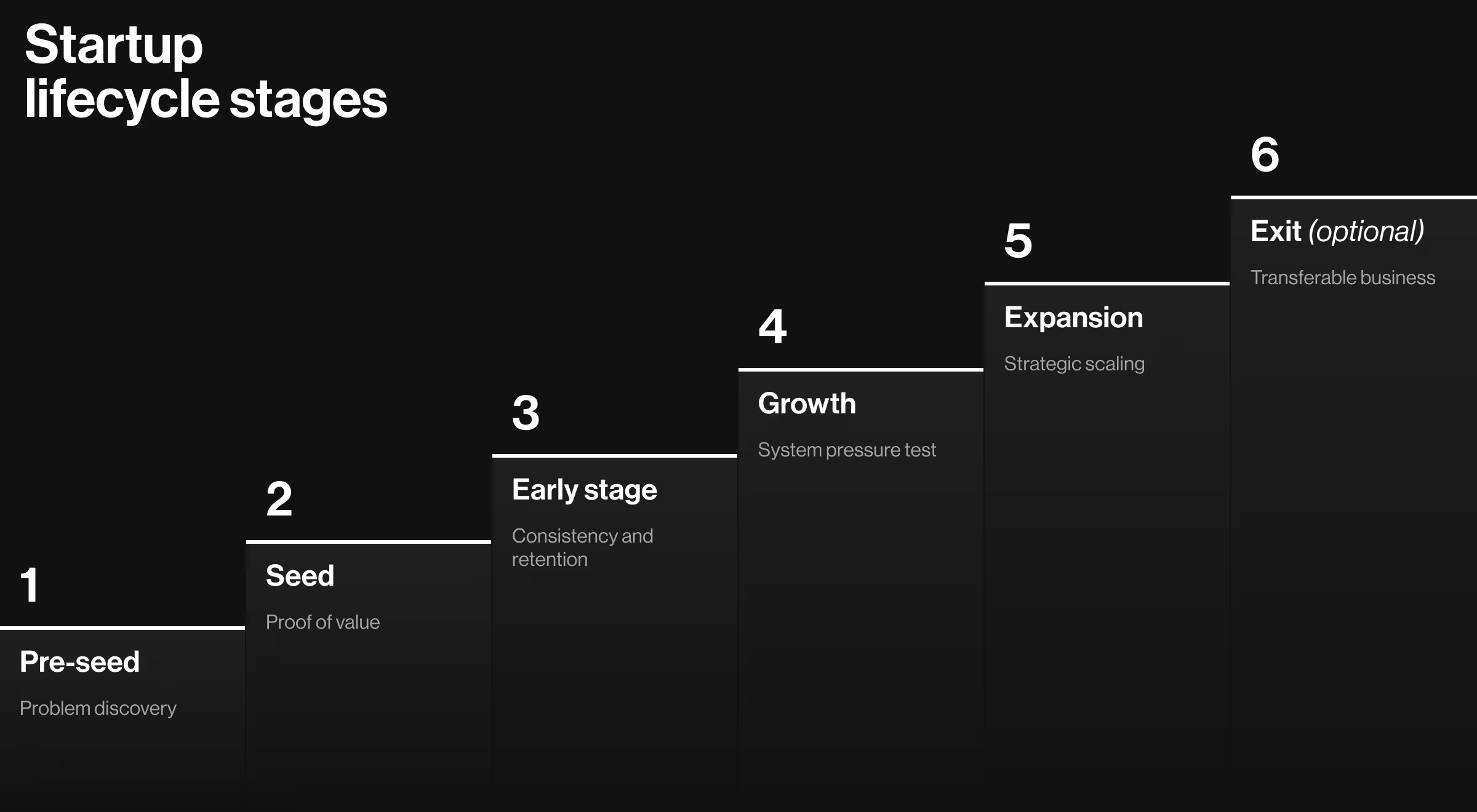
What does the startup lifecycle look like from idea to scale?
Scaling is a phase within a longer startup journey. There, mistakes made earlier surface fast and at full volume.
Understanding the startup lifecycle helps founders make the right decisions at the right time.
Below is a six-stage startup lifecycle, with clear priorities, risks, and signals to watch at each step.
1. Pre-seed
What this stage is about: You’re not building a company yet. You’re testing whether a real problem exists and whether you’re the right team to solve it.
What to focus on:
- A clear problem statement addressing the growing pains the market faces
- Formulating pilot hypotheses
What to avoid:
- Overdesigning and overengineering
- Assuming demand without product validation
Key question: Would anyone care if this didn’t exist?
2. Seed
What this stage is about: You’ve identified a problem worth solving and are proving that your solution works for a real audience.
What to focus on:
- A functional MVP
- Early user feedback loops
- Identifying (and addressing) the biggest obstacles to adoption
What to avoid:
- Premature hiring
- Complex pricing models
Key question: Do users get value without explanation?
🔍 Explore leading AI MVP design companies to help you get funded.
3. Early stage
What this stage is about: With early traction secured, you’re moving from “it works” to “it works consistently”.
What to focus on:
- Retention and usage patterns
- One repeatable acquisition channel
- Clear positioning and messaging
What to avoid:
- Custom solutions for every customer
- Expanding before stabilizing
Key question: Would this grow without constant founder involvement?
🔍 This is also where many tech startups hit their first Series A wall. Traction exists, but the product doesn’t yet signal confidence to investors. Sounds familiar? Read more on how to design for Series A funding and why your product might be the problem.
4. Growth
What this stage is about: Demand increases, and weak systems start showing. This stage reveals whether the business is built to scale or survive.
What to focus on:
- Ownership and accountability
- Optimizing existing processes
What to avoid:
- Scaling teams without systems
- Treating symptoms instead of causes
Key question: What breaks first when volume increases?
🔍 Learn more about strategic planning and UX optimization for future-ready digital products.
5. Expansion
What this stage is about: The company has a stable demand. Now scaling becomes strategic.
What to focus on:
- Cost decoupling
- Automation and standardization
What to avoid:
- Expanding in too many directions
- Diluting the product experience
- Losing strategic focus
Real-world example: At this stage, digital product design often becomes the deciding factor between plateau and scale. Accern is a clear case. After reaching Series B, the company partnered with Lazarev.agency to redesign its AI research product around real analyst workflows. The result was a scalable, AI-first product system that improved adoption and strengthened investor confidence. This way, a strategic digital product boost helped Accern raise $40M+ and progress from Series B to acquisition.
6. Exit (optional)
What this stage is about: Not every startup exits, and that’s fine. But when it does, disciplined scaling should be a priority.
What to focus on:
- Predictable performance
- Clean financials
- Transferable systems and leadership
What to avoid:
- Over-optimizing short-term metrics
- Last-minute restructuring
- Dependence on founders
Key question: Can the business run without you?
Why lifecycle awareness matters for scaling? Because scaling only works when applied at the right stage. Applied too early, it amplifies chaos. Applied too late, it hands the market to someone else.
Founders who understand the lifecycle build leverage stage by stage so that when scaling begins, it compounds.
How do you kick-start startup scaling with these 11 practical steps?
Scaling starts when you transform a working product into a repeatable business system. To make it stick, you must ensure there’s a growing demand, teams stay aligned, and operational efficiency is up and running.
This shift requires strategy, but progress comes from proven tactics set in action.
Follow the steps below to move from a functional product to a system built for organic growth.
1. Confirm real demand and validate product market fit
Goal: prove users want your product or service without founder-heavy pushing.
Do this:
- Identify 1–2 core use cases users repeatedly come for.
- Map the buying trigger: what happens right before they search for a solution?
- Validate willingness to pay with pricing tests.
Output:
A short PMF statement: user + pain + outcome + why you win.
🔍 Explore Lazarev.agency’s guide on how to identify market demand and build what customers are looking for.
2. Build a scalable business model for your start up
Goal: ensure revenue growth outpaces budget expansion.
Do this:
- Identify what drives customer acquisition cost (CAC), payback, gross margin, and churn.
- Standardize pricing and packaging (limit custom deals).
- Define your scale constraint: what resource becomes scarce first (support, infra, sales time)?
Output:
A 1-page model: Acquisition → Activation → Retention → Revenue → Cost drivers.
3. Align the team around a growth mindset
Goal: make decision-making scalable.
Do this:
- Define 3–5 operating principles (how we make trade-offs).
- Assign single-thread owners per domain.
- Build a culture of testing: hypotheses, experiments, testable outcomes.
Output: operating principles + ownership map.
🔍 Find out how design thinking reframes a conventional feature–building approach to a problem–solving mindset.
4. Invest in future-ready tech and automation
Goal: remove manual work that grows with volume.
Do this:
- Automate repetitive workflows: new customer onboarding, support triage, and reporting.
- Focus on anticipatory UX design.
- Build guardrails for quality checks, human review paths, and audit trails.
Output: an automation backlog ranked by ROI (time saved × frequency × risk reduction).
5. Optimize execution with strategic planning
Goal: remove structural blind spots and optimize execution as teams grow.
Do this:
- Bring in external UX/UI experts to audit core flows and decision paths.
- Document handoffs: who owns requirements, QA, launch criteria.
- Create one source of truth (product brief + product roadmap + UX success metrics).
Output: a prioritized execution improvement plan featuring what to fix now, what to automate, and what to redesign.
6. Treat digital product development as a business lever
Goal: use product and UX design to improve revenue drivers.
Do this:
- Connect product work to metrics: activation, monthly active users, conversion, and expansion.
- Build scalable UX patterns: consistent information architecture, reusable components, predictable behavior.
Output: a “growth-by-design” roadmap tied to business outcomes.
🔍 Explore Lazarev.agency’s growth strategies to maximize startup value with digital product design.
7. Write a scale-up business plan
Goal: make scaling a controlled execution plan.
Do this:
- Define your scale thesis (why now, why you, why this path).
- Set constraints: budget, hiring pace, quality bar, market focus.
- Set quarterly targets with leading indicators.
Output: 3–5 pages focused on actionable strategy, bets, milestones, risks, metrics.
8. Build an evidence-backed pitch deck
Goal: align story, proof, and product reality.
Do this:
- Lead with the problem and “why now” rationale.
- Make product screenshots match your positioning.
Output: a deck that answers: why this, why now, why us, why it will scale.
🔍 Take a look at Lazarev.agency’s guide on how to make a winning pitch deck.
9. Secure funding
Goal: fund scale without breaking unit economics.
Do this:
- Align your funding needs with your business model (product-led growth, sales-led, enterprise, or marketplace).
- Demonstrate how design and product maturity signals minimal risk for investors.
Output: a funding plan that defines the amount needed and the specific milestones this capital enables.
10. Document processes and performance metrics
Goal: make execution transferable across people and teams.
Do this:
- Document discovery, delivery, QA, release, and learn loops.
- Define a single metric owner per KPI.
- Create a weekly metrics review to trigger timely interventions.
Output: process documents, metrics dashboard, and a clear review routine.
11. Iterate based on performance and feedback
Goal: approach scaling as a continuous improvement loop.
Do this:
- Run continuous experiments in onboarding, activation, and retention.
- Track impact to see what moves key metrics.
- Review performance data and feedback monthly to adjust priorities.
Output: a repeatable iteration cycle that feeds continuous improvement and ensures the product evolves with user needs.
Most startups fail at step 5. Why and how to fix that?
Step five is where things get real.
Till now, you might be admiring how your business demand grows, whilst teams hustle. Then suddenly… progress slows. Everything feels heavier. When and how did it go wrong?
Let’s break down two common traps we’ve seen startups fall into.
Mistake 1. Underestimating the value of digital product design
Up to step five, startups tend to double down on engineering and operations while postponing serious design investment. Design is a “finishing touch” that can wait.
⛳ What goes wrong:
- Internal teams optimize digital product design locally
- UX debt accumulates faster than it’s resolved
- Design decisions become inconsistent
Why this inhibits scale: As mentioned above, scaling is about eliminating decision cost. Without strong design systems and strategic UX patterns, teams eventually break down under the pressure of inconsistency.
🟢 Fix: Reframe the digital product as a scaling instrument to:
- tie UX decisions to concrete business metrics (activation, retention, support load)
- design defaults that prevent misuse and minimize operational work
Mistake 2. Ignoring the value of an outside perspective
Founders and internal teams are too close to the product.
Here’s the paradox. What feels obvious internally is often unclear to users. What feels good enough from the inside often hides a structural problem.
⛳ What goes wrong:
- Internal assumptions go unchallenged
- Blind spots compound
Why this inhibits scale: Scaling magnifies blind spots. Fortunately or not, the cost of fixing them later is exponentially higher.
🟢 Fix: Bring in an outside perspective that has:
- seen multiple scale-ups fail and succeed
- no attachment to internal decisions
- experience aligning product design with business outcomes
External teams spot areas for refinement faster because they aren’t conditioned by internal context.
Scale your startup exponentially with the right partner
You might consider scaling up your startup to sell or expand it. Either way, you need a sensible, strategy-driven approach to succeed.
For starters, collaborate with a startup web design agency to clarify your digital product design framework.
A partner like Lazarev.agency helps startups:
- connect UX decisions to growth metrics
- remove areas of uncertainty before they compound
- design scalable product systems
If you’re looking for external design expertise to simplify your scaling journey and ground it in proven strategy, get in touch.
Let’s strengthen your product and make your scale-up trajectory a smooth ride.


.avif)