

An MVP landing page is like the Enigma machine. From the outside, it’s simple. Surely you just plug it in and read the result.
In reality, everything depends on how the system is set up. One wrong assumption, one loose or ambiguous signal, and you’re decoding the wrong message.
In this article, we’ll discuss what an MVP landing page should validate, when to use one, and which signals matter. We’ll walk through the different types of MVP landing pages, the assumptions each one tests, the metrics worth paying attention to, and more.
Let’s dive in.
Key takeaways
- MVP landing page is a learning tool. Clicks and emails matter when they reveal intent and behavior.
- MVP landing page triad: one assumption, one action, one signal. High-performing MVP landing pages test a single hypothesis with disciplined focus.
- Behavior always outranks opinions. Clicks, hesitation, and drop-offs reveal more truth than surveys ever will.
- Expert teams make signals cleaner. Seasoned design agencies like Lazarev.agency structure the test, remove bias, and turn that MVP landing page into reliable evidence.
What is a minimum viable product (MVP) landing page?
An MVP landing page is a focused webpage designed to see how people respond to a product idea before investing considerable resources into it.
Founders use it when the biggest risk isn’t how to build the product but whether it’s worth building at all. Instead of committing to a full MVP or premature engineering, the landing page tests demand and positioning first.
At its core, it reflects the central premise of lean startup methodology: optimize for validated learning. That means a signup only matters if it leads to insight. A click only counts if it reveals intent.
These 4 statements clearly define what an MVP landing page is and what it’s not:
✅ A validation tool rooted in user actions and conversations
✅ A way to test assumptions before writing code
❌ Not a “coming soon” page chasing signups
❌ Not a shortcut to skipping research
The last one often gets overlooked. And it’s a strategic misstep.
“Research and strategy are the bedrocks of any successful digital product. An MVP landing page doesn’t replace user research. Rather, it activates it. Every click, hesitation, and follow-up conversation becomes a critical research input. Ignoring this layer means facing the risks of skipping user research: teams validate interest without understanding user intent and move forward with confidence built on shallow signals.”
{{Kirill Lazarev}}
When approached as a research-reinforcing unit, a strategic MVP landing page replaces:
- Overbuilt MVPs based on internal assumptions
- Premature development that locks teams into the wrong direction
- Costly launches that answer the wrong question
Before you start an MVP landing page, get clear on a few fundamentals. Use this brief checklist as a reality check:
◻️ You validate one clear assumption about the product’s value.
◻️ Your page structure encourages meaningful user actions, like clicks or sign-ups.
◻️ Your metrics focus on behavior, such as engagement, drop-offs, and follow-up responses.
◻️ You are ready to engage directly with users and learn from their feedback.
The success of an MVP landing page depends on multiple factors. These include the scope of the product you want to validate, the structure you choose, and the metrics you use to judge success.
Yes, this prep work takes time. At the same time, it saves months of wasted development and gives you clarity when it matters most.
Next, we’ll discuss how to structure, measure, and iterate on an MVP landing page that delivers clear validation and shows you exactly what to build next.
When is an MVP landing page the right tool?
“An MVP landing page is the right move when the biggest uncertainty is direction. If you’re still baffled by who wants this, why now, or what actually resonates with your target audience, this tool earns its place straight away.”
{{Ostap Oshurko}}
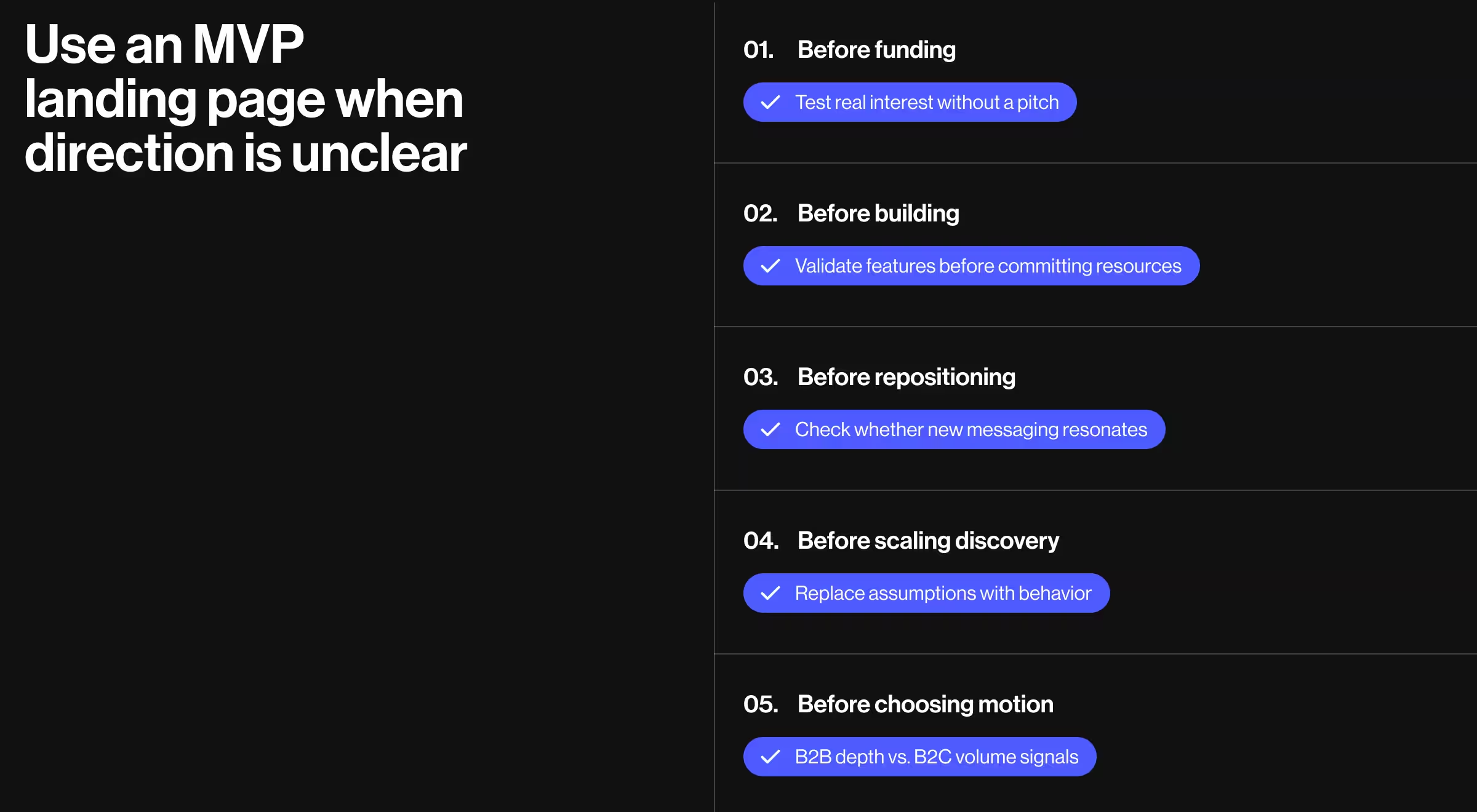
Below are the core use cases our design team sees most often, along with what an MVP landing page delivers in each.
- ⚖️ Pre-funding validation. Best for early-stage founders preparing to raise. Use it to test whether users engage with your idea without a pitch deck present. Strong signals help de-risk investor conversations and sharpen your value proposition.
- ✅ New feature validation. Ideal when roadmap ideas outnumber development capacity. Validate whether a feature creates pull before it creates cost. If users click, are ready to wait, or sign up right away, you’ve earned the right to design and build it.
- 📑 Market repositioning. Useful when growth stalls or messaging feels misaligned. Test a new audience or value proposition without touching the product. The landing page reveals whether the shift resonates or repels.
- 👱 Founder-led discovery. Designed for founders who want a first-hand signal. Here, an MVP landing page helps translate observed user behavior into insight and replace assumptions with evidence.
- 🔁 B2B vs. B2C nuances. In B2C, volume and speed expose actionable patterns. In B2B, fewer but higher-intent actions like demo requests or calls offer a much deeper insight.
🔍 For founders ready to act on these insights, partnering with specialized AI MVP design agencies can speed up validation. Explore these 23 AI MVP design companies to help you get funded.
MVP landing page vs full MVP vs marketing landing page: which one do you need?
An MVP landing page, a full MVP, and a marketing landing page may look similar on the surface, but they answer very different questions. The key is choosing the one that matches the uncertainty you’re trying to resolve.
The difference becomes even clearer when you see how each option plays out in practice.
Let’s look at a few real-world scenarios and which tool fits them best.
1. Early-stage SaaS idea before funding → MVP landing page
You have a concept, a target audience, and a clear problem hypothesis. Yet, there’s no proof of demand. An MVP landing page aligns with this scenario best.
It helps you validate:
- Whether users recognize the problem as such
- Whether your value proposition motivates action
- Whether people are willing to wait, sign up, and engage further
This approach surfaces intent early without draining resources. Instead of pitching investors on assumptions, you bring evidence and a clear direction for what is safe to build next.
🔍 Learn more about what expert-level SaaS MVP design gets you.
2. Productivity app with core flows already defined → full MVP
At this stage, users already want the solution. The open questions live inside the experience itself: usability, workflows, adoption patterns, and retention dynamics.
A full MVP is the right tool to validate:
- Core user flows and task completion
- Customer onboarding and time-to-value
- Long-term usage and engagement
Here, a landing page would underdeliver. You need real interaction with the product to learn what works, what breaks, and what needs refinement.
🔍 Explore how, once demand is validated, a full MVP becomes one of the most potent tools to maximize startup valuation.
3. Established product launching a new campaign → marketing landing page
The product already exists. Validation is out of the question. It’s a given at this phase. The real problem is performance.
A marketing landing page is the most optimal solution as it focuses on:
- Message clarity for specific campaigns
- Conversion rate optimization
- Funnel efficiency and acquisition costs
Its job is persuasion, not learning, as with MVP landing pages. If you’re still running discovery quests at this stage, something upstream went wrong.
What types of MVP landing pages exist, and what does each one validate?
Not all MVP landing pages test the same thing.
Confusing the different types is a quick way to gather activity without gaining real insight. And yes, this mistake shows up a lot in the wild. The trick is sticking with the type that validates the exact assumption you’re most uncertain about.
Below are the four most effective MVP landing page types to consider when validating your next product idea.
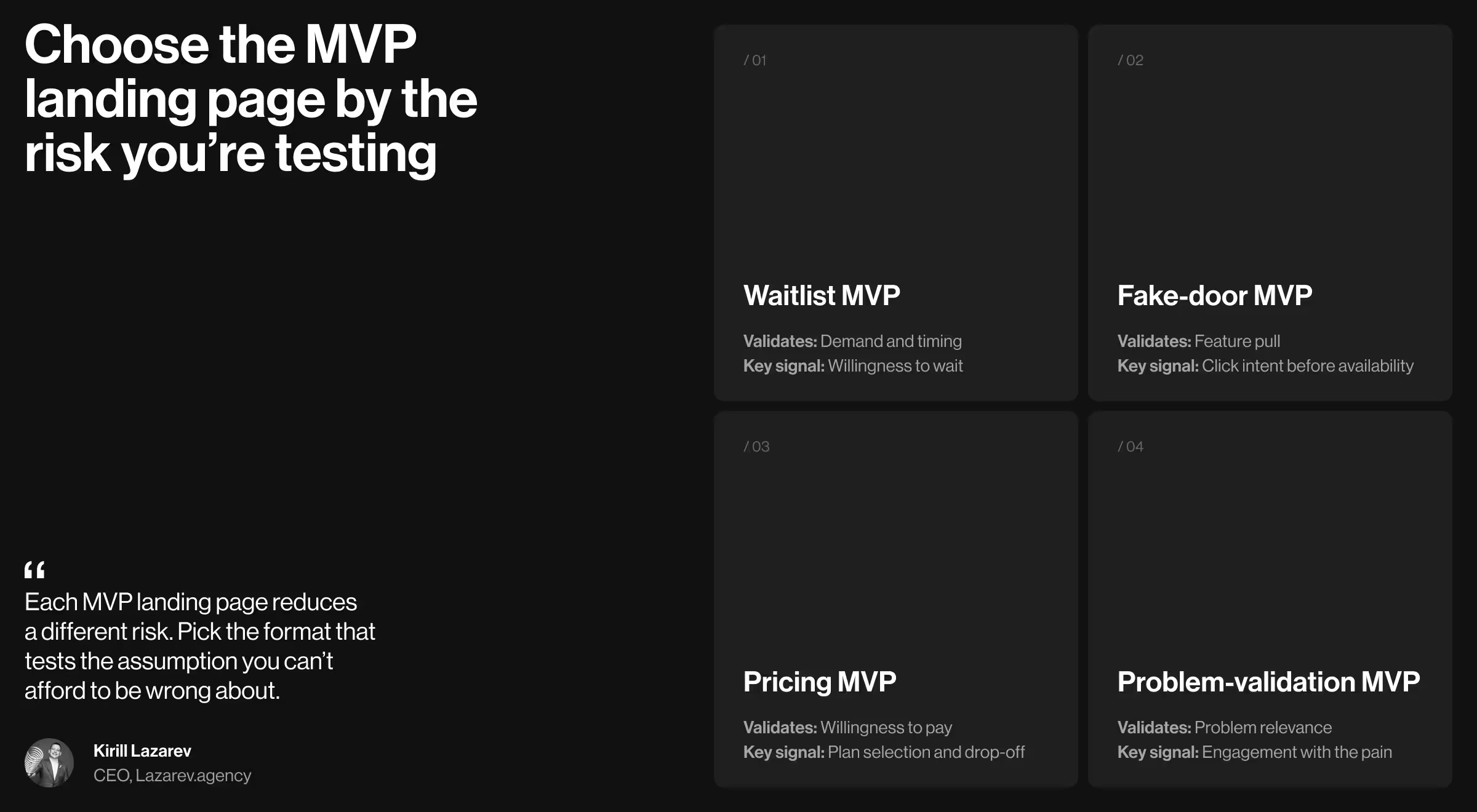
1. Waitlist MVP landing page
💡 What it validates: Demand and timing
This is the most familiar format. And also the most misused.
A waitlist MVP landing page tests whether users care enough to raise their hand. Users’ willingness to wait gives you the green light to move further.
Works best when:
- The idea is early, and demand is uncertain
- You want to test positioning and messaging
- You plan to follow up with users directly
What to measure:
- Clicks before email capture
- Waitlist conversion rate
- Response rate to follow-up conversations
Used correctly, it answers: “Do people want this enough to wait?”
2. Fake-door MVP landing page
💡 What it validates: Feature interest
A fake-door MVP landing page presents a feature as if it already exists. When users click, they’re informed it’s not available yet and asked to opt in.
Yes, it’s a little provocative. That’s the point.
Works best when:
- You’re testing a specific product feature
- Roadmap needs evidence
- You already have traffic (product or site)
What to measure:
- Click-through rate on the fake door
- Drop-off after the reveal
- Insightful feedback on why users clicked
It answers: “Would users actually try to use this?”
3. Pricing MVP landing page
💡 What it validates: Willingness to pay
When users choose a plan (or hesitate to do so), they disclose key ROI-grade signals like conversion and customer acquisition cost (CAC). These are the same metrics serious UX ROI case studies are built on. Interest is the easy part. It’s willingness to pay that tells the truth.
Works best when:
- You’re testing price sensitivity
- You need signals for revenue models upfront
What to measure:
- Pricing-tier clicks
- Plan selection patterns
- Drop-off between price exposure and sign-up
It answers: “Is this valuable enough at this price point?” — one of the most investor-relevant questions you can address early.
4. Problem-validation landing page
💡 What it validates: Problem relevance
Instead of pitching a solution, it tests whether potential users recognize and care about the problem itself.
Works best when:
- The problem space is unclear or just emerging
- You’re exploring a new target market
- You suspect users don’t yet articulate the pain point well
What to measure:
- Engagement with problem statements
- Scroll depth and interaction
- Quality of qualitative feedback
It answers: “Is this problem urgent and shared?” At the end of the day, no solution survives if the problem doesn’t hurt enough.
Here’s a simple way to choose the right type:
- Testing interest → waitlist MVP
- Testing feature pull → fake-door MVP
- Testing monetization → pricing MVP
- Testing problem relevance → problem-validation MVP
Each format exists to reduce a specific type of risk. Pick the wrong one, and you’ll still get data, just not the kind that helps you decide what to build next.
What are the key elements of a high-performing MVP landing page
A high-performing MVP landing page is a learning instrument, where every element exists to answer one question: “Do people care enough to act?”
Here’s a breakdown of the elements that make that happen.
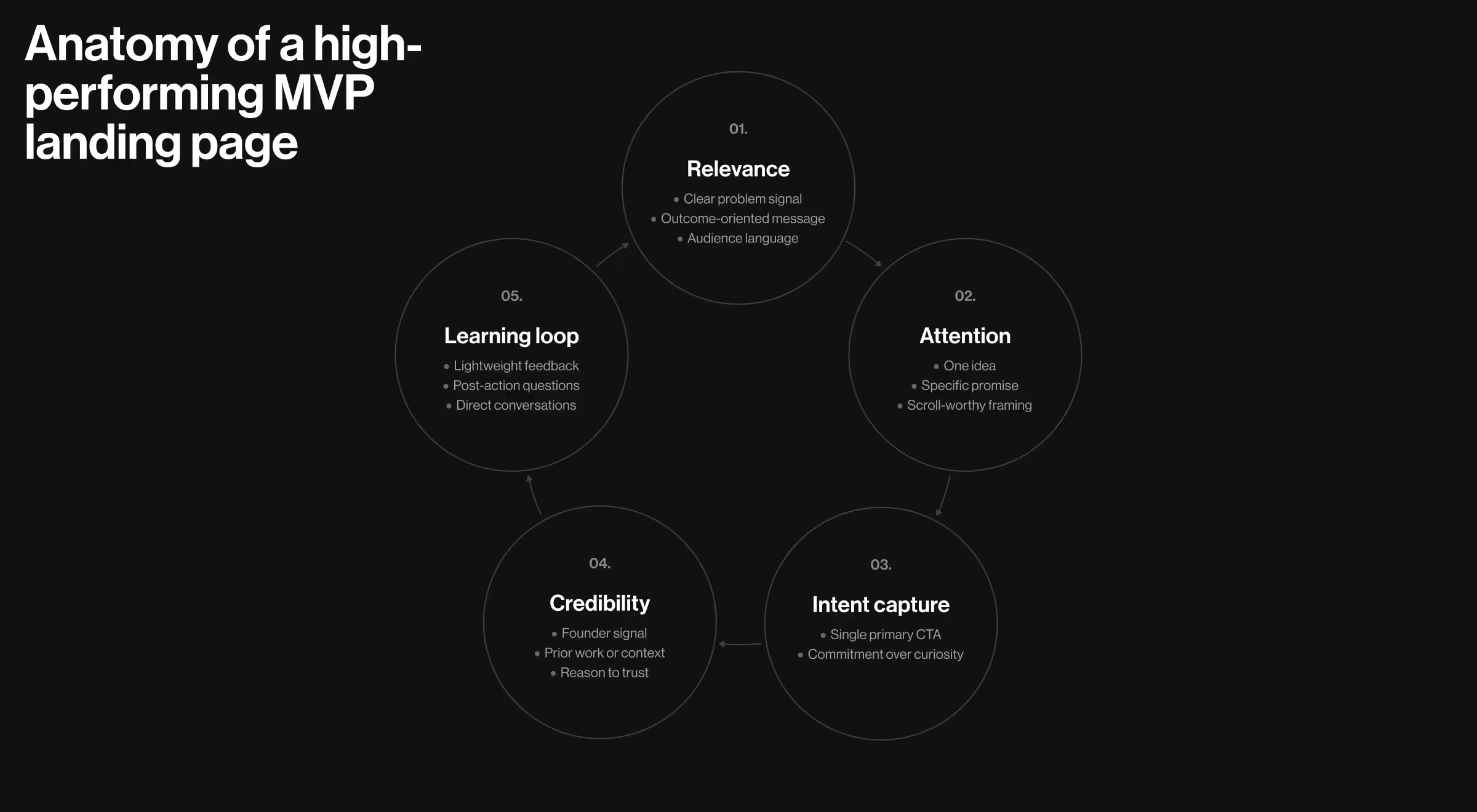
1. Compelling value proposition
🎯 Purpose: Signal relevance in under 5 seconds.
Think of your value proposition as a filter. It should repel the wrong audience as efficiently as it attracts the right one.
✅ Checklist:
◽️ States the key problem before the solution
◽️ Focuses on the outcome
◽️ Uses the audience’s language, doesn’t resort to internal jargon
2. Strong headline
🎯 Purpose: Earn the scroll.
Your headline is the first behavioral test on the page. If it’s vague or overloaded, users won’t engage deeply enough to validate anything.
✅ What works:
◽️ Problem-aware headlines over solution-first claims
◽️ Specificity over cleverness
◽️ One clear idea per headline
3. Focused CTA that captures intent
🎯 Purpose: Measure commitment.
An MVP CTA should signal intent. The goal is to understand how far users are willing to go.
✅ Effective CTAs:
- “Request early access”
- “See pricing”
- “Join the waitlist”
5. Feedback collection
🎯 Purpose: Turn actions into insight.
Signups without conversation can’t be interpreted as validation.
✅ High-signal feedback methods:
- One-question surveys after CTA interaction
- Feature-specific questions
- Follow-up emails that invite conversation
Think of your MVP landing page as a behavioral funnel: headline → value proposition → CTA → action → direct feedback.
A high-performing MVP landing page doesn’t chase a billion signups. What it should excel at is leveraging every opportunity to learn.
How to build an MVP landing page?
An MVP landing page may look deceptively simple. Just think of it: one page with a CTA conveying a single idea. Can it get any easier?
In practice, it’s anything but simple. At Lazarev.agency, a top AI UX design agency, we approach an MVP landing page as a condensed strategy exercise.
Each step removes ambiguity and reinforces informed decisions. Miss even one, and your validation ends up meaningless.
Here’s what the process looks like when done properly.
As you can see, MVP landing pages sit at the intersection of product strategy, UX/UI design, behavioral psychology, and accurate measurement.
Small mistakes compound fast. First, it’s the wrong assumption, then a vague promise followed by a click that looks like a demand but, in fact, isn’t.
That’s why many teams choose to reach out to an external design partner at this stage to structure the experiment and track actionable UX performance metrics.
Make the MVP landing page work in your favor
An MVP landing page works best when it’s treated as a learning system.
The teams that get the most out of MVP landing pages are curious before they’re confident. They design for commitment and accept that one honest signal beats a dashboard full of flattering metrics.
This is also where many founders and product teams bring in an external design partner to structure the experiment properly and challenge stale assumptions.
At Lazarev.agency, one of the top landing page web design companies, we approach MVP landing pages strategically. We help teams express product logic, AI workflows, and SaaS systems in a way users immediately grasp and act on. That’s how one page becomes a reliable signal for what to build next and what to walk away from early.
If you’re ready to start learning with intent, get in touch. We’ll help you design the experiment the right way from the first try.