

Most companies spend months refining product features and speeding up development cycles. And only a few pause to ask whether the design foundation is strong enough to support sustainable business performance. The product discovery process exists to answer that question before resources get wasted on untested assumptions.
Discovery doesn’t delay real work. It is the real work that determines whether everything that follows will hold. It defines load-bearing assumptions, validates demand, stress-tests technical feasibility, and aligns product logic with business intent. Without it, teams end up fighting windmills during development and post-launch.
In this article, we explain how we approach product discovery as the strategic foundation for setting business direction and shaping everything that follows in design and development.
Key takeaways
- Discovery defines structural integrity. The product discovery process is much like architectural planning. It validates assumptions before capital is deployed.
- Upfront research insights accelerate delivery. More research early reduces rework and protects engineering velocity later.
- UX strategy, architecture, and design depend on research. Positioning, IA, visual systems, and testing all inherit their logic from validated discovery insights.
What continuous product discovery includes
Product discovery is far from a simple warm-up exercise. It is a process with a clear structure and a set purpose. When approached strategically, it clarifies direction before resources are committed. When treated casually, ambiguity spreads into every later phase.
Discovery works best as a disciplined investigation across users, market context, technical feasibility, and business logic. Each dimension informs the next. In most cases, it starts with a session — see our guide on how to run a discovery workshop.
Below are the core components that define a comprehensive product discovery process.
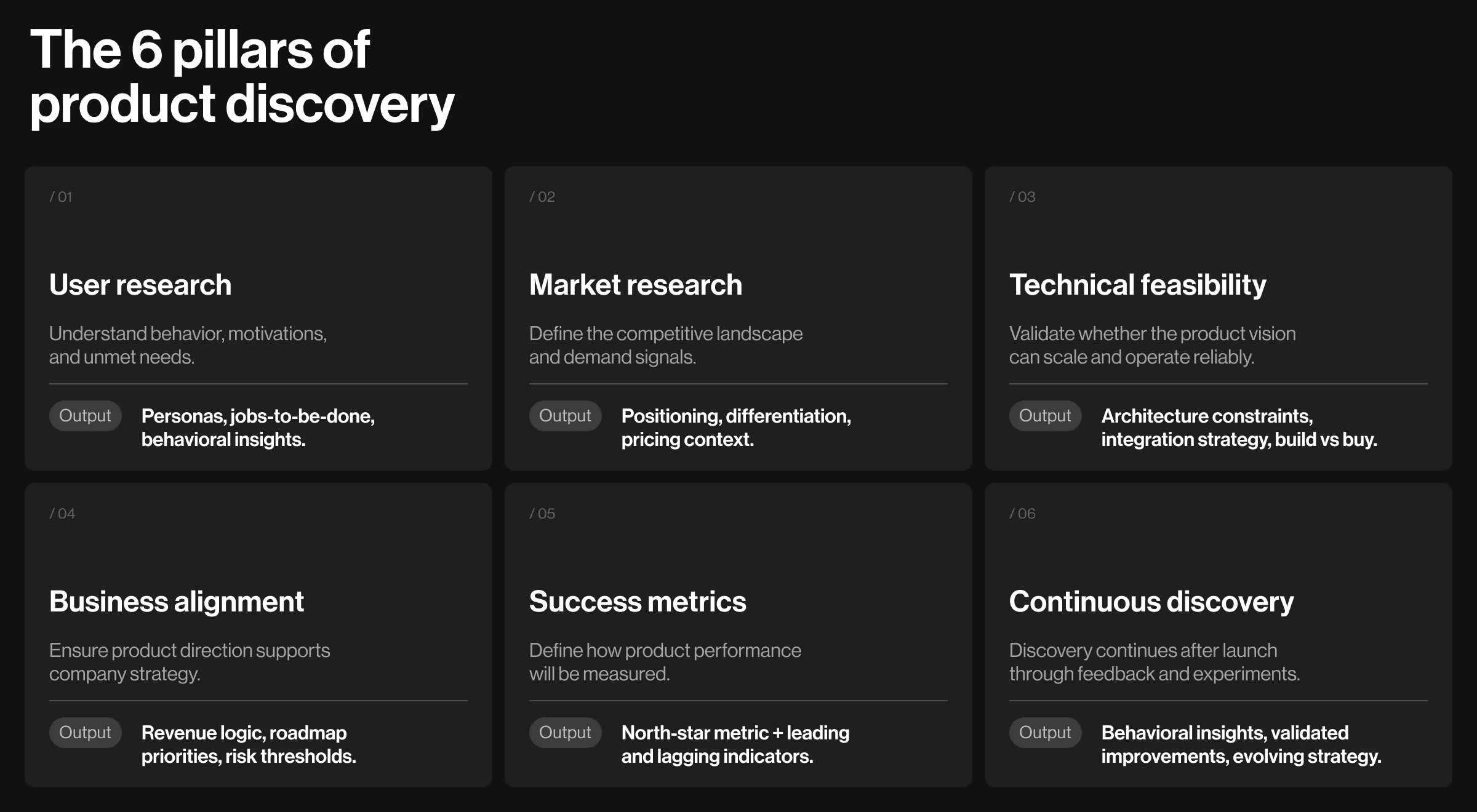
1. User research
User research is your fastest path to a relevant product offering. It replaces internal opinion with evidence about how people think, what they value, and why they choose to stay with your product or abandon it for a competitor.
Data insight: Users expect personalized experiences. McKinsey reports that 71% of consumers expect companies to deliver personalized interactions, and 76% become frustrated when that doesn’t happen. Personalization, however, is only possible when you’ve gathered enough structured insight to tailor UX the right way.
✅ User research phase includes:
- In-depth interviews to understand motivations and decision logic.
- Surveys to validate patterns across segments.
- Behavioral analysis of existing product data to identify why users ignore new features and where a stronger feature adoption strategy is required.
- Identification of unmet customer needs and contextual barriers.
- Mapping jobs-to-be-done and constructing user personas.
🔎 Learn more about the risks of skipping UX research in our detailed blog.
2. Market research
Market research defines the boundaries within which design decisions make sense. It combines competitor assessment with market opportunity analysis to ensure the product is shaped for a real environment.
Every interaction pattern, pricing cue, onboarding flow, and product feature must reflect validated market assumptions. If those assumptions are flawed, even exceptional design execution will fail to generate significant business impact.
✅ A rigorous market research process goes like this:
- Clarify positioning. Map competitors by value proposition and pricing model. Identify whether you compete on speed, intelligence, integration, cost, or specialization.
- Identify whitespace opportunities. Analyze where competitors overserve and where they ignore segments. Design should amplify market differentiation.
- Define willingness to pay before shaping feature tiers. Market signals and pricing benchmarks influence everything from upgrade prompts to subscription logic.
- Validate demand intensity. Assess search behavior and buying triggers. If demand is weak, no design sophistication will generate traction.
Data insight: According to CB Insights, 35% of startups fail because there’s no market for their product. Market research determines whether you are refining a viable concept or something the market will not sustain.
🔎 Explore our Lead Designer’s take on why market research and UX research are a duo your product needs to succeed.
3. Technical feasibility assessment
At this stage, teams evaluate whether the envisioned product can be built, scaled, secured, and maintained within the constraints of available infrastructure, budget, and time.
Ensuring technical feasibility means guaranteeing the vision survives contact with implementation.
Data insight: According to the Project Management Institute, nearly 40% of projects fail primarily due to product requirements being gathered and estimated inaccurately. In digital product development, faulty requirements often mask technical assumptions that were never validated. Architecture is then forced to adapt under pressure, leading to unmanageable costs and extended timelines.
✅ Technical feasibility assessment prevents that pattern through assessing:
- Architectural integrity — Can the proposed experience operate within a stable system structure?
- Scalability constraints — Will performance degrade under growth?
- Integration complexity — How dependent is the product on third-party APIs, legacy systems, or data pipelines?
- Security and compliance exposure — Particularly in fintech, healthcare, or enterprise systems.
- AI transformation and automation viability — Is sufficient structured data available to support machine learning claims?
This phase also informs build-vs-buy decisions. Engineering and design capacity is finite. Outsourcing it to external service providers might accelerate delivery but introduce dependency risks. Discovery identifies these trade-offs early, so your team can make the best decision aligned with your business objectives.
4. Business goal alignment
A product that delights your target audience but impedes your growth trajectory creates internal strain. Alignment prevents this by ensuring what is being designed advances the company’s direction.
It matters because:
- It connects product scope to revenue mechanics.
- It clarifies investment thresholds and return expectations.
- It ensures product roadmap priorities reflect strategic intent.
- It synchronizes product, marketing, and sales narratives.
- It reduces executive-level reversals late in development.
Data insight: The financial impact of alignment is well documented. McKinsey’s study revealed that companies in the top quartile of design maturity achieved 32% higher revenue growth and 56% higher total returns to shareholders compared to industry peers. The difference illustrates the strategic correlation between design decisions and business performance.
Alignment also protects against internal inefficiency. Research by the Project Management Institute reports that organizations lose nearly 10% of every dollar invested in projects due to poor performance, with misaligned objectives being a primary contributor.
✅ Business goal alignment during discovery clarifies:
- What product success looks like from a leadership perspective.
- Which metrics carry financial weight.
- What risks the organization is willing to take.
- How the product supports broader business strategy.
5. Success metrics definition
“Teams often assume product performance will be self-evident. In practice, ambiguity in measurement leads to misaligned priorities and reactive iteration.”
{{Oleksandr Holovko}}
Metrics define the standard by which the product will be judged. Without them, even valuable insights remain abstract, and post-launch evaluation becomes subjective.
✅ This phase of the discovery process:
- Establishes a clear north-star metric tied to business value.
- Distinguishes leading indicators (activation, engagement depth, usage frequency) from lagging ones (revenue, churn).
- Defines validation thresholds before development begins.
Defining success metrics upfront reduces bias in evaluation. It aligns product, marketing, and leadership around a shared definition of progress.
6. Continuous discovery and feedback integration
Discovery does not end when design begins. It evolves once the product addresses real users’ pain points.
Initial research defines direction, whereas continuous discovery ensures that direction remains valid over time.
✅ Continuous discovery calls for:
- Structured user feedback collection and analysis.
- Behavioral monitoring to detect adoption gaps.
- Experimentation to validate ongoing hypotheses.
- Periodic reassessment of positioning.
Role of product discovery in Lazarev.agency’s approach to product design
Product discovery does not sit at the beginning of the process as a formality. It defines the structural logic of everything that follows.
The clarity gained during research influences brand positioning, information architecture (IA), system scalability, and interaction depth. When discovery is incomplete, later phases have to compensate for overlooked constraints and vague assumptions.
At Lazarev.agency, product design is structured as a sequential discovery-driven system. Each stage builds on validated insight.
This framework is sequential, but not linear in impact. Each stage depends on validated insights from the previous one, and weaknesses in early phases multiply downstream.
- Discovery is structural. Research defines constraints, opportunities, user logic, and usability risk. Without research and discovery, every later phase operates on unstable assumptions.
- Strategy translates evidence into direction. The strategy stage converts validated insight into business commitments.
- Architecture operationalizes strategic decisions. Wireframes and IA reflect customer behavior patterns identified during research. When discovery is accurate, structure feels intuitive.
- Visual systems reinforce positioning. Design systems and high-fidelity screens should amplify the product intent defined earlier.
- Testing validates hypotheses. Usability testing measures assumptions identified during discovery and strategy. If those assumptions were clearly defined, testing becomes decisive. If not, it reveals foundational gaps.
- Implementation depends on scope stability. Engineering efficiency relies on well-defined requirements. Strong product research and discovery reduce requirement volatility and prevent mid-build conceptual shifts.
The timelines mentioned in the table are directional. They are not fixed rules. The duration of each stage depends on your product structure, stakeholder alignment, data availability, and the level of team engagement.
For example, a narrowly scoped SaaS MVP with high founder involvement may move faster. A multi-product enterprise ecosystem with distributed key stakeholders will require deeper alignment cycles.
Build with strategic clarity before building at scale
Product discovery defines the quality of every decision that follows. It is the foundation for the complex UX design process.
When discovery is thorough, development glides smoothly. When it’s rushed, teams compensate later at a higher cost.
At Lazarev.agency, we treat product discovery as a canvas for projecting user logic, market conditions, technical feasibility, and business objectives. This approach reduces structural risk and optimizes delivery cycles.
If you are planning a full-scale redesign or reassessing your product-market fit, structured discovery is the rational first move. Reach out to get that rational move right from the first try.