
You’re not losing deals because of strategy. You’re losing them because delivery can’t keep up. Business owners and product managers searching for white label web design companies usually face the same pressure point. Demand is there, but internal teams, freelancers, or fragmented workflows make execution …well, let’s call it inconvenient at best. Missed deadlines and shallow technical depth quietly drain your margins and dent your reputation.
That’s why white label design partnerships have become critical across SaaS, fintech, e-commerce, and B2B services. When specialized teams build under your brand name, you get to focus on performance, revenue, and client relationships without giving up an ounce of quality or speed. And that’s exactly what helps you stand out.
In this article, our AI UX design team:
- breaks down the real role white label design services play in scaling businesses
- shares a data-backed overview of why it outperforms in-house and freelance models
- presents a hand-picked list of the best white label web designers
No more pouring time into tasks better left to design connoisseurs. Let’s dig in.
Key takeaways
- White label design solves execution bottlenecks. Teams turn to white label partners when delivery speed, quality, and scalability start limiting revenue.
- AI UX is the new baseline. If you want to hire the best outsourced design agency for your business, look for partners like Lazarev.agency who deliver intelligent onboarding, adaptive flows, and explainable AI interactions.
- The right partner protects margins, credibility, and growth. Strong white label agencies let you take on high-value projects without hiring, delays, or brand risk.
White label agency vs. in-house teams vs. freelance designers: who is your safest bet?
There’s no universal winner here, only the option that breaks least under pressure. The right choice depends on what you cannot afford to compromise.
Is it time, quality, communication, revision speed, or accountability? While most teams say they want all five, their current setup quietly sacrifices at least one. Before comparing models, start with a reality check: is design a side task your team squeezes in, or a revenue-driving system your business depends on?
Start with a quick reality check. Be honest, ask yourself:
- Can you afford delays? → Missed launch dates cost more than design fees.
- Is quality tied to revenue or trust? → If UX affects conversion rates, user retention, or deal size, strong design becomes one of your most reliable growth levers.
- Do you need fast feedback and iterations? → Long revision loops degrade momentum.
- How critical is communication clarity? → Misalignment never scales.
- How do you treat your digital presence? Sales funnel? Credibility signal? Experiment? Serious, long-term investment?
Option 1: in-house design teams
This option works best when the design demand is stable and long-term. You get deep product knowledge and tight alignment, but capacity is fixed. Hiring is slow, costly, and, let’s be real, risky. When demand spikes, delivery suffers, and opportunities get lost along the way.
Option 2: freelance designers
Flexible on paper, yet fragile in reality. Freelancers can work well for isolated tasks. But their availability, accountability, and consistency of the output remain unpredictable. One missed deadline, or a slightly negative deviation in quality, and client trust is lost for good.
Option 3: white label design teams
Built for scale and predictable outcomes. White label partners act as an extension of your team, absorbing fluctuating workloads while maintaining consistent quality, structured communication, and fast iteration cycles. You keep ownership of clients and product strategy while specialists handle execution.
Here’s a simple decision checklist to simplify your decision-making.
Choose in-house if:
- You have a stable, continuous design demand
- You can justify full-time salaries and downtime
- Speed isn’t a priority
Choose freelancers if:
- The work is one-off or low-risk
- Quality variation won’t hurt performance
- You can manage ongoing revisions and coordination
Choose a white label design team if:
- You need speed and consistency
- Future-proof digital transformation is a priority
- Design output affects business performance
- Your team has limited time slots or fluctuating demand
- You want enterprise-level execution without enterprise overhead
5 concerns pushing businesses toward white label design
Most companies don’t start looking for white label design services out of curiosity. They do it when growth outpaces delivery and execution starts hurting revenue. Across agencies, SaaS teams, and product-led businesses, the same 5 structural problems show up again and again.
1. Your delivery capacity caps your growth
You can sell more work than your team can realistically deliver. Every new project stretches timelines, increases risk, or forces you to say no to revenue-ready clients.
2. Hiring in-house is expensive and inflexible
A senior designer or developer costs six figures annually before tools, onboarding, and management overhead. When demand fluctuates, that cost structure quickly becomes a liability.
3. Freelancers introduce brand risk
Inconsistent quality and missed deadlines damage trust. A single weak delivery can deteriorate your entire brand image.
4. You’re locked out of higher-value projects
Many teams can handle basic websites but lack depth in UX strategy, scalable design systems, and complex integrations. That limitation keeps you competing for smaller deals while enterprise work goes elsewhere.
5. AI UX expectations are rising faster than internal skills
Users expect intelligent onboarding, anticipatory interfaces, personalized flows, and explainable AI interactions. Most internal teams (and generalist freelancers) aren’t equipped to design AI-native experiences. Expert AI product design agencies like Lazarev.agency fill this gap by leveraging mature AI UX frameworks and human-AI interaction expertise.
Top 11 white label design companies reviewed by industry experts
Some white label design companies excel at strategic UX solutions. Others bring conversation UI, AI-ready design systems, or enterprise-grade delivery models.
Below, we prepared a comparison of 11 leading white label design companies, evaluated on experience, services, industries served, and delivery focus. This table will help you identify the best-fit partner based on your growth stage and industry needs.
1. Lazarev.agency
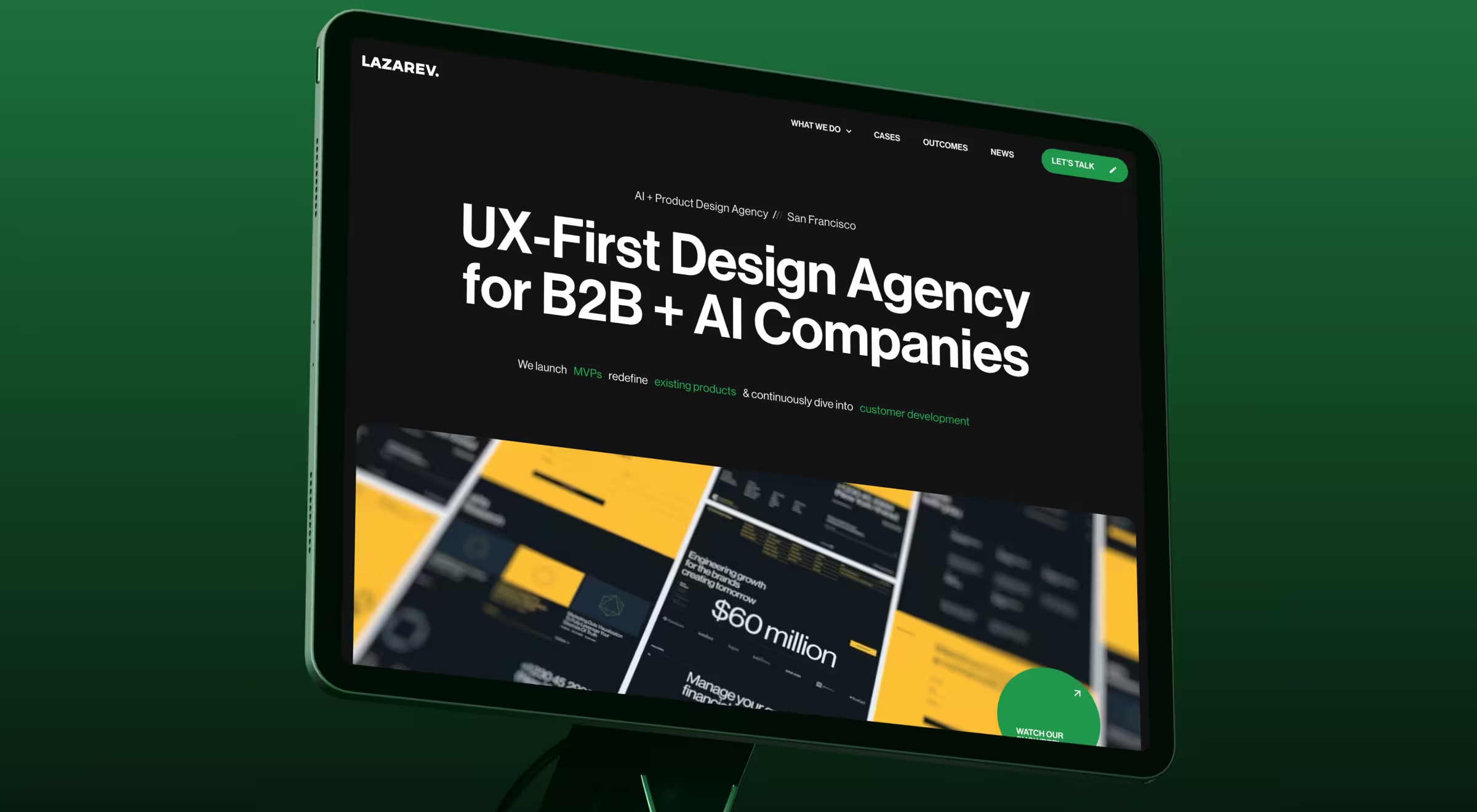
Based in the San Francisco Bay Area, Lazarev.agency is a go-to AI-native digital product design partner for startups and enterprise innovation teams. Our team takes dense technical systems (think AI models, agent workflows, analytics platforms, fintech logic, and multi-layered SaaS products) and shapes them into responsive and trustworthy interfaces.
- Founder: Kirill Lazarev.
- Differentiator: AI-first UX, complex systems design, enterprise-grade white label delivery.
- Industry recognition: 120+ international design awards, including 3× Webby Awards Winner, 2× Webby Awards Honoree, 2× Honoree & 5× Red Dot Awards, CSS Design Awards Nominee. Clients raised $500M+, alongside other impressive outcomes.
- Best use cases: Agencies and product teams delivering AI, SaaS, fintech, and data-heavy platforms.
- Clutch rating: 5.0
🔍 Explore our case studies to learn more.
2. Human Creative
- Founder: Tom Galecki.
- Differentiator: Strong balance of branding and UX for white label partnerships.
- Industry recognition: Acknowledged as one of the top web design companies.
- Best use cases: Agencies looking for a scalable UX/UI design framework and ongoing support for your design projects.
- Clutch rating: 4.9
🔍 Explore the company’s portfolio.
3. Passionate Agency (Passionates)
- Founder: Gor Gasparyan.
- Differentiator: Product-thinking mindset with startup agility.
- Industry recognition: Featured in Awwwards, Behance, and CSS Design Awards
- Best use cases: SaaS founders and agencies on the hunt for reliable web design delivery.
- Clutch rating: 5.0
🔍 Explore the company’s portfolio.
4. Wunderdogs
- Founder: Daria Gonzalez.
- Differentiator: Brand-led approach paired with strong UX execution.
- Industry recognition: Recognized as one of the leading graphic design agencies.
- Best use cases: Growth-stage SaaS and B2B companies.
- Clutch rating: 4.9
🔍 Explore the company’s portfolio.
5. LoveGunn
- Founder: Tom Love.
- Differentiator: Brand-first design with strong storytelling.
- Industry recognition: 2023 Transform Awards Winner.
- Best use cases: Brand-heavy products and consumer-facing platforms.
- Clutch rating: 4.9
🔍 Explore the company’s portfolio.
6. Digital Butlers
- Founder: Alex Butler.
- Differentiator: Motion-rich UX and premium visual execution.
- Industry recognition: Awwwards, CSSDA features.
- Best use cases: High-end web experiences and crypto projects.
- Clutch rating: 4.9
🔍 Explore the company’s portfolio.
7. Arounda
- Founder: Vlad Gavriluk.
- Differentiator: UX consistency at scale for white label clients.
- Industry recognition: Recognized as one of the best legal tech design agencies.
- Best use cases: SaaS and fintech agencies outsourcing UX/UI.
- Clutch rating: 5.0
🔍 Explore the company’s portfolio.
8. Usman Group
- Founder: Naveed Usman.
- Differentiator: UX strategy rooted in business transformation.
- Industry recognition: Known as a trustworthy interactive design agency.
- Best use cases: B2B, healthcare, and industrial platforms.
- Clutch rating: 4.9
🔍 Explore the company’s portfolio.
9. SPARK6 Inc
- Founder: Elijah Szasz.
- Differentiator: Product strategy, design, and development under one roof.
- Industry recognition: Clutch Leader, US-based enterprise clients.
- Best use cases: SaaS platforms and digital product transformation.
- Clutch rating: 5.0
🔍 Explore the company’s website.
10. League Design Agency
- Founder: Mykhailo Samovarov.
- Differentiator: Strong branding paired with UX/UI execution
- Industry recognition: Behance, Dribbble.
- Best use cases: Recognized as one of the best NY web design agencies.
- Clutch rating: 5.0
🔍 Explore the company’s portfolio.
11. Merge Rocks
- Founder: Pavel Tseluyko.
- Differentiator: Brand-to-product consistency for tech companies.
- Industry recognition: Recognized as one of the best generative AI UX design agencies.
- Best use cases: SaaS and digital-first brands.
- Clutch rating: 4.9
🔍 Explore the company’s portfolio.
What the right white label design agency can do for your business: insights from Lazarev.agency’s portfolio
White label design only proves its value when it solves real problems under your brand and on your timelines.
In practice, that means clarifying hard-to-explain products and establishing trust in high-stakes markets. Below are three case studies from Lazarev.agency’s portfolio that show what happens when white label design moves beyond execution and starts driving outcomes.
1. Bacca AI
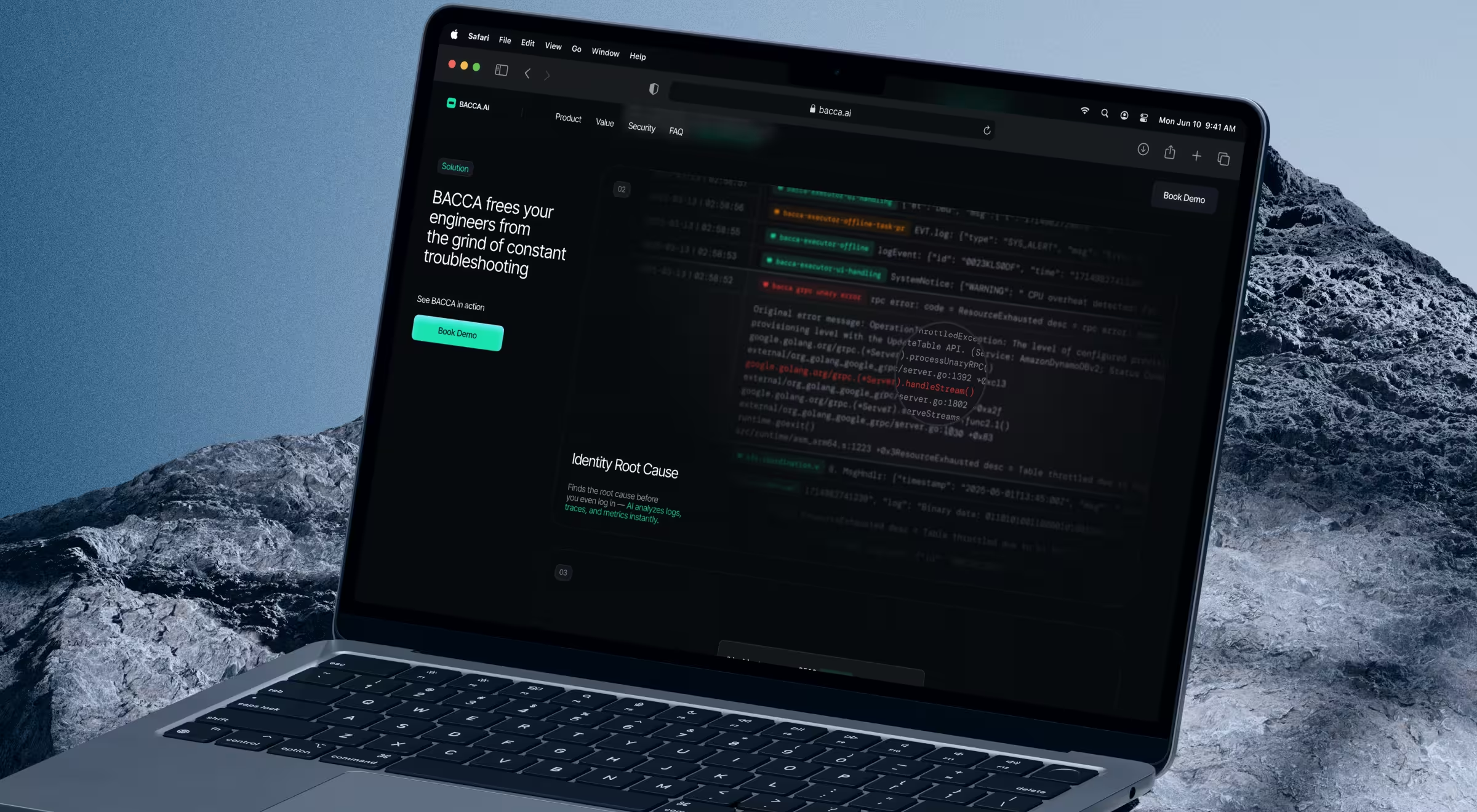
🔴 Client issue
Bacca AI built a powerful SRE platform. Yet its value was buried under highly technical language. Decision-makers couldn’t quickly grasp why the product mattered, while engineers struggled to understand how it fit into real-world workflows. The website failed to connect uptime with revenue impact. And that was exactly the story buyers needed to hear.
💡 Our solution
Lazarev.agency restructured the website around a clear narrative. We aligned messaging for executives and engineers, built a logical content flow around a sharp product vision, and leveraged visual storytelling to explain an invisible product without oversimplifying it.
🟢 Impact
The result was a site that speaks fluently to both sides of the buying table. Product value became obvious, and trust increased. That was how Bacca AI built a digital presence that supports customer acquisition instead of slowing it down.
2. DragonGC
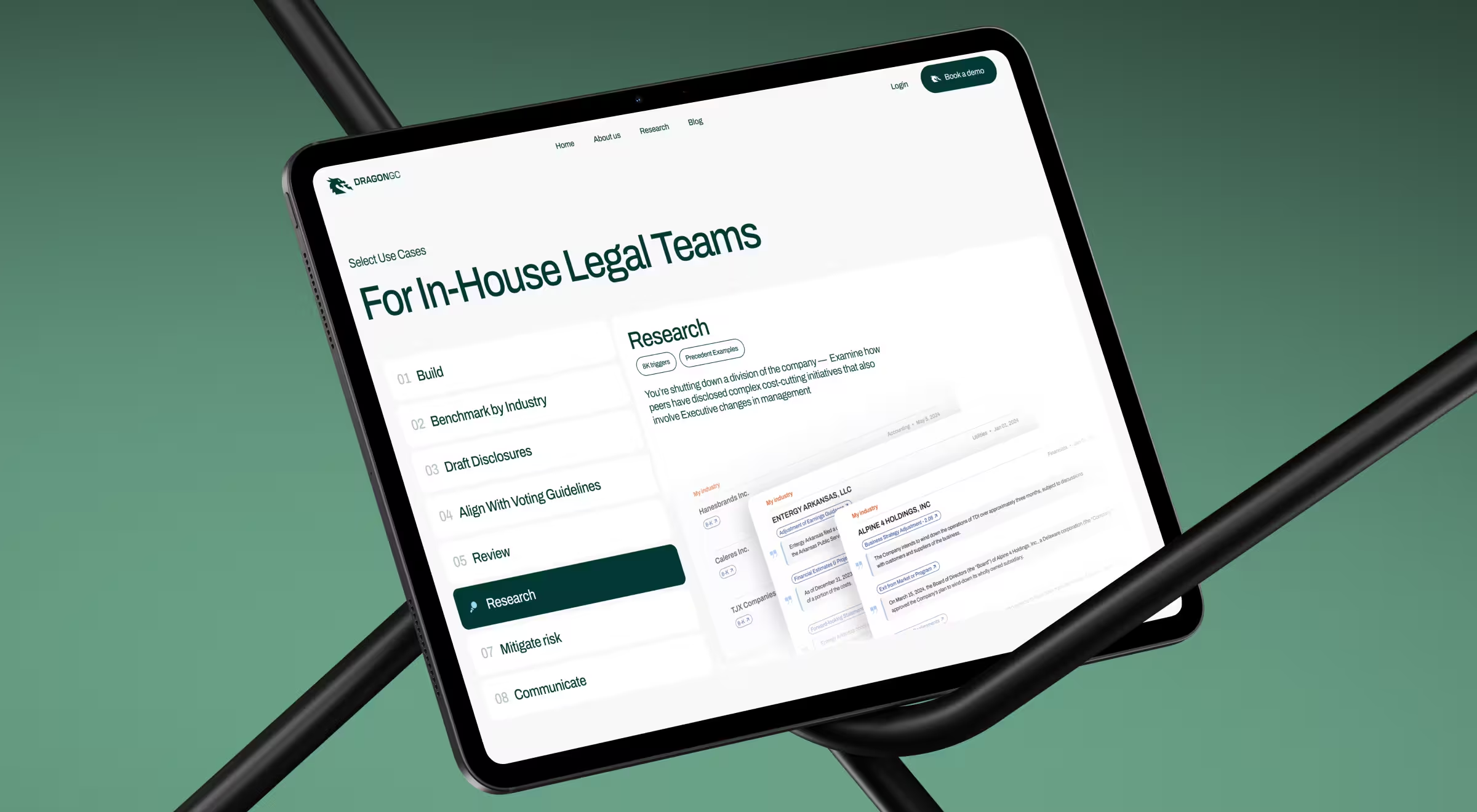
🔴 Client issue
DragonGC had a strong AI backbone and deep legal expertise, but its brand and website failed to signal authority. The product felt harder to trust than it actually was. With a major go-to-market push ahead, the company risked being overlooked in a crowded legaltech industry.
💡 Our solution
We rebuilt DragonGC’s digital presence from the ground up. We revised the brand strategy and supporting digital assets. We introduced social proof, humanized the brand, and designed a consistent system across all touchpoints.
🟢 Impact
DragonGC emerged as a credible, enterprise-ready platform. The new website clearly communicates value, lowers decision friction, and supports both acquisition and user retention. The brand now scales with the business instead of holding it back.
3. CollectorCrypt
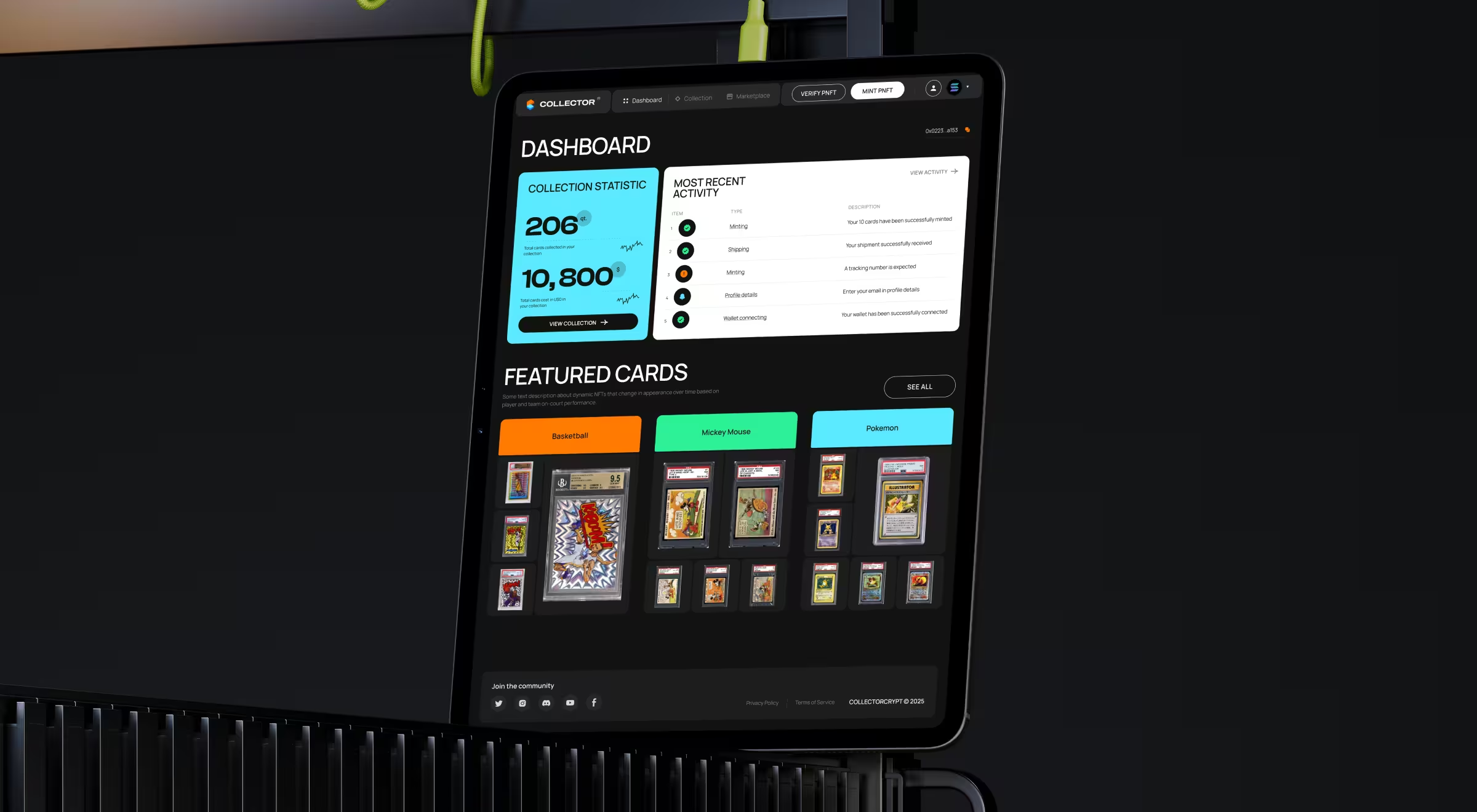
🔴 Client issue
CollectorCrypt set out to modernize a $402B collectibles market but faced a classic Web3 challenge.
You guessed it right, it was the lack of trust. The target audience needed clarity around asset ownership, shipment security, valuation, and transactions. Without intuitive flows, adoption and liquidity were at risk.
💡 Our solution
Lazarev.agency redesigned core platform flows, including shipment tracking, asset onboarding, collection management, and trading. We created data-rich “asset passport” pages, introduced secure onboarding for physical-to-digital transfers, and built a modular design system.
🟢 Impact
Collectors gained confidence, transparency increased, and engagement followed. Users returned more often, transactions accelerated, and the platform became easier to scale without losing clarity or trust — that’s what we call customer experience design in the age of AI UX.
Choose the right white label design partner for the best growth deal
Let’s cut to the real problem. You’re not short on ideas. You’re short on execution that keeps up. Projects stall. Quality becomes a negotiation. And every time delivery slips, it quietly chips away at revenue. That’s the pain pushing teams to look at white label web design companies in the first place.
The difference here is in who you partner with. At Lazarev.agency, we step in when things need senior digital product expertise. Think of AI-driven products, SaaS platforms, and enterprise workflows that need to be made usable, clear, and shippable (under your brand name, of course).
If you’re tired of saying no to good projects, or worse, saying yes and hoping delivery holds, this is your cue. Reach out to talk through your project. When execution stops being the bottleneck, growth finally feels… pleasantly predictable.



.webp)