
Speed vs. quality in product design: finding the right balance

A visual metaphor for balancing competing priorities in product development, using geometric forms to introduce the trade-offs between speed, quality, and cost.
Summary

In product design discussions, there’s one recurring question: “Can you do it faster?”

The request itself is reasonable. Product teams operate under pressure from stakeholders and competitors. Launch windows feel too narrow, and design often appears to be one of the few areas where timelines can be compressed with no apparent damage.

That assumption comes from a strategic misjudgement, because speed in design scarcely ever means what people initially believe it to mean.

When teams ask for faster delivery, they are unknowingly asking for trade-offs like limited discovery or fewer iterations. Understanding these is essential. Without that grasp of the two sides of the coin, teams risk building quickly but learning slowly.

In this article, we look at the relationship between speed and quality in product design. We’ll consider why timelines exist, what consumes time during the design process, and how teams can move faster without undermining the foundations of their product.

Key takeaways 

  • Speed, quality, and cost form a fixed triangle. In product design, you can optimize for only two of these variables. Increasing speed always affects cost or quality.
  • Most design time goes into reducing uncertainty. Discovery, iteration, testing, and refinement ensure the product solves the right problem before development begins.
  • MVP-first is the most reliable way to move fast. A focused MVP delivers a credible product experience quickly while leaving room to expand the UX after launch.
  • Never compromise the core user journey. Users judge a product by their first successful interaction. Protecting that experience matters more than adding extra features to your product. 

The timeline myth: what founders get wrong about speed

“Product teams often ask for speed as if it were independent from everything else. In reality, you can optimize for only two of three variables: speed, quality, and cost. If you push one aside, the other adjusts.” 
{{Kirill Lazarev}}

This observation captures a dynamic that experienced product teams encounter time and again. Design timelines are shaped by the relationship between three variables: speed, quality, and cost.
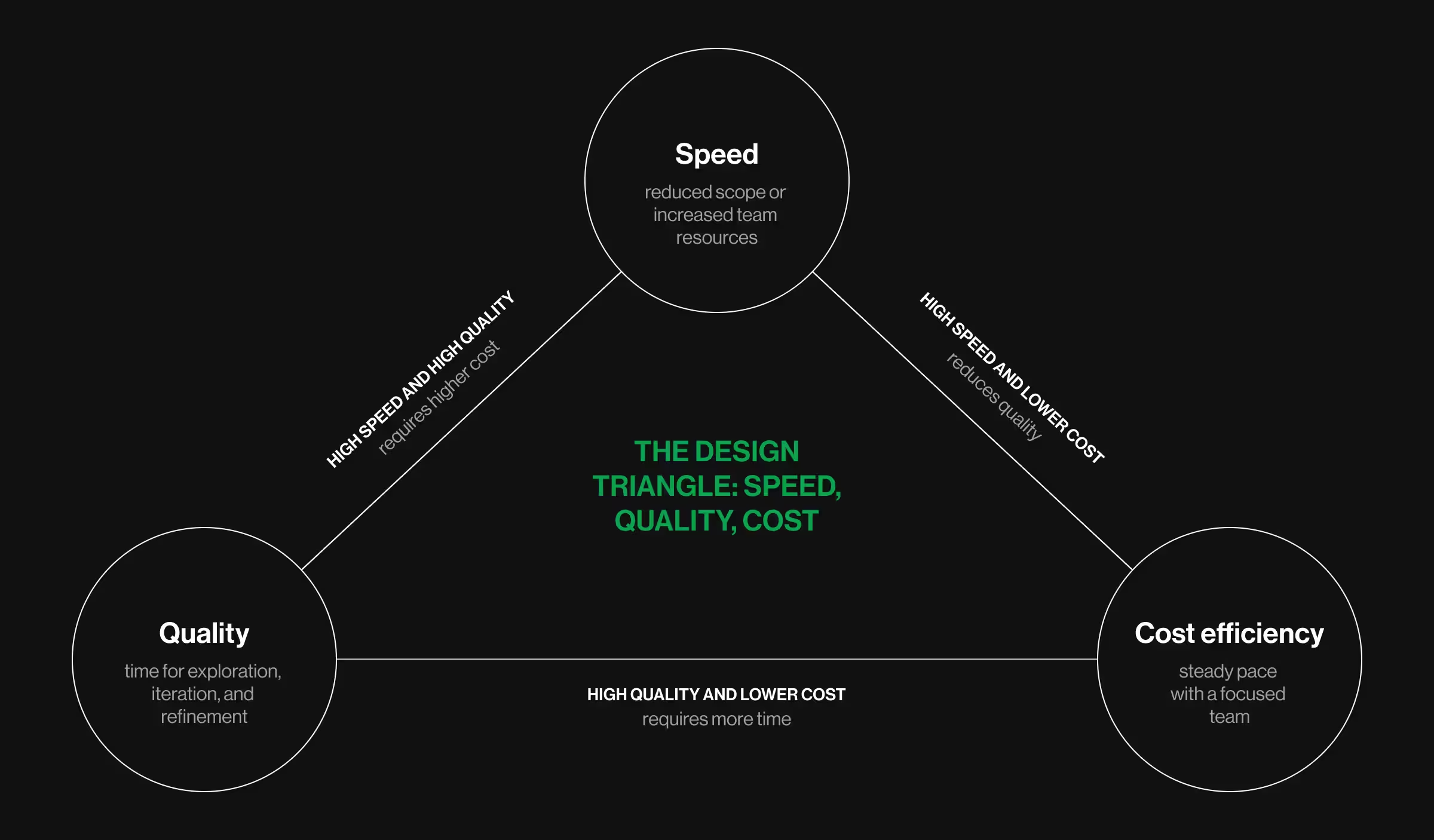
The design triangle framework explaining how project timelines, budget constraints, and quality expectations influence one another throughout the product design process.
  1. A project can move quickly if the scope is reduced or if additional resources are introduced. 
  2. It can achieve very high quality if the team has time to explore alternatives and iterate carefully.
  3. It can remain cost-efficient if the timeline allows a focused team to progress at a sustainable pace. 

What it cannot do is maximize all three simultaneously.

Many founders approach design assuming speed is just a matter of working harder. In practice, the timeline reflects a sequence of decisions about research depth, iteration cycles, and team capacity — all defined in realistic terms based on your specific project context. 

Typical design timelines reflect this reality:

These ranges vary depending on scope and product complexity. A landing page has limited interaction paths and minimal logic. In parallel, an MVP calls for deeper decision-making related to the product’s information architecture and user flows.

When teams push for faster timelines, the compression comes from skipping two stages of the process: product discovery or iteration.

  1. Skipping discovery gets the research informing the product’s direction out of the success equation. Discovery is key to defining user problems and identifying market positioning. Without it, teams design quickly, but often the wrong thing.
  2. Skipping iteration introduces a different problem. Early design concepts rarely represent the strongest solution. Iteration reveals usability issues and sets the stage for timely improvements before development begins.

When teams compress timelines aggressively, these stages are the first to disappear.

The consequence is: speed always carries a cost. The real question is not whether speed is possible, but what cost a team is prepared to accept.
The hidden timeline: what takes time

To understand why design timelines exist, we should start with the mechanics of the design process itself. Design is frequently associated with the visual output: layouts, typography, and the overall style/aesthetic framing of the interface. In fact, these artifacts stand for only a portion of the work.

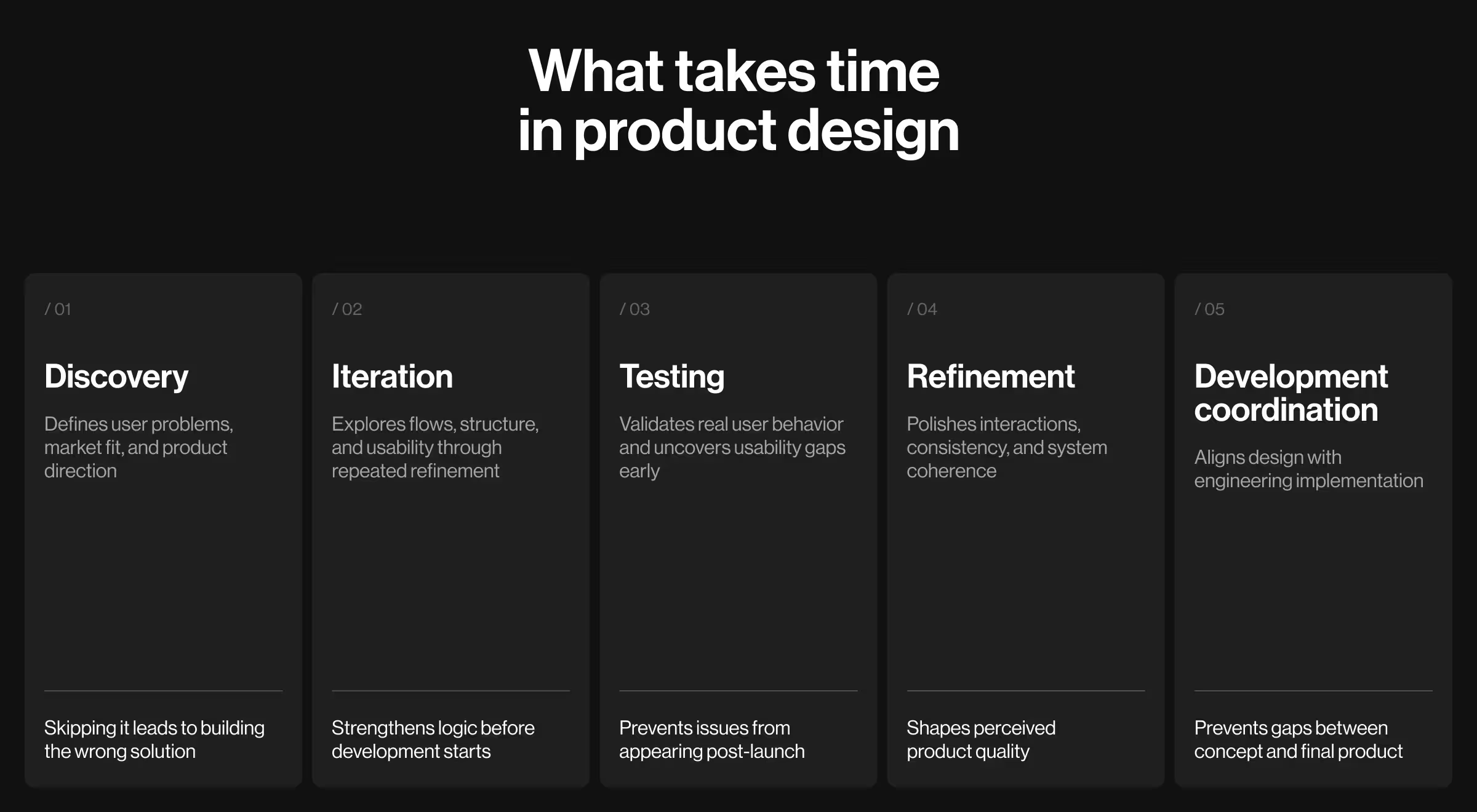
Most of the time in product design is spent reducing uncertainty before development begins. Each stage exists to answer a specific question about the product.

A breakdown of the core activities that consume time in product design, highlighting the role of discovery, iteration, testing, refinement, and development coordination in creating successful products.

1. Discovery and research

Discovery is the stage that gets underestimated the most. During discovery, teams investigate the product environment before any interface decisions are made. 

Data insight: CB Insights reports that poor product-market fit accounts for nearly every second (43%) startup failure — the direct consequence of skipping the discovery phase. 

This stage covers:

The enumerated activities set clear objectives for what the product should solve and how it should differentiate itself. When discovery is omitted, assumptions govern design. 

🔍 Still hesitant about the need to invest time and resources into discovery and research? Get yourself convinced once and for all with our Lead Designer’s take on the risks of skipping UX research

2. Design iteration

After discovery defines the direction, designers begin shaping the product experience.

This stage includes:

  • Wireframes and information architecture
  • Interaction flow development
  • Internal reviews and revisions
  • Stakeholder feedback cycles

Iteration leaves the door open for improvement discussions. Early UI versions expose gaps in logic and usability. Each iteration tackles ambiguity and strengthens the final product.

3. Testing and validation

Even experienced designers cannot predict every usability issue in advance. Testing introduces real user behavior into the design process.

Teams often test:

These insights reveal obstacles that would otherwise surface only after development.

4. Refinement and polish

A common observation among designers is that the final 20% of the work often consumes most of the effort. Once the core structure of a product is defined, the team must refine the details responsible for the coherence of the user experience.

This phase includes:

  • Interaction details
  • Visual consistency
  • Design system alignment
  • Micro-interaction behavior

These adjustments might appear subtle, but they strongly influence how the product is perceived. Interfaces that skip refinement often feel inconsistent, even when the underlying functionality is spot on.

5. Development coordination

Design does not end when interfaces are complete. Designers and engineers must align on how the product will be implemented.

This stage often includes:

  • Component documentation
  • Design system preparation
  • Developer handoff discussions

When coordination is off, implementation gaps appear between the design and the built product.

🔍 Explore our design system 101 to learn why every growing product needs one

Each of these 5 stages has a distinct purpose. Removing one may shorten the timeline (temporarily), but it also increases the likelihood of revisiting the work later.

MVP-first approach: how to launch faster without sacrificing core quality

“After more than a decade of designing digital products across industries, we’ve found that the MVP-first approach consistently provides the best balance between speed and credibility. We deliberately narrow the initial scope to avoid the temptation of designing the entire product at once. The goal is to deliver a high-quality core experience under time constraints, then expand the UX once the product proves its value in the market.”
{{Kirill Lazarev}}

Across many product engagements, we’ve seen teams attempt to design the entire product ecosystem before the first release. While the founders’ desire to present the full vision from day one is understandable, such an approach often stretches timelines and diffuses design effort across way too many features.

The MVP-first framework addresses this challenge by centering design work around the product’s essential value — the interaction that proves the product is worth using. Once that moment is under your belt, the scope for the full product design becomes far clearer.

Yet don’t mistake an MVP for a condensed version of the entire product. It’s the smallest set of product capabilities that convincingly showcases value. And to distill that set correctly, you need to separate the essential functionality from features feasible for future expansion.

Key questions guide that decision:

  • Problem statement: What is the single problem the product must solve first?
  • Core flows: Which user flows must exist for that value to be experienced?
  • Deferred features: Which features can wait until after launch?

With the MVP scope established, the launch timeline focuses on the essential experience. After release, additional features can be introduced through iterative development.

🔍 Expanding the product functionality is a matter of strategy. Have a closer look at our Lead Designer’s playbook on best feature adoption strategies

However, the MVP-first model does not apply universally.

It works well when:

  • Startups are validating a market opportunity
  • Product teams need early user feedback
  • Competitive markets require a rapid presence

It’s less suitable when:

  • The product operates in regulated environments
  • Reliability is critical from day one
  • The product controls sensitive infrastructure

Prioritization under pressure: what to cut and what to protect

Regardless of the tactic you opt for to reach that speed-quality equilibrium in design — be it an MVP-first approach or another product strategy — setting priorities right early on is what gets you ahead of the game. 

When timelines tighten, design teams face a fundamental decision: which elements of the product must remain intact and which can be deferred.

Here’s a handy framework for setting the core product path apart from the other elements.

Protect Cut
1. Core user flows Edge cases
2. MVP features Advanced functionality
3. Conversion paths Secondary interactions
4. Navigation clarity Non-essential visuals

The fundamental principle is never to trade the quality of the user journey for speed.

During their first interaction, users focus on completing a single meaningful action. If that action is intuitive and reliable, the product earns credibility. Should the primary journey be confusing or unstable, additional features cannot compensate for the lost trust.

For this reason, protecting the core experience is often the most strategic decision a team can make.

When speed requires money: the premium for acceleration

Returning to the earlier principle — speed, quality, and cost — accelerating design work necessitates increasing the number of specialists involved in the project.

When timelines compress, the design workflow becomes denser. Tasks that would normally happen one after the other have to occur in parallel. 

Typical project configurations illustrate this relationship:

Timeline Team setup Cost impact
Standard (3–4 months) Core design team Baseline
Accelerated (2–3 months) Expanded design team ~1.5× cost
Rush (4–6 weeks) Multiple designers working in parallel 2–3× cost

The increased budget reflects two things.

First, additional designers and strategists must support the project. Second, compressed timelines require more intensive collaboration and faster decision cycles.

Transparent conversations about these trade-offs benefit both sides. Product teams gain clarity into what product design acceleration requires, whereas design teams can structure the workflow in a way that preserves quality.

How a strategically phased design approach works

At Lazarev.agency, we take a phased approach to digital product development. Each stage seeks to set a strong foundation for the next, starting with a comprehensive product discovery up to the final handoff. 

For a medium-scope product design project, a realistic timeline would resemble the following:

Phase Typical duration Purpose
1. Product discovery and research 3–4 weeks Define problem space, user needs, market context and ensure product-market fit
2. Product architecture 2–3 weeks Structure user flows and information architecture
3. UX design 4–5 weeks Develop wireframes and interaction models for intuitive user interaction
4. UI design 3–4 weeks Establish the product’s visual language and interface system
5. Testing and validation 2–3 weeks Identify usability improvements and interaction gaps
6. Refinement and handoff 2 weeks Prepare documentation and align with engineering teams

Each phase builds on the previous one: 

Discovery informs architecture ➡️ architecture guides UX design ➡️ UX design enables interface refinement ➡️ testing validates the solution before development begins.

Speed and quality are strategic choices

Timelines for a product design initiative are shaped by the project scope, availability of the resources, and the level of certainty a team wants before building.

True, fast projects exist. So do high-quality ones. The difference lies in the trade-offs each path introduces.

For product teams, understanding these trade-offs ensures better conversations about timelines and expectations. For design teams, it enables structured workflows that balance ambition with realism.

Teams exploring how experienced studios structure product design timelines can examine our case studies to consider how different projects balance speed, scope, and quality. This preparation gives you an actionable perspective for planning a future product initiative.

If you’ve already decided to pursue product design (redesign) or would like to discuss the best trajectory for your prospective project, reach out to our team for expert consultation.

No items found.
No items found.
No items found.
No items found.

FAQ

/00-1

How do we choose the right speed–quality balance for our specific product?

You don’t choose “speed vs. quality” in isolation — you choose based on what failure would cost you more.

  • If your risk is shipping the wrong product, invest in discovery and iteration.
  • If your risk is missing the market window, reduce scope and go MVP-first.

For most growth-stage B2B products, the optimal setup is:

  • Full discovery on core flows
  • Compressed iteration on secondary features
  • Strict protection of the primary user journey

This aligns with how design reduces uncertainty — which is where most time is spent.

/00-2

What does an accelerated timeline require from our side?

Speed is a decision-making constraint.

To move from a 4-month timeline to ~2–3 months, your team must:

  • Assign a single decision owner (usually CPO / Head of Product)
  • Commit to weekly design reviews with clear approvals
  • Provide fast access to stakeholders and users for validation

Without this, adding more designers only increases noise.

Acceleration works when:

  • Decisions happen in hours or days 
  • Trade-offs are accepted early
/00-3

How do we ensure we don’t waste budget on speed that creates rework later?

You protect ROI by not compressing the wrong stages.

The highest-cost mistakes come from:

  • Skipping discovery → building the wrong flows
  • Skipping validation → fixing issues post-development

A better approach:

  • Keep discovery intact
  • Narrow MVP scope aggressively
  • Defer non-critical features

This prevents the most expensive scenario:
fast launch → low adoption → full redesign cycle

Given that poor product-market fit drives ~43% of startup failures, skipping early validation is the most expensive shortcut you can take.

/00-4

How does an MVP-first approach translate into measurable business outcomes?

A strong MVP is a focused revenue engine.

For your ICP, the impact shows up in:

  • Faster time-to-first-value (critical for demos and sales cycles)
  • Higher feature adoption, especially for AI capabilities
  • Clearer positioning in enterprise deals

Instead of spreading design effort across 20 features, you:

  • Design 3–5 flows that prove value
  • Make those flows frictionless and defensible

This directly supports your core metrics:

  • Activation
  • Adoption
  • Expansion

Which are the exact outcomes your ICP is accountable for.

/00-5

When does it make sense to invest 1.5–3× more for faster design delivery?

Only when speed directly impacts revenue, funding, or strategic positioning.

Typical justified cases:

  • Upcoming enterprise deal or demo cycle where product perception matters
  • AI feature launch tied to board-level expectations
  • Competitive pressure where being late reduces market credibility

In these scenarios:

  • Faster timelines = faster validation or sales enablement
  • Additional cost = leverage, not overhead

If speed is not tied to a concrete business milestone, paying a premium for acceleration rarely delivers ROI.

/00-6

/00-7

/00-8

/00-9

/00-10

/00-11

/00-12

/00-13

/00-14

Read Next

A conceptual AI visualization illustrating the connection between human reasoning and machine intelligence, setting the stage for discussions around AI product design, user trust, and intelligent systems.

Making AI value visible: dashboard design for AI products

AI & digital transformation
A bold visual metaphor for asking the right questions, featuring a highlighted question mark emerging from a sea of uncertainty.

10 questions to ask every design agency

Digital product design
3D illustration of a checklist and verification icon on a soft blue background, symbolizing evaluation, approval, and decision-making.

How to evaluate and choose a design agency

Industry UX/UI playbooks
Glowing blue 3D letterforms on a dark background, symbolizing artificial intelligence, digital innovation, and futuristic technology.

How AI-first companies should think about UX

AI & digital transformation
Abstract illustration of a glossy blue magnifying glass on a soft blue background, symbolizing research, product discovery, and strategic exploration.

Design systems 101: why every growing product needs one

Industry UX/UI playbooks
Abstract 3D illustration of a glossy blue magnifying glass on a soft blue background, symbolizing research, discovery, and strategic analysis.

The product discovery process: why research comes before design

Digital product design